BOOK
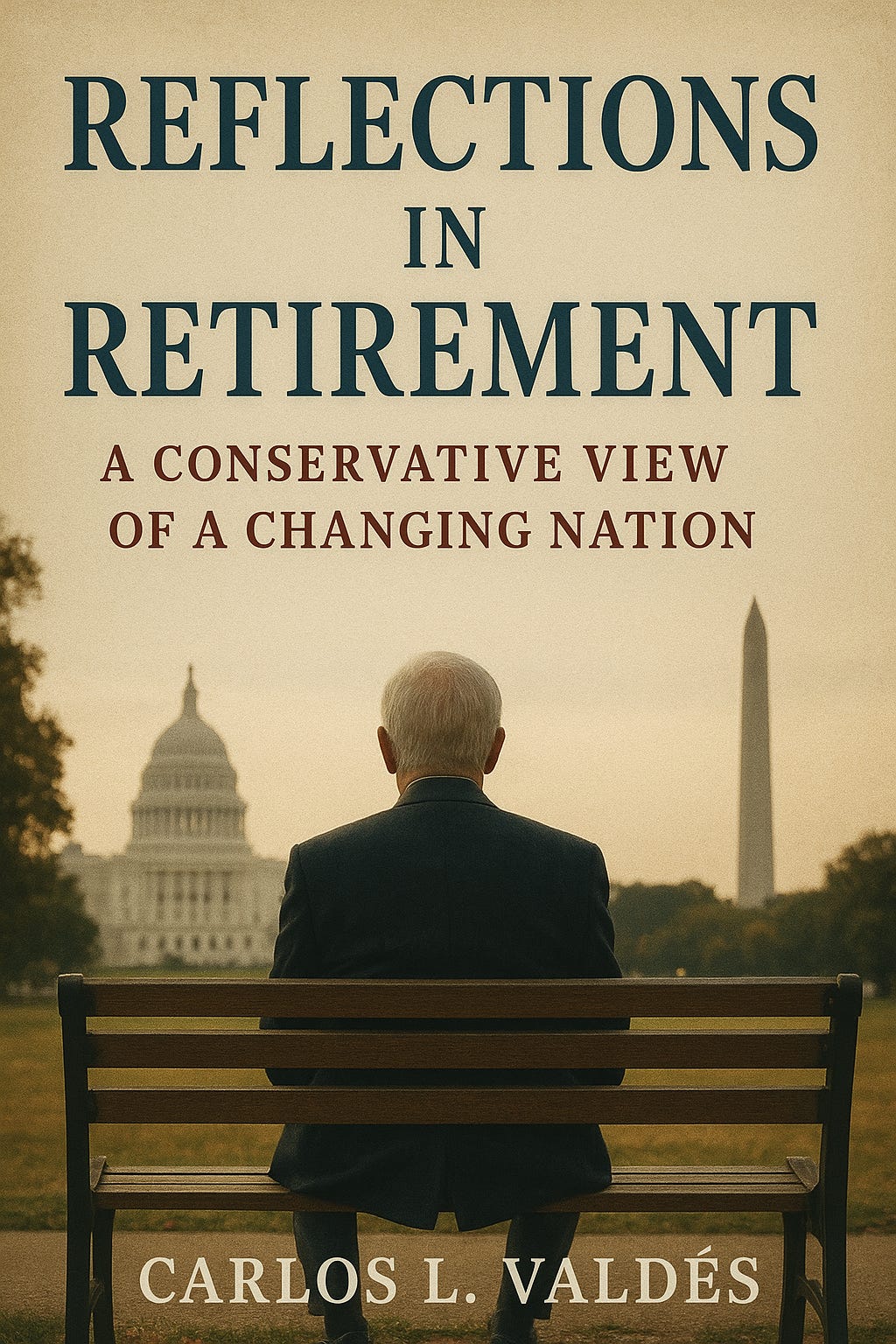
REFLECTIONS IN RETIREMENT - A CONSERVATIVE VIEW OF A CHANGING NATION

Carlos L. Valdés
Pembroke Pines, Florida
Tel: (305) 267-1818
email: cvaldes@carlosvaldes.com
REFLECTIONS IN RETIREMENT
A CONSERVATIVE VIEW OF A CHANGING NATION
Carlos L. Valdés
REFLECTIONS IN RETIREMENT
A CONSERVATIVE VIEW OF A CHANGING NATION
Carlos L. Valdés
Copyright © 2025 by Carlos L. Valdes
All rights reserved. No part of this book may be reproduced, stored in a retrieval system, or transmitted in any form or by any means—electronic, mechanical, photocopying, recording, or otherwise—without the prior written permission of the author, except for brief quotations used in reviews or scholarly works.
First Edition
Publisher: Self-Published by Carlos L. Valdes
ISBN: 979-8-218-83943-7
Cover design: Carlos L. Valdes
Interior design and typesetting: Carlos L. Valdes
Disclaimer:
This book is a work of non-fiction. The information and opinions contained herein are the author’s own. While every effort has been made to ensure accuracy, the author and publisher assume no responsibility for errors, omissions, or contrary interpretation of the subject matter.
Printed in the United States of America
DEDICATION
“To the generous and noble citizens of this great nation- Past, present, and future”
ON GOVERNMENT
“No man’s life, liberty, or property is safe while the legislature is in session.”
— Mark Twain
“The nine most terrifying words in the English language are:
I’m from the government and I’m here to help.’”
— Ronald Reagan, August 12, 1986
Table of Contents
REFLECTIONS
“We The People” Fed Up With The Status Quo. 2
A Patriot Who Refuses to Surrender 3
What Was Once Fiction Has Become Our Reality. 5
What are “We the People” waiting for?. 7
Food for Thought: Our True National Security Crisis. 8
Communism Is Dead. So Why Are the Communists Still Among Us? 9
When the Revolution Turned Against the Family, It Fractured Our Bloodlines 12
Authoritarianism and the Dismantling of Democracy. 14
When Families Fracture: From Batista to Castro to Modern America. 18
The Case for Financial Literacy and Social Etiquette in High School Education 21
The Autopsy is Finished: The Self-Inflicted Death of the Mainstream Media and the Democratic Party. 25
Suicide by Hubris: How the Media and the Democratic Party Engineered Their Own Collapse. 26
From Bricks to Dividends: Why REITs Deserve a Place in Our Real Estate Portfolio. 30
Public Spending and Declining Freedom: The Price of Unchecked Bureaucracy 32
Freedom to Criticize and Oppose: The True Meaning of Living in a Free Country 34
We Didn’t Come to Be Kept: A Call to Protect America’s Freedom.. 35
The Freedom to Criticize Is What Keeps Us Free. 36
Strike the Nukes, Not the Myth: Khamenei’s Death Should Be Strategic, Not Symbolic. 38
Trump’s Two-Week Delay Shows Strength, Not Hesitation. 40
We Once Lived Better With Less—We Still Can. 41
Rediscovering Order in an Age of Excess: When Less Was Truly More 42
The Strike on Iran Was Necessary—Now Let’s Be Ready for What Comes Next 45
From the Darién Gap to the Panama Canal: The Risk We’re Ignoring 47
The Israeli Spirit: How a Nation Perseveres Through Crisis and Conflict 48
The Bubble Has Popped—Liberty Is Not Free. 50
The Axis of Energy: China’s Dangerous New Alliance with Iran and Russia 52
New York Is Feeling the Heat — But the Real Danger May Be Political 54
Diminished Oil Shock Reflects a Shift in Global Energy Power 56
It still baffles me every time I think about it. 57
The Rise of the Permanent Political Class. 58
Our Founding Fathers’ Vision of Citizen Service vs. Today’s Career Politicians 61
Primary Politics and Partisan Entrenchment 63
The Power of Individual Responsibility and Self-Reliance. 64
Strengthening Traditional Values in a Changing Culture. 65
Government Expansion Is Part of the Problem.. 67
The Consequences of Abandoning Core Values. 68
Generational Shifts in Community Life and the Breakdown of Cultural Transmission. 70
Individual Responsibility and Moral Character 72
Family Structure and the Foundation of Community. 74
Welfare Policy and the Displacement of Family Roles. 75
Market Solutions and the Spirit of Entrepreneurship. 77
When the American Dream Becomes a Local Nightmare. 79
The Slippery Slope of Selective Taxation. 81
Entrepreneurship and the Bonds That Build Community. 83
Independence Day, or Just Another Debt Day?. 84
The Splenda Syndrome of Government Spending. 86
The Rise of the National Debt and the Soaring Cost of Interest 87
Big Beautiful Bill: Why It’s the Worst Time to Be Named Bill 89
I Voted for Him Again- But I Cannot Support This Bill 91
Debt by Design: Why I Oppose the “Big Beautiful Bill”. 93
How the BBB Accelerates Entitlement Insolvency. 94
What’s Missing in the U.S. is Us. 96
From Bicentennial to Semi quincentennial: A Patriot’s Reflection. 98
Singapore’s Success and America’s Stagnation: A Wake-Up Call We Can’t Ignore 101
If We Lose New York, We May Lose America. 104
The Work Ethic of a Generation: A Comparative Analysis. 105
Morning Coffee, Stubborn Trees, and the Fifth Set 109
The Politician Who Does Not Sell Out - Stands Alone in a Compromised System 111
Everything Permitted Unless Forbidden- The Illusion of Freedom in a Politically Opportunistic World. 113
Half a Trillion in 48 Hours—And We’re Supposed to Be Okay With That? 116
The Headline Hides the Truth About Job Growth. 117
When Politics Divides the Dinner Table: A Conservative’s Reflection on Silence, Fear, and Lost Connection. 118
The Luxuries of Government: Bureaucratic Perks at the Taxpayer’s Expense 120
Getting Harder to Find Where Freedom Lives. 122
Planting Shade for Tomorrow: A Reflection on Legacy, Foresight, and the Trees We Grow.. 123
A Naturalized Citizen’s Reflection: The Privilege and Responsibility of Living in Peace. 128
Rebuilding the Pillars of a Great Nation. 130
What I’ve Learned Along the Way. 132
Turning the Page: Why I Still Read Every Day. 134
The Vanishing Lines: How Moral Clarity Became Countercultural 136
The Rise of Radical Politics in the Democratic Party. 138
Our Nation is Going Broke—But Hey, At Least the Valet’s Still Working 140
Keep Politics Out of the Pulpit 142
Because We Can—Should We? - A question worth asking. 143
The Power of the IF: A Conservative Opening in the Midterms. 145
The Coming Collapse of Social Security. 147
Were Perot and Paul Really Wrong? Or Just Right Too Soon?. 148
Why Ending Federal Funding for NPR and PBS Is the Right Call—And a Warning for Mainstream Media. 152
I’m in the Market—But I Don’t Understand the Optimism.. 154
Ambition, Friendship, and the Illusion of Money as a Cure-All 155
33 Years Later: Same Bureaucracy, Bigger Bill 157
Unshackling American Business: The Call to Invest and Create Jobs Again 159
Accountability Must Return to Public Assistance. 160
Who Is Responsible For The Border Crisis? Start Naming Names. 162
The Cost of Truth Is Down. 164
Speak Clearly. Stand Firm. Say What You Mean. 166
When Congress Checks Out, the Media Should Check In. 167
Pizza, Hamburgers, Hotdogs… and Ozempic?. 169
What the Great Depression Taught Us About Real Estate—And Why Today Feels Even Stranger 171
The Market Isn’t Crashing—It’s Freezing. 173
Cancel Culture or Cancelled Checks? The Real Reason Colbert Got the Hook 175
Even at 0% Interest, Miami Homes Are Still Out of Reach. That’s the Real Crisis. 176
Why the Republican Party Has Never Had a Socialist Candidate And Why Socialists Feel Right at Home Among Democrats. 180
The Not So Great Society: When the Government Replaced the Family 183
Lose the Market’s Compass, Sail Blind Into the Storm.. 184
I’d Rather Walk Alone Than Follow a Crowd Headed the Wrong Way 186
When Dinner Wasn’t a Decibel Contest 187
Headline of the Day: Redistricting — or as I call it, Gerrymandering for Gerry 188
Communism died. The communist did not. 189
The Uninformed, the Mis-informed, and the Flat-Liners. 191
Alaska Is No Place for Tapas: Trump, Putin, and Zelensky Face History 193
The Silent Collapse of Public Education—And Why We Must Start Barking for Reform.. 194
The Evolution of the Coffee Shop: From Mojo to Mobile Office. 196
Confessions of a Tech-Timid Veteran. 197
The Forgotten War on Christians. 198
Our Nation Was Built by Those Who Stepped Forward. 201
The Book That Out-Googled Google. 203
Why Trump’s Crime Message Resonates. 207
How South Florida Left Its Middle-Class Access. 210
Educating China’s Elite? A Risk We Can’t Afford. 213
“A Correr, Liberales del Perico!” – A Call for American Resolve. 214
Madness in an Insane World. 216
Supporting Reform Without Surrendering Principle. 218
Trying to Stay Sane in a Desert of Ignorance. 219
The Bull in the China Cabinet: Why Power Is Always Checked. 220
When Realtors Enable Market Delusion. 222
Don’t Blame Rates: Lessons from the 1970s and 1980s Housing Market 223
A Billion-Dollar Name Change Won’t Defend America. 224
The End of Washington’s Work-From-Home Culture. 225
Life as a Bicycle Ride: Lessons from Pedro. 227
When Knowledge Outpaces Wisdom.. 228
When Walking Becomes a Menace: The Unleashed Dog Problem in South Florida. 229
When Memory Fades: The Betrayal of Our Own History. 231
Hubris at Home: America’s Numbers Problem.. 234
Swatting the Elephant: Why Americans Hesitate to Challenge Corrupt Local Leaders. 236
Florida’s Republican Majority Is the People’s Victory. 237
On 9/11, Smoke Rose Over America. 240
Qatar: America’s “Ally” That Arms Our Enemies. 241
History- The Teacher We Keep Ignoring. 242
Ideological Movements Are Fueling America’s Chaos. 244
Charlie Kirk’s Assassination: A Turning Point for Conservatives. 245
A Legacy of Property Tax Reform in Florida. 247
Freedom to Criticize and Oppose: The True Meaning of Living in a Free Country 248
Quarterly Reports: Why Regular Investors Need Them More Than Ever 249
The Dollar on the Brink: Why We Need Strong, Independent Leadership Now 250
We Should Be the Target in the Drug War 251
NATO Fuels the Threat It Fears. 252
The Cycle of Reform: When Political Decay Demands Renewal 253
What Business Leadership Owes a Free Society. 255
Societies That Don’t Create Wealth. 257
Accountability, Not Cancel Culture, Strengthens Our Nation. 258
Commerce Funds the Enemy: Chevron in Venezuela and NATO in Russia 259
Relax — the Sky Isn’t Falling. 260
The Government’s Permanent Vacation Program.. 260
The UN Prefers Fantasies Over Democracies. 261
Why the World Might Be Better Off Without the UN.. 262
Contrast Between the Left and Right 263
The Fragile Stewardship of Nuclear Power 265
Last Reflection – For the Moment…... 266
PROLOGUE
A Shift in Language, Not in Memory
There was a time when nearly everything I wrote was in Spanish. It was the language of home, of exile, of the community that raised me. Spanish was how we mourned what we had lost in Cuba and how we made sense of what we were rebuilding in America.
That generation—my parents and their peers—is slowly disappearing. They were strong, resilient people who worked tirelessly to give their children a better life. Yet many never had the time or opportunity to master English beyond conversation. Spanish remained their comfort zone, their cultural anchor.
Decades later, those of us who arrived young—or were born here—live in a different linguistic world. We are bilingual, but English has become the language through which we work, think, and engage with society. It’s where public debate takes place and where ideas are tested. For me, English is now the natural language of political thought and cultural reflection.
Some in my generation have even lost the fluency they once had in Spanish—not from neglect, but from adaptation. Daily life demanded English, and so I write in it today. Not to forget where I came from, but to be heard where I stand.
I’ve never called myself a professional writer, yet I’ve always felt compelled to respond to events—deciphering currents beneath the headlines, offering perspective rooted in principle. Many of those reflections were published, and when I revisit them decades later, I smile. What seemed “off base” then often looks obvious now.
This book continues that practice. It is written for those who still remember the front porch conversations in Spanish but now process the world in English. It is for a new generation of Americans who live between two cultures but seek clarity in one common language.
I was nine years old when I left Cuba with my family, fleeing a regime that promised equality but delivered only repression. We arrived in the United States with hope—and with a deep appreciation for freedom that only those who have lost it truly understand. That experience shaped my worldview and instilled in me a lifelong commitment to liberty, responsibility, and the principles that built this nation.
Over the decades, I have watched America change—sometimes for the better, often in troubling ways. As a public servant, legislator, and citizen, I have tried to make sense of these shifts through writing, speaking, and service. This book is another chapter in that effort.
I do not write from the ivory tower of theory but from the front porch—from the lived experience of someone who has seen both liberty lost and liberty defended. My hope is that these reflections will resonate with citizens who feel the ground shifting beneath their feet and who are searching for voices rooted in principle, not party.
The conversation continues—one reflection at a time.
But before looking ahead, I want to return to where my own reflections began: the porch of my childhood, where community, freedom, and responsibility first came alive.
INTRODUCTION
Reflections in Retirement: A Conservative View of a Changing Nation
I can still picture the quiet evenings of my childhood—sitting on the front porch as the day wound down. Neighbors would stop to share stories, discuss local news, or talk politics. In my family’s case, the conversation often turned to Cuba—our homeland, which we left sixty-five years ago to escape a failed socialist-communist regime. That ideology promised equality but delivered only oppression and misery, not just in Cuba but across much of the world.
Across the street, children played until the streetlights came on. There were no glowing screens to pull us indoors. Community felt alive—sustained by conversation, shared experience, and a sense of responsibility to one another.
Today, the porches remain, but they sit empty. The glow now comes from behind curtains—televisions and phones lighting solitary rooms. Though we live just as close together, the distance between us has never been greater.
This change arrived gradually—through small choices that traded connection for convenience, resilience for comfort, and engagement for endless entertainment. With each trade, something vital was surrendered.
We now live in a time of contradictions. We can communicate instantly, yet loneliness is widespread. Information floods our lives, yet knowledge and reasoning fade. We enjoy material abundance, yet contentment feels scarce. We possess extraordinary technology, yet the systems we depend on prove fragile when tested.
This book does not romanticize the past. The porches I remember belonged to communities with flaws of their own. But they also embodied something essential we are losing: genuine connection. Neighbors didn’t just coexist—they knew and helped one another, sharing the skills and knowledge that sustained daily life.
The challenges we face today go deeper than politics or technology. At their heart, they concern how we relate to one another, to our communities, and to the foundations that once anchored our society. History reminds us that no civilization is immune to decline. Rome, the Soviet Union—each followed the cycle of growth, complacency, decay, and collapse. The question before us is not whether decline is possible, but how far along we already are—and whether we will change course.
In the reflections ahead, I examine how politics grew captive to special interests, how convenience and technology dulled our competence, and how essential skills are vanishing even as dependence on fragile systems deepens. But this is not only a diagnosis. It is also a call to action—for individuals determined to build resilience and for communities ready to reclaim strength and purpose.
We stand at a crossroads. The choices we make now will decide what kind of nation our children inherit. Will it be fragile and fragmented—or a society that awakened in time and rebuilt on stronger ground?
The porch lights may be dimming, but they are not extinguished. With purpose and resolve, we can reignite the light of community, competence, and courage—before it slips away.
REFLECTIONS
Two Centuries of Memory
Retirement has given me the special joy of reconnecting with old friends and reliving the moments that shaped us. Picking up conversations after decades—sometimes as many as six—feels like slipping into a familiar and comforting ride down memory lane.
Yet the joy doesn’t end there. I now have the time to explore the treasure chest of family memories tucked away in old boxes. Each box is a window into the past, filled with the choices, sentiments, and traditions of those who came before me. In the faded letters and tender poems, I find echoes of my grandmother’s bond with my father—their whispered secrets, their enduring love. Alongside them are the voices of friends long gone, who also left their mark in ink.
Friends tease me by calling my collection a “mini museum.” Some even joke that I should throw it all away—after all, won’t these relics be discarded when I’m gone? But I refuse. To me, letting go of them would mean letting go of part of myself. I see my role as a custodian of our heritage, safeguarding pieces that endured exile, hardship, and time itself.
And what treasures they are. Some reach back nearly two centuries, predating Cuba’s republic. Among them rests an original lottery ticket from 1881, sepia-toned portraits from the early 1800s, and my father’s 1934 track medals, still shining with youthful triumph. There is his first baseman’s mitt, its leather worn smooth by countless games, and elegant linen guayaberas from El Encanto—timeless emblems of Cuban grace.
Perhaps dearest to me is a Christie’s London silk top hat, worn by my mother’s godfather as he walked her down the aisle, since her own father had already passed away.
These artifacts are not mere objects. They are threads binding me to my roots, shaping who I am. And so, even in an age of smartphones and fleeting digital memories, I will continue to honor and protect this legacy. Because ultimately, it’s not just about what these possessions are—it’s about the story they tell and the person they have helped me become.
In retirement, rediscovering this history is more than nostalgia—it is a joyful journey of identity and remembrance.
“We The People” Fed Up With The Status Quo.
The MAGA (Make America Great Again) movement is fueled largely by working- and middle-class Americans who feel abandoned by the political establishment, economic globalization, and cultural shifts that seem to have left them behind. Supporters often describe themselves as “the little guy” standing up against elites in government, corporations, and the media—institutions they believe prioritize global interests, big business, and progressive agendas over the needs of ordinary citizens.
Economic hardships, outsourcing, the decline of manufacturing, frustration with immigration policy, and resentment toward political correctness have only deepened this divide. Trump’s outsider image, blunt style, and pledge to “drain the swamp” resonated with millions who felt ignored by both parties, giving them a voice in the national conversation.
Yet MAGA is more than an economic or cultural revolt—it is a philosophical challenge to what many see as a corrupt, technocratic ruling class. At its core lies a vision of national sovereignty, self-reliance, and government accountability to the people rather than entrenched politicians, bureaucrats, and corporate elites.
The movement blends reaction and aspiration: undoing policies seen as harmful—outsourcing, mass immigration, political correctness—while pushing to reclaim America’s identity, economic independence, and traditional values. Over time, it has grown beyond Trump himself, adapting to new concerns such as Big Tech’s influence, government overreach, and global instability.
This shift is reshaping the Republican Party. The old pro-corporate, interventionist establishment is giving way to a more working-class, America-first platform. Even politicians outside MAGA’s orbit now borrow elements of its message because they see its wide appeal. If this trend continues, it could redefine conservatism for a generation.
The challenge lies in balance. To endure, the movement must stay rooted in grassroots energy while refining its message to reach beyond its base. If it remains focused on working-class concerns, sovereignty, and fighting corruption—while presenting practical solutions—it could secure a dominant role in American politics for years to come.
Like Warren Buffett’s investment philosophy, Trump’s populism may outlast its founder. In the short term, Trump remains central, but long-term survival requires a broader bench of leaders who embody the principles rather than merely copy his style. Figures like Ron DeSantis, JD Vance, and Vivek Ramaswamy are already shaping their own versions of the movement. Its longevity will depend on whether future leaders build upon Trump’s defiance of the establishment or fall into infighting and compromise.
The greatest threats come from within: ego clashes, corporate infiltration, or leaders more interested in power than principle. History shows populist movements often fracture once the founding figure steps aside. To endure, MAGA must resist co-option, keep leaders accountable, and preserve its grassroots authenticity.
Education and media also play a decisive role. Today’s corporate media often blurs the line between reporting and shaping the news, fueling distrust. Social media, meanwhile, both fragments communities and offers opportunities for grassroots connection—depending on how it’s used. Restoring community dialogue, fostering critical thinking, and resisting media manipulation are essential if the movement is to stay anchored in truth rather than distraction.
Crises alone, like the COVID-19 pandemic, have proven insufficient to change societal attitudes. Real reform requires persistent education, stronger communities, and a cultural shift toward shared purpose and responsibility. That won’t come from entrenched bureaucracies, which resist change to protect their own power, but from outsiders willing to disrupt the system—exactly what made Trump unique.
The movement’s future depends on whether it can institutionalize this spirit of resistance without losing its soul. Like a sequoia, it must grow deep roots—anchored in persistence, resilience, and resistance to compromise—so it can weather political storms and remain a lasting force in American life.
A Patriot Who Refuses to Surrender
For too long, the political establishment, corporate elites, and media giants have ignored the voices of hard-working men and women across this country. The MAGA movement was never about one man—it has always been about “We the People” standing up against a system that no longer serves us.
Across our communities, we see the consequences of globalist policies, job outsourcing, declining industries, and an economy that prioritizes foreign interests over American workers. We feel the frustration of being dismissed, talked down to, and told that our concerns are outdated or irrelevant. But we know better. We know that the values of self-reliance, hard work, and national pride are not relics of the past—they are the foundation of a strong and sovereign America.
This movement is more than just political; it is a fundamental rejection of a ruling class that has grown disconnected from the will of the people. It is a demand for leadership that serves, not rules. It is a declaration that power belongs to the citizens, not career politicians or corporate elites who profit from our struggles.
Though President Trump ignited this movement, it has grown beyond any one leader. It is a spirit of defiance that must be carried forward by those willing to challenge the status quo—whether through new leaders like Ron DeSantis, JD Vance, and Vivek Ramaswamy, or through everyday Americans refusing to be silenced.
We face many challenges ahead. The establishment will not surrender its grip easily. They will try to divide us, infiltrate our ranks, and steer us off course. To endure, we must remain committed to the principles that brought us here: putting American workers first, fighting corruption, standing for truth, and rejecting the influence of those who seek to control us.
The media will continue to twist our message, suppress our voices, and paint us as extremists. But we must not waver. We must rebuild real communities, foster critical thinking, and reconnect with one another beyond the noise of social media and cable news. The strength of this movement will be found in town halls, local businesses, and kitchen table conversations—where real Americans come together to determine their own future.
This is not just a political moment. It is a generational fight to reclaim the country we love. Like a mighty sequoia, our movement must stand resilient, weathering every storm thrown our way. Our success will not be measured in election cycles alone, but in whether we pass this fire of defiance to the next generation.
The future of America belongs to those who refuse to accept decline. It belongs to those willing to challenge a broken system and demand something better. We will not be silenced. We will not back down. And together, we will restore a government that truly serves the people.
Stay strong. Stay united. Stay the course.
What Was Once Fiction Has Become Our Reality
Reading Orwell’s 1984 for the first time in the mid-70s, and revisiting it multiple times since, I never imagined how closely it would come to resemble our modern society. What was once a cautionary tale about totalitarianism, surveillance, and truth manipulation now serves as an unsettling reflection of today’s world—marked by government overreach, social media control, and the erosion of privacy and free speech.
The novel’s depiction of constant surveillance through telescreens mirrors modern digital tracking. Smartphones, security cameras, facial recognition, and social media platforms continuously collect and analyze personal data, much like Orwell’s omnipresent “Big Brother.” The concept of “Newspeak” and the Party’s control over language and history find echoes in the rise of politically correct language, algorithmic content moderation, and the manipulation of information through digital platforms and media echo chambers. Similarly, Orwell’s “doublethink” aligns with today’s struggle against misinformation, selective narratives, and the reinforcement of biased viewpoints through algorithm-driven content curation.
The erosion of privacy and individual freedom is another stark parallel. Government surveillance programs, predictive algorithms anticipating personal behavior, and mass data collection by corporations challenge our autonomy in ways Orwell warned about. The novel’s themes of political control and social conformity also manifest in the increasing concentration of media power, strategic public manipulation, and the use of fear to maintain social order. The blurred line between corporate and governmental interests poses an even greater concern, particularly for the overburdened taxpayer.
Yet, despite these alarming similarities, modern society still holds key differences. Access to diverse information sources, democratic institutions, and technological tools that empower individual expression provide counterbalances that did not exist when Orwell wrote 1984. His novel was not a prophecy but a warning, urging vigilance against unchecked power and manipulation. The book remains a powerful lens through which we can critique contemporary technological and political landscapes.
Reflecting on the past, I feel fortunate to have grown up in an America where patriotism and civic values were instilled by my family, neighbors, and veterans who had lived through the sacrifices required to preserve freedom. One such neighbor, Mariano Arranz, left an indelible mark on me. A young soldier at 21, Mariano fought against totalitarian forces in Europe, enduring grave injuries from a grenade blast, where among his various injuries, lost an eye and was left permanently disfigured. Despite years of painful surgeries and an altered life, he remained a warm, humble, and patriotic man—never bitter, never boastful, yet unmistakably proud of the country he served.
Mariano’s story, like that of so many veterans, is not fiction. It is a reality that underscores the price of freedom, a price too easily forgotten in today’s world. Every Veterans Day, I remember and honor the countless men and women like Mariano who gave so much so that we could continue living in the “Home of the Free.”
Sadly, 1984 is no longer just a novel. What was once fiction has become our reality.
What are “We the People” waiting for?
It’s time to stop complaining and start exercising our constitutional rights. Imagine a government that strictly adheres to the Constitution and limits its involvement in areas not explicitly authorized.
While predicting the future is challenging, history demonstrates that significant change often arises from a blend of awareness, leadership, and collective action. If citizens stay engaged and committed to advocating for their beliefs, we can reach a point where meaningful change occurs. Ultimately, the potential for such a moment hinge on the collective will and determination of the people. I believe that moment is now, and we must not let it slip away.
Picture “We the People” demanding that the government strictly follow the mandates of the Constitution. Consider the impact of such an effort if it challenged government spending or involvement in areas not explicitly authorized. Some may argue that legal challenges deter them, but my response is that this is precisely what the Supreme Court is for.
Imagine a study that quantifies the savings if the U.S. government strictly adhered to constitutional mandates. The findings could spark creative ideas that inspire “We the People” to rise from sitting idle begging for their rights to standing up and claiming them.
Sometimes, a specific event or crisis can act as a catalyst for change, motivating people to mobilize and advocate for reforms. This could be a financial crisis, a major policy decision, or a legal ruling. Whether we will reach a moment of significant collective action and change regarding government spending and constitutional adherence remains to be seen. However, I believe we are at a point where serious consideration and action are not only necessary but also brewing.
Food for Thought: Our True National Security Crisis
For years, we have been warned about our growing dependence on foreign countries for our medication. When COVID-19 disrupted supply chains and exposed how reliant we are on countries like China and India for everything from antibiotics to over-the-counter painkillers, it was a wake-up call. But a far more fundamental dependency is only now beginning to register; we also rely on foreign nations for our food.
And while a healthy population can survive without regular medicine, no one, healthy or not, can survive without food. Let that sink in.
The United States, once the proud breadbasket of the world, has allowed policies, corporate consolidation, trade deals, and regulatory red tape to slowly chip away at our agricultural independence. We import nearly 15% of our food supply, including over 30% of our fruits and vegetables and 80% of seafood. Much of this comes from countries whose interests don’t always align with ours, and whose stability is far from guaranteed.
We’ve let small farms die while mega corporations have pushed production offshore in pursuit of cheaper labor and looser environmental regulations. We’ve neglected rural America, the backbone of domestic food production, while subsidizing systems that reward global dependency.
We must ask ourselves, what happens when those supply lines break down, what happens if trade routes are disrupted by war or political conflict, what happens if a hostile power decides to hold food exports hostage, what happens when the next pandemic, drought, or economic collapse disrupts foreign food sources? We are no longer asking hypothetical questions, these scenarios are playing out in real time across the world.
Just as energy independence became a national goal in the wake of the oil crisis, food independence must now be treated as a matter of national security. It should not be a fringe idea. This is not a nostalgic appeal to agrarian America. It is a real, tangible, life-or-death priority that should not be ignored any longer. It is a true national security crisis.
We must reinvest in our farmers, land, and processing infrastructure. We need to decouple from fragile global systems and restore the ability to feed our own people, with food grown on our soil, by our citizens, under our standards. This doesn’t mean isolationism. It means resilience.
Because in the end, a nation that cannot feed itself is a nation that cannot lead — or survive.
Communism Is Dead. So Why Are the Communists Still Among Us?
Fidel is gone. But his followers—along with those of Mao, Ho, and Kim—live on, not just abroad but right here in America.
I often argue that while communism as a formal system has collapsed in many parts of the world, communists—the believers, the ideologues, the revolutionaries—have never truly gone away.
I know this not just from history books, but from personal experience.
In 1960, just a year after Fidel Castro and his army marched down from the Sierra Maestra mountains with rosaries around their necks, my parents made a life-saving decision. They were wise enough to recognize the threat that communism posed and brave enough to legally seek refuge in the United States—the “Land of the Free.” They protected our family from the destructive ideology that was rapidly engulfing Cuba.
I was very young, but I remember vividly the televised images of Havana welcoming the Fidelistas in a frenzy of hysteria and celebration. My parents were not Batistianos—they did not support the dictatorship of Fulgencio Batista—but they could sense that something was wrong with the new regime. It didn’t “smell” right, as they put it.
Their instincts were soon validated. Within a month of taking power, Castro’s government began consolidating control through fear and repression. Anyone associated with the old regime was accused and condemned without due process. Revolutionary tribunals replaced judicial courts. Prison sentences were handed out indiscriminately. Firing squads became a tool of political vengeance. And all of it was carried out under the watch of armed militias loyal to Fidel and his ideology.
What continues to intrigue me is how otherwise intelligent people—Nobel laureates, no less—were seduced by the romance of revolution. Gabriel García Márquez openly admired Castro, while Mario Vargas Llosa needed twelve years to finally denounce the regime he once supported. How could such bright minds miss what was so obvious to my parents?
More than six decades later, the world looks different, but the ideological struggle remains. Several countries continue to identify with communist or socialist ideologies. The degree to which they implement these systems varies, but their allegiance to Marxist-Leninist principles is clear.
Cuba, China, Vietnam, Laos, and North Korea are still officially governed by Communist Parties. Nicaragua, Venezuela, and Bolivia may not officially be communist, but they are heavily influenced by socialist and authoritarian doctrines.
Even in Western democracies, socialist and social-democratic parties maintain significant influence. Spain, Portugal, Norway, and India are democratic nations where socialist parties often hold power—though they operate within capitalist frameworks. In my view, the difference between a communist and a socialist is simply one of speed. One runs faster, but both are heading toward the same ideological destination.
Sixty-five years after arriving in my adopted country, I am more convinced than ever: communism may have been declared dead, but the communists are very much alive. Fidel Castro is gone, but Fidelistas remain. Mao Zedong is dead, but Maoists still agitate. Ho Chi Minh passed long ago, but Ho Chi Minhdistas endure. Kim Il-sung is a relic of the past, but Kim Il-sungistas still rule.
We must also not overlook the modern leftist authoritarians: Daniel Ortega in Nicaragua, who revived the Sandinista revolution with Marxist-Leninist overtones after ousting the Somoza dynasty in 1979; Hugo Chávez, who launched Venezuela’s “Bolivarian Revolution” in 1999; and Evo Morales, elected in 2006, who brought a socialist movement to power in Bolivia. Their ideological heirs—the Orteguistas, Chavistas, and Moralistas—are very much alive and active today.
And yet what truly disturbs me is what I’ve witnessed here, in Miami—a place that became a beacon of hope for Cuban exiles. I’ve seen people who once sympathized with the Castro regime—who excused or defended its brutality—suddenly flee Cuba and claim asylum in the very country they once scorned. They arrive claiming they “couldn’t stand it anymore,” that the oppression was unbearable. Yet once settled, many live off public assistance, never meaningfully contributing to the community that took them in. And worse, they return to Havana—not as dissidents—but as tourists. With shopping bags in hand and dollars in their pockets, they stroll the same streets where others once bled for freedom.
That contradiction—fleeing oppression while propping up the regime with tourist dollars—is not just hypocrisy. It’s a slap in the face to every Cuban who truly sacrificed for liberty and every immigrant who works hard to build a better life in this country. It reveals just how hollow some of those claims of suffering truly are, and how deeply embedded the ideological confusion remains.
Meanwhile, democratic socialism in Europe evolved through labor movements and reform, not violent revolution. But its influence is far-reaching. Spain under Felipe González in the 1980s and now under Pedro Sánchez. Portugal under Mário Soares. The Nordic nations—Sweden, Norway, Denmark, and Finland—all represent a different face of socialism, but one that still leans toward state control and expansive social policy.
The ideological battle never truly ended. It just changed its mask. History has proven that communism is unworkable in practice. But its disciples persist. They adapt, rebrand, and resurface—often in the very societies that once rejected their doctrines.
The fight for freedom and individual liberty is not over. It simply continues in new forms, across new fronts, and often—unnoticed—within our own communities.
When the Revolution Turned Against the Family, It Fractured Our Bloodlines
I left Cuba with my entire family in 1960. We came together, holding on to each other tightly as everything around us began to fall apart. At the time, we thought we were leaving behind a political crisis. We hadn’t yet realized we were also leaving behind a version of ourselves we would never get back.
Before the revolution—even under Batista’s dictatorship—our family could have political arguments without fear. One uncle might defend Batista, another might whisper his hopes for the revolution. But we still shared meals, celebrated baptisms, and gathered for Noche Buena as one. Politics caused tension, sure—but it didn’t sever blood.
Batista’s government was harsh, repressive, deeply unequal. But it didn’t infiltrate the family. It didn’t demand that children judge their parents or that neighbors spy on each other. It left the walls of the home intact. You could still go to church, whisper your doubts, and raise your children according to your values. The state mostly stayed outside the door.
That changed the moment Fidel Castro’s revolution took hold. Almost overnight, everything began to shift—how we spoke, what we believed, who we could trust. This wasn’t just a change in government; it was a campaign to reshape the very core of who we were, including how we related to each other. The revolution demanded loyalty not only in public, but in private. It redefined what it meant to be Cuban.
I remember hearing how children were being encouraged to report their own parents for “counterrevolutionary” ideas. Schools pushed Marxist ideology. The Pioneros trained children to chant slogans and place the revolution above the family. Churches were shut down. Priests disappeared. Friends became informants. The Comités de Defensa de la Revolución—the CDRs—popped up on every block: watching, listening, documenting every whisper.
Fortunately, my parents made their decision early. We left not just to escape political instability—but to preserve our dignity, our freedom, and our family. We were among the early wave of exiles, still able to leave together. We arrived in Miami with little more than suitcases and memories. We told ourselves it was temporary. Like so many others, we believed we’d return soon.
But Cuba closed behind us like a door sealed shut. For years, we lived suspended between two worlds. Letters were intercepted, phone calls monitored, visits unthinkable. We knew people left behind who were being watched, questioned, punished simply for having relatives abroad. Some of our cousins stopped writing. Others pretended we didn’t exist. Whether out of fear or ideology, the result was the same: silence, disconnection, and a growing void.
Even though we escaped together, the trauma still followed us. We carried it in our routines, in the food we cooked, in the accents we struggled to hold on to. I watched my parents age faster in exile. They mourned quietly, without a grave to visit or a goodbye to say. They missed their siblings, their childhood homes, the street corners where their lives had unfolded. They never stopped hoping they’d go back—but they never did.
I built a successful life in the United States. I grew up speaking English, pledging allegiance to the “Land of the Free,” surrounded by memories and photos of Cuba, listening to boleros on Sunday mornings. When you are forced
to leave your homeland, you inherit something more than nostalgia—you inherit loss. A kind of inherited grief I don’t have a name for.
Now I see it clearly. Our family left together, early, but we still became part of the revolution’s collateral damage. Because even from miles away, it found a way to split our bloodlines, turn our absence into silence, turn our memories into myths, make strangers of people we once called primos and tíos, and teach generations born in exile to long for a homeland they’ve never seen.
I’ve never been back. I refuse to return, to get close to what my parents lovingly protected me from. I know many who have gone back to visit the failed system they once fled. When they return, their stories are all the same: the Cuba they found was not the one they remembered. The buildings were familiar, but the spirit had changed. Those who stayed behind have lived under a different truth. Their conversations remain guarded, politics avoided.
Here in Miami, every Noche Buena, my family continues to gather as we did 65 years ago in Havana. We roast the lechón, play old songs, dance. And at some point in the night, someone always raises a glass and says, “Next year in Havana.” We all smile, but we know better. Havana is not the same—and neither are we.
The revolution promised unity, but for millions of us in exile, it delivered fracture. It redrew the boundaries of loyalty. It replaced love with fear. It rewrote our family histories with silence. We survived—but something essential did not.
Even now, after all these years, the pain of those fractured bloodlines still lingers. Quiet. Persistent. Unhealed.
Authoritarianism and the Dismantling of Democracy
In March 1952, just months before scheduled elections, Batista orchestrated a military coup that deposed President Carlos Prío Socarrás. This move suspended the democratic process and marked the beginning of his second and most repressive period of rule. The 1940 Constitution—one of the most progressive in Latin America at the time—was effectively nullified. Civil liberties were abolished, political parties were marginalized, and legislative processes became ceremonial, subservient to executive power backed by the military.
Batista’s government ruled primarily through decree. High-ranking military officers and loyalists were installed across public institutions, while the public was stripped of its voice in governance. The veneer of legality was occasionally preserved through controlled or fraudulent elections, but these exercises lacked credibility both domestically and internationally. The regime’s political structure thus reflected a classic model of authoritarianism: centralized control, the suppression of dissent, and the strategic use of constitutional violations to maintain power.
State-sponsored repression under Batista was both calculated and brutal. Following the 1953 Moncada Barracks assault—an unsuccessful attack led by a young Fidel Castro and his revolutionary group—the regime initiated a campaign of arrests, summary executions, and torture of political opponents. Survivors of the assault were tried in military tribunals and sentenced under heavy security, often without access to legal representation or due process.
Torture centers such as the Buró de Investigaciones in Havana became notorious for the inhumane treatment of prisoners. Detainees frequently reported electric shocks, beatings, and sleep deprivation. The regime’s security apparatus, supported by U.S.-supplied arms and surveillance techniques, conducted widespread surveillance of suspected dissidents. Between 1952 and 1959, it is estimated that over 20,000 Cubans died at the hands of Batista’s forces, many without formal charges or trials. These acts were not isolated incidents but part of a deliberate state strategy to instill fear and prevent organized resistance.
In addition to the physical violence, Batista’s government imposed strict censorship on the press and curtailed academic freedom. Independent newspapers were shut down or forced to toe the government line, while radio and television broadcasts were monitored and regulated. Intellectuals, students, and union leaders were particularly targeted, creating a climate of widespread fear and silence in public discourse.
Even as Batista promoted the illusion of economic progress—particularly in Havana’s urban centers—rural Cuba remained impoverished and grossly underserved. The country’s wealth was overwhelmingly concentrated among a small elite aligned with foreign capital, especially American corporate interests. U.S. businesses controlled vast portions of Cuba’s most productive land, utilities, and industries. By the mid-1950s, American companies owned more than 70% of arable land, 90% of Cuba’s utilities, and significant stakes in the sugar, telephone, and transportation sectors.
The rural population bore the brunt of this inequality. In provinces like Oriente and Las Villas, thousands of families lived in makeshift huts without access to clean water, healthcare, or education. Illiteracy rates were high—up to 40% in some areas—and life expectancy was significantly lower than in Havana. Sugarcane workers, the backbone of Cuba’s export economy, faced seasonal employment, often working only three or four months per year and left jobless the rest of the time.
Meanwhile, Havana became a playground for American tourists, mafia-linked casino operators, and corrupt officials. Batista’s regime had close ties with organized crime figures such as Meyer Lansky, who helped transform Havana into a hub for gambling, prostitution, and money laundering. Batista himself allegedly received millions of dollars in kickbacks from mafia-run hotels and nightclubs. The state was thus not only economically dependent on foreign interests but morally compromised by corruption at its highest levels.
By the late 1950s, the contradictions of Batista’s Cuba were too glaring to ignore. The state’s repression had radicalized a generation of youth and intellectuals, while the pervasive inequality and political disenfranchisement had eroded any remaining legitimacy. The Cuban population was divided between a wealthy minority benefiting from Batista’s rule and a majority whose basic needs and rights were systematically denied.
It is in this context that the Cuban Revolution was born—not merely as an ideological rebellion, but as a direct response to political authoritarianism, economic exploitation, and social neglect. Batista’s Cuba was a nation broken by its own government, where injustice was not a byproduct of poor policy but a pillar of regime survival.
The revolutionary regime that replaced Batista promised a radically different model. It abolished the old elite structures, expelled or imprisoned many of Batista’s allies, and nationalized industries and land once controlled by U.S. corporations and domestic oligarchs. Universal healthcare and education became foundational priorities. The literacy rate increased, rural clinics multiplied, and land reform redistributed property to the peasantry. These changes were touted as signs of progress, though the extent of their effectiveness remains highly contested.
However, political freedom did not return. While the revolution dismantled Batista’s apparatus of torture and corruption, it replaced it with a centralized, one-party state that stifled dissent and eliminated free elections. The Cuban Communist Party consolidated all authority, and political opposition was criminalized. Surveillance became institutionalized through neighborhood watch structures such as the Committees for the Defense of the Revolution (CDRs).
Expulsion and imprisonment of Batista’s former supporters were often accompanied by extrajudicial executions. Revolutionary tribunals sentenced hundreds to death, and many were executed by firing squad without due process. These acts were widely publicized as revolutionary justice but also drew international condemnation for violating human rights.
In economic terms, Cuba transitioned from capitalist dependence on the U.S. to a Soviet-style planned economy. While this shift provided initial stability and material support, it also entrenched inefficiencies, discouraged entrepreneurship, and ultimately led to severe shortages and systemic breakdown after Soviet subsidies collapsed in the 1990s.
By the 21st century, Cuba faced widespread poverty, food insecurity, and an exodus of skilled professionals. Hospitals lacked basic supplies and even electricity; medicines were scarce, and public infrastructure deteriorated. The revolutionary promise of shared prosperity had, in practice, devolved into shared deprivation. The population endured rationing, chronic malnutrition, and declining public health.
Notably, both Batista and Castro were, at different points, supported by the United States. Batista maintained strong ties with U.S. business and military interests throughout his rule, receiving arms and political backing despite mounting human rights abuses. In the early phase of the revolution, the U.S. initially showed cautious support for Fidel Castro, viewing his movement as a nationalist uprising against dictatorship. However, this support evaporated quickly after Castro’s alignment with Soviet communism and nationalization of American assets.
Thus, the revolution brought some measurable but deeply contested changes in access to education, healthcare, and rural services, while simultaneously replicating and expanding authoritarian controls. Where Batista had ruled through fear and corruption to maintain elite privilege, the revolutionary state ruled through ideological conformity and repression to impose mass equality—defined not by shared opportunity, but by shared misery. In both eras, the Cuban people suffered under regimes more committed to control than to liberty.
When Families Fracture: From Batista to Castro to Modern America
Throughout history, the strength of families under pressure has revealed as much about a society as its laws or revolutions. In times of political upheaval, family ties either strengthen in resistance or dissolve in silence. The trajectory from Batista’s dictatorship to Castro’s totalitarianism and now to a fragmented America reveals a haunting trend—one where power, ideology, and fear reshape the very structure of trust between loved ones.
In Batista’s Cuba, repression was evident. The dictator wielded control through corruption, censorship, and violence. Yet even in that climate, the family unit remained surprisingly resilient. Political dissatisfaction may have been widespread, but it did not rip families apart. In fact, discontent was often a shared experience—something whispered about behind closed doors, expressed in cautious tones, but shared nonetheless. The family home was a sanctuary from the state, a refuge from the fear that governed public life. Batista’s regime demanded obedience, not conversion of belief. People were silenced, not severed from each other.
Then came Castro. With his revolution, Cuba’s authoritarianism evolved into something more intimate—and far more insidious. Castro did not simply want to rule people; he wanted to remake them. Revolutionary loyalty became a civic religion, and private life was not spared. Children were taught to revere the state. Neighbors were trained to report one another. A careless word in the wrong setting could lead to prison—or worse. Families learned to fear one another. Parents hid opinions from children. Brothers stopped speaking to sisters. The family no longer functioned as a safe haven; it had become one more institution of ideological risk.
The most wrenching effect of Castro’s reign wasn’t merely the psychological self-censorship—it was the literal scattering of families. As Cubans fled to the United States, often leaving relatives behind, the fracture was no longer metaphorical. The division was real, geographic, and permanent. Entire generations were raised under two flags—one in exile, one under surveillance—and the trust that once held them together had been replaced by suspicion and silence.
Today in America, no dictator commands loyalty. No revolutionary committee sits on street corners. And yet, families are once again drifting apart—not under state orders, but under cultural pressure. Political polarization, once confined to campaign seasons or newspaper columns, has entered our homes and sunk deep into our most personal relationships. Friends avoid each other. Parents and children cease speaking. Extended families fracture. The fault lines are many—race, gender, climate, religion, vaccines, history—and while the issues may differ from those in Cuba, the outcome echoes the same tragic chord.
What makes this moment unique is that no external force is imposing the fracture. We are doing it to ourselves. The age of social media has replaced the surveillance state with self-surveillance. Algorithms divide and radicalize with ruthless efficiency, feeding us not information but identity. It is no longer enough to disagree—we must be pure. And in that quest for ideological cleanliness, families become contaminated simply by dissent.
The tragedy is made all the more bitter when disagreement is not met with debate, but with disappearance. One of the most telling dynamics today is not heated argument, but the quiet vanishing of engagement. In many families, there are those who desperately want to have a serious, respectful conversation about the state of the country, about what matters, about truth itself. They show up prepared to disagree in good faith. But on the other side are people—often highly educated, professionally accomplished—who withdraw behind a mask of neutrality. They say they are politically independent, claim no loyalty to party or ideology, and bristle at what they label “divisiveness.” Yet when asked to express their own views, they offer none. When invited to defend an idea, they change the subject.
This is not genuine independence. It is a strategic evasion—one driven not by principle but by a desire to remain palatable to all. These individuals present themselves as peacemakers, above the fray, allergic to extremism. But their silence isn’t healing anything; it is eroding trust. They critique tone, not substance. They express discomfort with conflict, but never clarity about conviction. They long to be liked—by everyone—and in doing so, they leave the people closest to them in a fog of alienation.
A member of one such family put it simply: “They say they want unity, but won’t tell you what they think. They won’t defend an idea, and they won’t challenge yours either. They just vanish into politeness.” The result is a hollow peace—one that avoids confrontation but also avoids intimacy. We are left not with dialogue, but with distance. Not with disagreement, but with doubt about whether the relationship itself can withstand honesty.
This too is a form of fracture. It does not erupt—it erodes. Slowly. Quietly. Relentlessly. And just like in Cuba, it creates a house where people do not speak freely, not because they fear punishment, but because they fear disapproval. In this way, our culture has become its own enforcer. It does not imprison dissenters. It shames them, isolates them, and labels them unfit for polite society—even within their own families.
We would do well to remember that freedom is not merely the absence of tyranny. It is the presence of trust. It is the willingness to speak the truth in love, even when it risks discomfort. It is the refusal to surrender family bonds to political tribalism or social approval. The Cubans who resisted Castro, the ones who whispered their truth in a system that punished them for it, understood this. They paid the price of exile and persecution, not just to be free, but to speak freely.
Today, we are being asked to make a similar choice—not by a regime, but by a culture that no longer knows how to disagree without destroying. And in that choice lies the future—not just of political health, but of family itself. Because when trust disappears from the family, so too does democracy from the culture.
The road back is not paved with silence. It is walked through conversation—honest, even painful, but grounded in the conviction that love is greater than fear, and truth more necessary than comfort. The most radical act in a fractured age may not be protest or revolution. It may be simply to stay in the room with someone you love, and say what you believe.
The Case for Financial Literacy and Social Etiquette in High School Education
In today’s fast-paced, hyper-connected world, young adults are entering adulthood with impressive academic credentials—but glaring deficiencies in basic life skills. Chief among these are financial literacy and social etiquette: two foundational competencies that have been consistently neglected in the modern American high school curriculum. As students prepare to leave the structured environment of secondary education and enter the workforce or higher education, their inability to manage personal finances or engage in professional social interactions becomes a significant liability.
This essay argues that financial literacy and social etiquette must be mandatory components of the high school curriculum, beginning as early as ninth grade and continuing through twelfth. It further contends that this educational reform is essential not only because students are lacking these skills, but because many parents—and even educators—are similarly unequipped, perpetuating a generational cycle of under preparedness.
A growing body of evidence shows that young people are entering adulthood financially illiterate. They graduate knowing how to solve quadratic equations but lack the basic knowledge to create a personal budget, understand interest rates, or manage a credit card. The consequences are real and lasting: overwhelming student loan debt, poor credit management, impulsive spending habits, and a general sense of confusion when faced with adult financial responsibilities. Without proper education, these patterns persist into adulthood, eroding long-term financial stability and independence.
Simultaneously, students are also emerging from high school without the social tools necessary to succeed in formal and informal settings. Many struggle to conduct themselves in professional environments, write a proper email, speak confidently in interviews, or participate in respectful discussions. These deficiencies are often dismissed as minor or personality-driven, but they are in fact teachable skills—and essential ones. Social etiquette, including the ability to communicate clearly, listen attentively, and demonstrate respect for others, is not merely about decorum; it is a cornerstone of career readiness, civic engagement, and personal development.
While schools bear some responsibility for this oversight, the problem extends beyond the classroom. The current generation of parents is often unable to fill this gap at home because many of them were never taught these skills themselves. Financial and social illiteracy are not isolated traits—they are symptoms of a systemic failure that has affected multiple generations. In households where budgeting is not practiced or discussed, or where digital devices have replaced meaningful social interaction, children receive little to no reinforcement of these critical life skills.
To compound matters, many teachers are also ill-equipped to teach these subjects. This is not a reflection of their competence or dedication but rather the result of a system that has never prioritized these areas. Most teacher preparation programs do not include training in financial education or social etiquette instruction, and professional development opportunities in these areas remain rare. Expecting educators to teach what they themselves were never taught—without formal curriculum support or resources—is both unrealistic and unfair.
For these reasons, school boards must lead the way. Rather than waiting for state-level mandates, local districts can take immediate steps to design and implement a required, credit-bearing course that covers financial literacy and social etiquette. This curriculum should include age-appropriate, practical instruction in topics such as saving, budgeting, credit, taxes, and investing, as well as lessons in professional communication, manners, networking, and collaboration. More importantly, teachers should be given training and materials to confidently deliver these lessons. The course should grow in complexity with each grade level and offer students opportunities for real-world application.
The benefits of such a program are far-reaching. Students who learn to manage their money wisely and interact respectfully with others are more likely to succeed in college, secure and maintain employment, and contribute meaningfully to their communities. These are not abstract goals—they are measurable outcomes that benefit not only individuals but also the society and economy at large.
In conclusion, the absence of financial literacy and social etiquette instruction in high schools is not a minor gap—it is a structural flaw with serious implications. Students, parents, and teachers are caught in a loop of unpreparedness that can only be broken through intentional, curriculum-based intervention. By institutionalizing these subjects as core components of secondary education, we can begin to reverse this generational deficiency and equip students with the tools they need to thrive as competent, confident adults.
The longer we delay, the more we risk graduating students who are academically qualified—but fundamentally unprepared—for the real world.
The Bear Is at the Door
I spent my career as a small businessman—making payroll, managing risk, and dealing with reality. For 12 years (1988-2000), I also served as a conservative state legislator, doing everything I could to apply common-sense fiscal restraint to government.
Believe me when I say America’s financial position is not just concerning—it’s perilous. This fiscal year, interest payments on the national debt will exceed $1 trillion. We now spend more just servicing our debt than on the entire defense budget—and more than on Medicaid, disability insurance, and food stamps combined.
If a business operated this way, it would be bankrupt. If a household tried it, it would lose everything. Yet the federal government keeps borrowing and printing, pretending nothing is wrong.
Markets have noticed. Warren Buffett, hardly a doom-and-gloomer, is moving billions into foreign markets such as Japan. That is not diversification—it is a hedge against American dysfunction. When the most disciplined investors shift away from U.S. assets, we should ask why.
The answer is simple: Washington does not live in the real world. The people in charge rarely have to meet a payroll or balance a budget outside a government spreadsheet. They deal in slogans and omnibus bills while our debt spirals and interest rates climb.
As a businessman, I learned that numbers do not lie. As a legislator, I saw how quickly politicians ignore those numbers when the truth is inconvenient. But truth does not wait for political convenience.
Thomas Jefferson warned, “To preserve our independence, we must not let our rulers load us with perpetual debt.” John Adams cautioned, “There are two ways to conquer and enslave a nation. One is by the sword. The other is by debt.” Our founders understood the danger of financial dependency; we ignore their wisdom at our peril.
Many Americans still believe deficits do not matter—that someone else will pick up the tab. But the bill is coming due, and it will fall on the backs of our children and grandchildren—anyone who still believes in the American Dream.
The bear is no longer roaming the woods. It is asleep on our front porch, and Washington steps over it as if it is not there. This is not about partisanship; it is about stewardship. We once valued thrift, responsibility, and sacrifice. We urgently need that spirit again.
We need leaders willing to say “no,” to explain trade-offs, and to stop borrowing from the future to fund present illusions. Washington must begin thinking like the rest of America—like a household, a farm, a business—because if we continue acting like an empire immune to reality, we will not remain an empire for long.
The bear only sleeps so long. When it wakes—God help us if we are still pretending.
The Autopsy is Finished: The Self-Inflicted Death of the Mainstream Media and the Democratic Party
There were no assassins. No fatal blows from rivals. No conspiracies lurking in shadow. The fingerprints on the weapon were their own.
Mainstream media and the Democratic Party did not fall to external forces—they collapsed inward, victims of arrogance, detachment, and a stubborn refusal to confront reality. In their final moments, they doubled down on delusion: the media abandoned journalism for narrative management, while the Democratic Party traded working-class grit for elite technocracy and identity politics masquerading as justice.
The media didn’t die because Americans stopped seeking news. It died because it stopped telling the truth. Credibility, once earned over generations, was squandered. Every fact-check that felt like spin, every glaring omission of inconvenient stories—these weren’t minor missteps. They were hemorrhages of trust. Rather than reflect reality, the media tried to manufacture it. But the public, more connected, skeptical, and informed than ever before, simply walked away.
The Democratic Party’s decline mirrored that decay. Once the home of blue-collar labor, it chose Silicon Valley boardrooms over Youngstown barstools. It abandoned populism for paternalism, and moral clarity for cultural manipulation. “I feel your pain” gave way to elitist scolding. Dissent became dangerous. Debate became hate. The party lost not just elections—it lost the soul of its own movement.
This was not a defeat at the hands of stronger adversaries. It was institutional rot. A refusal to self-correct. The belief that legacy alone would sustain them, that public perception could be reshaped indefinitely—never realizing the audience had already changed the channel.
This was not a murder. It was suicide. A slow surrender of purpose, a rejection of truth—and the consequence was self-inflicted irrelevance.
Suicide by Hubris: How the Media and the Democratic Party Engineered Their Own Collapse
If history ever writes a proper obituary for the American mainstream media and the modern Democratic Party, it won’t be filled with tales of assassination by enemies or sabotage from foreign influence. Instead, it will read like a tragedy—one where the principal characters willingly and repeatedly chose delusion over truth, elitism over empathy, and control over credibility. Their deaths were not accidents. They were self-inflicted.
Let’s begin with the media.
There was a time when the term “mainstream media” carried a sense of authority. Names like Cronkite and Murrow weren’t just respected—they were trusted. But trust is a currency that must be earned daily and spent wisely. Over the past two decades, the major media institutions squandered it. In the pursuit of influence and alignment with the cultural elite, they transformed from observers into participants. They stopped asking hard questions and started protecting preferred answers.
From selective outrage to coordinated silence, media giants perfected the art of omission and rebranding. Inconvenient facts were buried, uncomfortable debates were reframed as misinformation, and ideological deviation was pathologized. The phrase “disinformation” became not a warning about lies but a cudgel against unapproved opinions. Meanwhile, independent voices—some serious, some fringe—rose to fill the vacuum, further eroding the gatekeeping power of the legacy press.
The public noticed. They didn’t need a media literacy class to sense they were being played. They simply stopped tuning in. Poll after poll confirmed the obvious: trust in mainstream media reached historic lows not because of fake news, but because the real news was filtered through a lens of paternalistic bias.
But the press wasn’t alone in its decline. The Democratic Party, once the champion of working Americans, followed a similar trajectory—choosing cultural aristocracy over class solidarity.
It began subtly. As globalization shifted wealth and jobs to urban centers and coastal strongholds, the party reoriented itself toward professional managerial elites—those who benefited most from the new economy. The rhetoric of solidarity was maintained, but the substance shifted. Instead of economic empowerment, the new message was top-down moral instruction: vote for us, or you’re a racist, a misogynist, or worse.
The result? A slow-motion divorce from the American working class.
While Republicans were hardly offering a coherent populist alternative at first, the Democrats’ growing disdain for traditional values, religious sentiment, and economic frustration left many disillusioned. Rural Americans, once union Democrats, found themselves ridiculed as “deplorables.” Inner-city residents heard lectures from activists living in gated communities. Immigrants heard promises of inclusion while watching their neighborhoods crumble from bureaucratic neglect.
The party’s answer to rising populism was not self-correction, but suppression. Debate was labeled dangerous. Censorship was outsourced to tech monopolies. And rather than rebuilding trust, they doubled down on division—betting that identity politics and cultural intimidation could substitute for genuine leadership.
In both cases—the media and the Democratic Party—the cause of death was not political defeat, but institutional arrogance. The belief that dissent was illegitimate. The assumption that control over platforms meant control over minds. The faith that moral superiority could mask strategic incompetence.
What they failed to grasp was that Americans are not as easily managed as they once were. The information age made everyone a fact-checker. The economic squeeze made political correctness feel irrelevant. The pandemic made institutional trust a question of life and death—and millions chose to believe their neighbors over their networks.
By the time the warning signs became undeniable, it was too late. The ratings collapsed. The base walked away. And the credibility they once owned was scattered across a fractured landscape of independent voices, community forums, and uncensored digital spaces.
To be clear, neither the media nor the Democratic Party is gone entirely. Their logos still flash on screens, their candidates still campaign. But the authority they once wielded—the gravitational pull that shaped consensus—is gone. What remains is a hollow shell, animated by denial and defended by echo chambers.
The autopsy is complete. The fingerprints are theirs. The cause of death: suicide by hubris.
Brick and Stocks
After fifty years in the real estate business, I can say that I helped many families buy their homes and lived a dignified life, thanks to the enduring value of land and brick. Like many property owners, I had full confidence in what I could see, touch, and rent. For me, there was no better investment.
And I wasn’t wrong. Properties weathered crises, appreciated over time, and offered advantages that few financial instruments can match: rental income, tax benefits, capital appreciation, and, above all, leverage. To illustrate: with a down payment of just $100,000, one can acquire a $500,000 property and, after three decades, see it transformed into an asset worth around $1.5 million. That’s a return of over 1,400% on the initial capital. And if you buy in with only 10% down, the return nearly doubles. (Between 1995 and 2025, the average home price in the U.S. rose 309%.) Tell me that’s not a good business.
However, now retired—and with the benefit of time and perspective—I must admit something I didn’t clearly see for many years: while we were tending to roofs and walls, the stock market was growing quietly but steadily in parallel… and sometimes even more strongly.
Over that same period, the S&P 500 grew by more than 1,000%, the Dow Jones by nearly 850%, and the Nasdaq—driven by the tech revolution—by over 2,000%.
Even within the same real estate world, but through the stock market, there are stories worth telling. Take the case of Realty Income, a company dedicated exclusively to leasing commercial properties. If you had invested $100,000 in this company during that same period and reinvested every monthly dividend, today you’d have an investment worth approximately $4.7 million. That’s a total return of 4,605%.
If, instead of reinvesting the dividends, you had chosen to take them in cash, the payouts would have grown at an average annual rate of 4.3%, and the stock value would be “only” about $2.9 million. Not bad for a real estate asset without leaks, surprise repairs, or difficult tenants.
I don’t mention this to diminish traditional brick-and-mortar investments. On the contrary—they remain a cornerstone of any solid portfolio. But it’s worth asking: how much more could we have today if we had combined tangible property with its financial counterpart in the market?
Most of us didn’t do that simply because we didn’t know what we didn’t know. Not out of a lack of intelligence, but a lack of information. We believed that mastering zoning laws, mortgage rates, and local market cycles was enough. And it was—enough to live well. But not necessarily to grow our wealth to its fullest.
In my case, I never explored the stock market because it seemed risky, complicated, foreign. Today I understand that was a misperception. The stock market isn’t some exclusive game for experts or a dangerous roulette. It’s a legitimate tool for growing wealth—with its own rules, yes, but also with tremendous advantages for those willing to learn.
To be clear, I’m not offering investment advice. I have no experience and only a basic understanding of the subject. I only regret not being able to say I have fifty years of expertise in that field as I do in real estate. But I’m still learning, and the more I learn, the clearer it becomes: the numbers don’t lie—sustained growth in the financial markets over the last three decades has been nothing short of remarkable.
Since retiring, I’ve spent more time studying finance than in my entire working life. And if I’ve learned anything, it’s that it’s never too late to invest differently. Those of us who are already property owners are better positioned than most—because we understand what it means to think long-term and care for an asset. We just need to widen the lens.
It’s not about abandoning brick-and-mortar. It’s about not depending solely on it. Because if these fifty years have taught me anything, it’s that good investing doesn’t depend only on the property—but on perspective.
From Bricks to Dividends: Why REITs Deserve a Place in Our Real Estate Portfolio
After fifty years in the real estate business, I can say that I helped many families buy their homes and lived a dignified life, thanks to the enduring value of land and brick. Like many property owners, I had full confidence in what I could see, touch, and rent. For me, there was no better investment.
And I wasn’t wrong. Properties weathered crises, appreciated over time, and offered advantages that few financial instruments can match: rental income, tax benefits, capital appreciation, and, above all, leverage. To illustrate: with a down payment of just $100,000, one can acquire a $500,000 property and, after three decades, see it transformed into an asset worth around $1.5 million. That’s a return of over 1,400% on the initial capital. And if you buy in with only 10% down, the return nearly doubles. (Between 1995 and 2025, the average home price in the U.S. rose 309%.) Tell me that’s not a good business.
However, now retired—and with the benefit of time and perspective—I must admit something I didn’t clearly see for many years: while we were tending to roofs and walls, the stock market was growing quietly but steadily in parallel… and sometimes even more strongly. Over that same period, the S&P 500 grew by more than 1,000%, the Dow Jones by nearly 850%, and the Nasdaq—driven by the tech revolution—by over 2,000%.
Even within the same real estate world, but through the stock market, there are stories worth telling. Take the case of Realty Income, a company dedicated exclusively to leasing commercial properties. If you had invested $100,000 in this company during that same period and reinvested every monthly dividend, today you’d have an investment worth approximately $4.7 million. That’s a total return of 4,605%. If, instead of reinvesting the dividends, you had chosen to take them in cash, the payouts would have grown at an average annual rate of 4.3%, and the stock value would be “only” about $2.9 million. Not bad for a real estate asset without leaks, surprise repairs, or difficult tenants.
I don’t mention this to diminish traditional brick-and-mortar investments. On the contrary—they remain a cornerstone of any solid portfolio. But it’s worth asking: how much more could we have today if we had combined tangible property with its financial counterpart in the market?
Most of us didn’t do that simply because we didn’t know what we didn’t know. Not out of a lack of intelligence, but a lack of information. We believed that mastering zoning laws, mortgage rates, and local market cycles was enough. And it was—enough to live well. But not necessarily to grow our wealth to its fullest.
In my case, I never explored the stock market because it seemed risky, complicated, foreign. Today I understand that was a misperception. The stock market isn’t some exclusive game for experts or a dangerous roulette. It’s a legitimate tool for growing wealth—with its own rules, yes, but also with tremendous advantages for those willing to learn.
To be clear, I’m not offering investment advice. I have no experience and only a basic understanding of the subject. I only regret not being able to say I have fifty years of expertise in that field as I do in real estate. But I’m still learning, and the more I learn, the clearer it becomes: the numbers don’t lie—sustained growth in the financial markets over the last three decades has been nothing short of remarkable.
Since retiring, I’ve spent more time studying finance than in my entire working life. And if I’ve learned anything, it’s that it’s never too late to invest differently. Those of us who are already property owners are better positioned than most—because we understand what it means to think long-term and care for an asset. We just need to widen the lens. REITs (real estate investment trusts) deserve a broader place in the wealth conversation—especially for younger investors or retirees.
It’s not about abandoning brick-and-mortar. It’s about not depending solely on it. Because if these fifty years have taught me anything, it’s that good investing doesn’t depend only on the property—but on perspective. In markets, as in life, perspective compounds faster than capital.
Disclosure: I do not own shares of Realty Income
Public Spending and Declining Freedom: The Price of Unchecked Bureaucracy
In the midst of a digital age and unprecedented technological advances, the U.S. government continues to expand as if there were no limits. Today, in 2025, federal public spending accounts for nearly 40% of the Gross Domestic Product—an alarming figure that reflects not only the oversized growth of the State but also an inflated bureaucracy that consumes resources without delivering proportional results.
The federal government employs nearly 3 million civilian workers, and when contractors and subcontractors are included, that number grows even larger. At the state and local levels, the situation is no better: there are nearly 20 million public employees in total, many of them in bloated and costly structures that often duplicate functions or outsource them to opaque private entities. In Florida, for example, the official number of state employees has decreased in recent years, but the total number of people working for the state—including contractors—has increased significantly.
This bureaucratic growth has direct and negative consequences. It increases the tax burden, reduces the competitiveness of the private sector, and creates a system where efficiency and innovation are virtually absent. Bureaucracy does not self-limit; it consumes whatever budget it is given and always seeks more, without clear accountability or substantial improvements in the services it is supposed to provide.
The average citizen foots the bill for this ever-growing State—not only with their taxes but also with their time and trust. Meanwhile, politicians and bureaucrats dodge responsibility and perpetuate a self-sustaining system.
The solution is not simple, but it is urgent: a deep restructuring of federal, state, and local government is imperative. We must return to a government that serves the people efficiently, respects taxpayers’ money, and does not become a monster that devours resources and opportunities.
If we want a more competitive, fair, and dynamic country, it is time to stop this uncontrolled expansion of bureaucracy. We cannot continue growing without limits—we must begin governing with common sense, responsibility, and transparency.
Freedom to Criticize and Oppose: The True Meaning of Living in a Free Country
The hallmark of a truly free society is not found in its slogans, its rituals, or even its elections—it is found in the freedom of its people to criticize and oppose those in power without fear. This is the bedrock of any meaningful concept of liberty. A country may hold regular votes and have a written constitution, but if its citizens are punished for dissent, intimidated for challenging authority, or silenced for speaking uncomfortable truths, then its freedom is an illusion.
To livein a free country is to be able to say: I disagree—openly, passionately, and without retribution. This freedom goes beyond mere tolerance; it presupposes that dissent is not only allowed but necessary. Without criticism, there is no accountability. Without opposition, there is no check on power. Freedom to speak out is what keeps power from becoming tyranny and government from becoming a machine that serves only itself.
Historically, some of the most oppressive regimes have allowed certain superficial liberties while crushing the freedom to oppose. What they fear most is not rebellion through arms, but rebellion through words—through ideas that spread, questions that challenge, and voices that inspire others to think independently.
In a genuinely free country, the citizen is not a subject. He is not expected to remain silent in the face of error, corruption, or injustice. He is not merely permitted to protest—he is empowered and, in many ways, obligated to do so. That is the price and the privilege of liberty.
Ultimately, the freedom to criticize and oppose is not just a right—it is the essence of democratic citizenship. It is what transforms a mass of governed individuals into a self-governing people. It is the signal that fear no longer rules the public square. And when that freedom thrives, so too does the hope that society can remain just, open, and responsive to the will and conscience of the people.
We Didn’t Come to Be Kept: A Call to Protect America’s Freedom
In 1960, my family and I left Cuba—a country where the government controlled every aspect of life, promising equality but delivering oppression.
We left behind our home, our roots, and everything familiar. Not in search of comfort, but in search of something far more valuable: the right to live without fear, without censorship, without the government dictating how we think, work, worship, or speak. We escaped the lies of a system that promised equality and delivered misery, control, and repression.
When we arrived in the United States, we came with empty hands—but full hearts. No one offered us guaranteed income or subsidized housing. What we were given was far more powerful: a free society where hard work, discipline, and character could build a future. And like so many other immigrants of that generation, we seized the opportunity—not with entitlement, but with deep gratitude.
Today, that American promise is being strained, not by enemies from abroad, but by decisions made within. Too many now arrive on our shores not to build, but to benefit. They come not to contribute, but to claim. Not to embrace our laws, language, and values—but to sidestep them.
Let’s be clear: illegal immigration and systemic abuse of public benefits are not acts of desperation—they are rejections of the very principles that define the American spirit. When people come not to become Americans, but to extract what they can while remaining separate, the nation weakens.
America’s strength has always come from people who accepted risk, worked hard, obeyed the law, and gave more than they took. That was true of immigrants who fled communism, war, or poverty with the intention of becoming part of this country—not a burden on it.
Dependence, whether imposed by ideology or chosen out of convenience, is the path toward a larger government and a weaker citizen. We saw it in Cuba. And we see signs of it now here—through policies that excuse lawbreaking, reward idleness, and invite division under the banner of “compassion.”
We cannot afford to forget what makes America different. This is a land of opportunity, not entitlement. A nation of responsibility, not redistribution. A republic of laws, not exceptions.
The answer is not to close the door to those fleeing oppression, but to insist that those who enter respect the rules, embrace the values, and contribute honestly. Immigration should be about addition, not subtraction.
We must defend the idea that freedom is earned, not given; that rights come with duties; and that our future depends on preserving the culture of work, law, and liberty that made this country possible in the first place.
This is not just a policy debate—it is a moral one. America must remain a nation where people come to rise, not to be kept.
Freedom is not maintained by comfort. It is preserved through clarity, courage, and commitment.
Let us not betray what so many sacrificed to find.
The Freedom to Criticize Is What Keeps Us Free
In today’s America, where speech is filtered, opposition is vilified, and dissent is equated with danger, we must ask ourselves a hard question: Are we still truly free?
The measure of a free country has never been found in its slogans or ceremonies. It has always rested on one test: Can the citizen criticize power without fear? Can he stand in the public square—real or virtual—and say, “I disagree,” without being canceled, surveilled, audited, or branded a threat? That is the essence of liberty. And increasingly, that liberty is under siege.
As a conservative, lifelong Republican, I speak from experience and decades defending conservative causes. I’ve seen firsthand how power resists scrutiny, how bureaucracy protects itself, and how dissent—even from within—is often punished instead of debated.
I believe government exists to protect individual rights—not to define truth, enforce consensus, or shield itself from criticism. Yet today, challenging government narratives on public health, elections, education, or foreign policy— often leads to censorship by proxy, corporate blacklisting, or targeted harassment. And while the state may not always silence you directly, it has learned how to outsource repression to tech platforms, media allies, and entrenched institutions.
This isn’t freedom—it’s soft authoritarianism, dressed in the language of safety and “democratic norms.” And it’s fundamentally un-American.
To be clear: the freedom to speak, criticize, and oppose must always be exercised peacefully, civilly, and within the bounds of the law. A free republic requires both liberty and order. The right to dissent does not mean the right to defame. But it does mean that law-abiding Americans have not only the right—but the duty—to speak boldly in defense of principle, to question authority, and to resist the slow creep of centralized power.
The First Amendment wasn’t written to protect politeness—it was written to protect confrontation. It is the safeguard of the dissenter, and the citizen who refuses to be silent. Once any government or institution begins deciding which opinions are permissible and which are dangerous, freedom becomes conditional. It becomes something granted, not something guaranteed.
Some claim that dissent undermines democracy. I would argue the opposite. A society that can no longer tolerate dissent is not democratic—it is controlled. Governments that fear criticism don’t fear lawbreaking; they fear being exposed. That’s why tyranny always starts with speech restrictions. They don’t need public agreement—they need silence.
Our Founders, many of whom were considered extremists in their time, understood that freedom is meaningless without the right to oppose. They didn’t build a Constitution to protect a political class. They built it to restrain it. Today, those of us who still believe in the primacy of the individual over the state must stand firm and demand that the right to speak, criticize, and lawfully oppose be protected without exception.
Freedom doesn’t begin with obedience. It begins with peaceful, principled resistance. And if we lose the right to resist within the law, we will have lost the republic itself.
Strike the Nukes, Not the Myth: Khamenei’s Death Should Be Strategic, Not Symbolic
Iran’s Supreme Leader Ayatollah Ali Khamenei is 86. The question isn’t if he’ll die—it’s when, and how. Some argue we should hasten the inevitable with a targeted strike. After decades of Iran humiliating the West, arming militias, and enriching uranium, it’s tempting. But that doesn’t make it wise.
Khamenei’s death by foreign hands wouldn’t collapse the regime—it would harden it. It would hand the Revolutionary Guard the perfect excuse to tighten its grip and name an even more militant successor. Instead of toppling the system, we’d end up fortifying it.
I say this as someone who strongly supports immediate and decisive military action against Iran’s nuclear program. Their uranium enrichment and missile development pose an existential threat not just to Israel and our allies—but eventually to us. I believe we must destroy that capability now, without hesitation. That’s not provocation—it’s prevention.
But we must separate strategic military targets from symbolic ones. Khamenei isn’t the system’s weak point. He’s its figurehead. And ironically, the longer he remains in power, the more brittle the system becomes. His death—by natural causes—would create a rare moment of internal vulnerability the regime can’t control.
We’ve seen this playbook before. When a dictator dies on his own terms, power vacuums emerge, factions compete, and suppressed movements gain room to breathe. But when a regime loses a leader to foreign force, it tightens, lashes out, and survives—stronger, not weaker.
Khamenei has spent 35 years consolidating power, imprisoning reformers, and feeding the Revolutionary Guard. No one who follows him will inherit his religious clout or revolutionary credibility. His death could trigger not reform, but opportunity—for the people of Iran to test the limits of a tired, aging regime.
We must be ready for that moment. And we must not squander it with an action that feeds the regime’s favorite narrative: that it is under constant attack from the West, and that only force can preserve Iran’s sovereignty. That myth is the lifeblood of the Islamic Republic. We shouldn’t help it thrive.
Yes, Iran has trolled and threatened us for decades. I’ve felt the same anger and frustration as anyone who’s watched them export terror, arm Hezbollah, and send drones toward Israel and our allies. But foreign policy isn’t about satisfying righteous anger—it’s about shaping outcomes. And right now, the outcome we want is not a hardened Iran but a fractured one.
Khamenei’s time is running out. How much gas does he really have left in the tank? We don’t need to force the moment—nature will do the work. Our job is to prepare for what follows.
This isn’t a call for appeasement. It’s a call for precision. Take out the weapons. Stop the bomb. But don’t hand the regime a myth it can weaponize for another generation. If we want to see Iran change, the smartest move may be the one we don’t make—yet.
Trump’s Two-Week Delay Shows Strength, Not Hesitation
President Trump’s decision to delay a potential military operation in the Middle East by two weeks may raise eyebrows among critics quick to label any pause as weakness. But let’s be clear: this is not indecision—it’s strategy. And it’s working.
This calculated delay gives U.S. forces critical time to reposition assets, strengthen regional readiness, and prepare for any potential Iranian retaliation. In military terms, it’s called strategic patience—an approach that reflects foresight, not fear.
At the same time, Israel continues targeted strikes against Iranian missile infrastructure, effectively degrading Tehran’s ability to respond with strength. The longer this pressure continues, the less capable Iran becomes—and the more leverage the United States gains, both militarily and diplomatically.
But this isn’t just about preparing for battle. It’s about giving Iran one last chance to reconsider its direction. The message from Washington is unambiguous: the United States will not tolerate the development or possession of weapons of mass destruction by rogue regimes. Period.
This two-week window offers Tehran an opportunity—to step back from the brink, de-escalate tensions, and choose diplomacy over confrontation. But if it doesn’t, the U.S. will be prepared to act with overwhelming force and international support.
President Trump’s approach balances strength with restraint. It gives our military time to organize, our allies time to coordinate, and our adversaries time to think twice. That’s not weakness. That’s leadership.
At a time when the world feels increasingly unpredictable, Americans should take comfort in a strategy that combines readiness, resolve, and realism. History favors the nation that is both prepared for peace and unwilling to shrink from war. This administration understands that balance—and is putting it into action.
We Once Lived Better With Less—We Still Can
There was a time in America when we lived in smaller homes, owned fewer things, and somehow managed to live richer, more organized lives. Before big-box retail and online bulk-buying, before garage overflow and storage-unit culture, people survived—and thrived—without feeling the need to purchase toilet paper by the pallet or own fifteen pairs of shoes.
What changed?
Much of it stems from the rise of hyper-consumerism, fueled by convenience and the illusion of savings. The emergence of stores like BJ’s, Costco, and Sam’s Club normalized buying in bulk—not out of necessity, but because we could. Along the way, our homes began to accommodate our shopping habits. Extra closets. Oversized garages. Spare bedrooms turned storage units. Shopping began to shape the way we lived.
In the process, we lost something essential: intentionality.
I was once strolling through quaint downtown Blowing Rock on a cool summer day. I stopped to enjoy a cup of coffee from a small mom-and-pop café and sat down on a bench to take it all in. An elderly man approached and asked if he could sit while his wife browsed a small retail shop nearby. We struck up a quiet conversation, and he shared a bit of wisdom I’ve never forgotten. He said, “In the 55 years we’ve been married, I’ve never seen her be able to walk by a store and not enter. I figure that I have everything I need. And if I don’t have it, it’s because I don’t need it.”
That moment stuck with me. It captured the quiet contentment of a life not ruled by endless consumption.
Previous generations didn’t have less because they were poor. They had less because they were careful. A few well-made shoes, one or two sets of good towels, and a house-sized for the family—not for stuff. Life was built around reuse and routine, not impulse and excess. And somehow, the houses were cleaner, the meals were healthy, and the family time was more focused.
Today, we’re surrounded by abundance, and yet many feel more overwhelmed than ever. Clutter piles up. Spending outpaces income. Entire industries now exist to help people “organize” their belongings—belongings they never needed in the first place.
This is not a call to abandon modern conveniences or denounce all forms of comfort. But we should question how and why we consume the way we do. Are we buying out of need or out of habit? Are we living in homes or in warehouses?
There’s dignity in living within limits. There’s freedom in knowing how to do more with less. If we can resist the marketing machine that constantly tells us we’re one purchase away from happiness, we might rediscover a more balanced, satisfying life.
We once lived better with less. It wasn’t perfect, but it was sustainable. It might be time to reclaim that wisdom—before our garages, closets, and calendars are too full to notice.
Rediscovering Order in an Age of Excess: When Less Was Truly More
In a not-so-distant past, our lives were more organized, more deliberate, and far less burdened by the clutter of modern consumerism. We didn’t need three dozen rolls of paper towels on standby. Our closets weren’t filled with unworn shoes. And our homes didn’t resemble warehouse storage facilities.
We lived modestly, and yet more meaningfully.
Back then, the concept of “enough” had cultural weight. A family might own two or three pairs of shoes per person—everyday, Sunday best, and maybe work boots. Towels were washed, not tossed. You mended clothes, didn’t discard them after a single season. You bought what you needed, not what filled a cart or came with a rebate. Resourcefulness was a virtue. Frugality was not shameful—it was smart.
Contrast that with the present. We live in the age of BJ’s, Costco, and Amazon Prime. It’s become standard practice to stock up, store up, and even build out—expanding garages and closets not for people, but for possessions. This is not driven by need. It’s driven by a consumption culture that equates abundance with security and success.
But the consequences are far-reaching.
Today’s homes are bigger, but so are our storage needs. Entire industries—self-storage, closet organization, home decluttering services—exist simply to help us manage what we’ve accumulated. Meanwhile, mental health professionals have noted a growing connection between cluttered homes and anxiety. The more we own, the less at peace we feel.
This isn’t just a problem of square footage or supply chains—it’s a loss of orientation. We’ve traded simplicity for volume, and efficiency for impulsiveness.
I was reminded of this a few summers ago while walking through downtown Blowing Rock, North Carolina. It was a cool, breezy day, the kind where time seems to slow down. I bought a cup of coffee from a small, local café—family-owned, unpretentious, welcoming. I sat on a bench to enjoy it and take in the charm of a town that hadn’t yet been overtaken by the tempo of modern life.
An elderly gentleman approached and politely asked if he could share the bench while his wife stepped into a small retail shop to browse. We exchanged a few words—pleasant, relaxed. Then he said something I’ve never forgotten.
“In the 55 years we’ve been married,” he said, “I’ve never seen her walk by a store without going in. I figure that I have everything I need. And if I don’t have it, it’s because I don’t need it.”
That one sentence spoke volumes. It reflected a lifetime of experience, but also a worldview rooted in simplicity and gratitude—not scarcity or hoarding.
We once cooked meals with what we had in the pantry, not what required a trip to a specialty store. We cleaned with rags, not with disposable wipes that required refills and plastic cartridges. We didn’t think of shopping as entertainment or therapy. There was no such thing as “retail therapy”—just errands.
And while those older times weren’t always easy, they were organized. Life had rhythm. People sat on front porches and spoke with neighbors, not just on text threads. Weekends weren’t consumed with assembling furniture from flat-pack boxes or rearranging overflowing garages. There was more time for family, for church, for conversation—less time spent tending to things.
What’s perhaps most striking is how consumer behavior has begun to dictate architectural trends. Where once the size of a home was based on the number of occupants, now it’s based on the amount of stuff. Three-car garages. Bonus rooms. Walk-in pantries the size of old kitchens. Our houses aren’t just homes anymore—they’re storage facilities.
The irony is that despite all of this, Americans are more stressed than ever. We’re surrounded by convenience, yet overwhelmed by it. We’ve been sold the idea that more is better—but the reality is, it often brings more debt, more mess, and more emotional fatigue.
This is not an anti-progress message. There’s nothing inherently wrong with having a BJ’s membership or owning multiple pairs of shoes. But when our possessions begin to organize us—rather than the other way around—it’s time to take stock.
So how do we reset?
First, by recognizing that less truly can be more. Simplicity isn’t about deprivation. It’s about clarity—knowing what we truly need, and being content with that. It’s about resisting the constant pull to buy, stock, and upgrade.
Second, by designing our lives—not just our closets—around what matters. Relationships. Routines. Reflection. Not just retail.
Third, by remembering that we once lived with less—and we lived just fine. Maybe even better.
In the end, the question is not whether we can afford to live simply. The question is whether we can afford not to.
The Strike on Iran Was Necessary—Now Let’s Be Ready for What Comes Next
At a time when the world grows more dangerous by the day, America must project strength. President Trump’s decision to target Iran’s nuclear infrastructure was not only justified—it was necessary. For too long, Iran has funded terror, defied inspections, and inched closer to the unthinkable: a nuclear weapon in the hands of a regime that openly calls for the destruction of Israel and seeks to challenge U.S. leadership across the region.
This strike was not reckless. It was a decisive response to years of Iranian provocation and broken promises. Destroying hardened nuclear sites is not an act of aggression; it is an act of deterrence. It sends a message not just to Iran, but to Hezbollah, Hamas, and every rogue actor watching from the sidelines: the United States and its allies will not tolerate a nuclear Iran.
Conservatives understand the weight of such decisions—and the importance of acting before threats become catastrophes. We know that an unchecked Iran is not just a threat to the United States but an existential danger to Israel and the broader Middle East. This strike was a necessary course correction after years of appeasement and diplomatic dead-ends.
But while the operation itself was justified, we must also be clear-eyed about what comes next. Within hours of the strike, both China and Russia issued statements condemning the U.S. and defending Iran’s so-called right to “peaceful development.” These aren’t spontaneous objections—they’re coordinated efforts to undermine American credibility and weaken our strategic alliances.
Russia, already tied to Iran through military cooperation in Syria, quickly offered to “mediate.” China, which continues to buy Iranian oil in defiance of U.S. sanctions, echoed those calls. Together, they are building a global coalition aimed at undermining the West—and at shielding Iran from accountability.
Instead of backing down, Iran has responded with defiance, signaling a likely increase in proxy activity across Lebanon, Gaza, Iraq, and Yemen. Israel, as always, stands on the front line of this conflict. And once again, Americans and Israelis are reminded that our security is linked—not just by treaty or shared values, but by the real enemies we both face.
The strategic challenge ahead isn’t just about firepower. It’s about clarity of purpose. The U.S. must avoid the mistakes of the past—vague objectives, overextension, and unclear missions that bog us down without achieving long-term deterrence. This is not the time for endless war, but neither is it the time for strategic retreat.
Iran, China, and Russia are watching our next move. So are our allies—from Jerusalem to Amman to Riyadh. The strike may have disrupted Iran’s timeline, but the long-term threat remains. America and its allies must stay united, focused, and prepared for asymmetric retaliation—from cyberattacks to proxy warfare.
The American people should also recognize how we got here. This confrontation was not manufactured overnight. It is the culmination of years of appeasement, failed diplomacy, and neglect. We are living with the consequences of missed opportunities and unenforced red lines.
The President acted with moral clarity and resolve, and we should support him. But let’s not allow this to become a “mission accomplished” moment. Tactical success must not be mistaken for long-term victory. The work ahead requires vigilance, unity, and strategic discipline.
Now is the time to stand proudly with our troops, stand firmly behind our Commander-in-Chief, and stand shoulder to shoulder with Israel. These are not separate battles—they are part of the same larger fight for Western civilization, national sovereignty, and the right of free nations to live without the threat of nuclear blackmail.
The strike may have bought us time. Let’s use it wisely.
From the Darién Gap to the Panama Canal: The Risk We’re Ignoring
As the world watches events unfold in the Middle East following escalations with Iran, one of the most strategic vulnerabilities to U.S. interests may lie not in the Persian Gulf—but in our own hemisphere. While all eyes are on the Strait of Hormuz, few are asking a critical question: what happens if rogue actors target the Panama Canal?
For years, the Darién Gap—the lawless jungle corridor between Colombia and Panama—has been a glaring symbol of regional instability. Once nearly impassable, it is now a bustling superhighway for human trafficking and mass migration. In 2023 alone, over 500,000 people, many from distant nations like Iran, Syria, and China, crossed it en route to the United States. Some of them may be more than just economic migrants.
While we have rightly focused on Iranian proxies like Hezbollah and the Houthis in the Middle East, we’ve ignored their presence and potential in the Americas. Iran has cultivated ties with regimes in Venezuela, Nicaragua, and Cuba, and its proxies have long operated in the Tri-Border Area of South America. What’s to stop them from leveraging those networks to strike at one of the Western Hemisphere’s most vital arteries?
The Panama Canal handles roughly 6% of global maritime trade. It is a critical link not just for commerce, but for U.S. naval readiness. Disruption here—whether through sabotage, cyberattack, or maritime blockade—would send shockwaves through global supply chains and damage American strategic flexibility. And unlike Hormuz, where U.S. forces are on high alert, the Canal remains vulnerable.
We don’t need to imagine sci-fi scenarios. A single rogue vessel intentionally grounded, as we saw with the Ever Given in the Suez Canal, could halt traffic for weeks. A cyberattack on the Canal’s control systems, or worse, a Hezbollah-style coordinated strike, could disable infrastructure, cause casualties, and provoke panic—all without deploying a single warship.
We must connect the dots. The porous U.S. southern border, the unchecked flow through the Darién Gap, and Iran’s global playbook of asymmetric warfare are not isolated stories. They are parts of a larger, more dangerous picture. And unless we act, the next act of sabotage might not happen in the Strait of Hormuz—it might be in the Isthmus of Panama.
The solution isn’t just increased military spending or border security—it’s a full-spectrum strategy. That means: Reinforcing U.S. intelligence cooperation with Panama, Colombia, and regional allies; Enhancing cyber defenses and physical security around Canal operations; Revamping vetting protocols for migrants from high-risk nations; And finally, recognizing that homeland security no longer begins at the Rio Grande—it begins deep in the jungles of Darién.
The Iranian regime thrives on misdirection, proxies, and soft targets. If we keep treating the Panama Canal as an afterthought, we may soon find ourselves playing defense in our own backyard.
The Israeli Spirit: How a Nation Perseveres Through Crisis and Conflict
I was fortunate enough to witness it firsthand.
During a visit to Israel, I expected to see a nation consumed by the weight of its security challenges. What I found instead was something far more profound: a people determined not just to survive, but to live—fully, purposefully, and without apology. Despite constant threats, Israelis carry on with a quiet strength, a stubborn optimism, and an unshakable belief in the future. That experience stayed with me, especially as the world once again watches conflict unfold in the region.
What I saw wasn’t just national resilience. It was a lesson—for all of us—on how to persevere through crisis and hardship, whether as a nation, a community, or an individual.
First, the power of perseverance. Israel has spent most of its modern existence surrounded by hostility. But instead of allowing fear to dictate its destiny, it presses forward. Its people build, teach, raise families, and innovate—all while rockets may be flying overhead. That perseverance is not rooted in naivety, but in the conviction that life must go on, even under fire. It’s a mindset from which the rest of the world could learn.
Second, the ability to adapt. Crisis response in Israel is second nature. From civil defense to emergency medicine to secure infrastructure, Israelis have built systems to manage chaos without collapsing under it. That spirit of preparedness—of refusing to be caught off guard—is a lesson that transcends geography. In our own lives, whether facing economic downturns, natural disasters, or personal loss, the ability to adapt is essential to survival.
Third, the strength of unity. In Israel, hardship brings people together. The sense of shared responsibility is striking. Whether it’s reservists reporting for duty or civilians helping neighbors under threat, there’s a collective understanding: survival is a team effort. In times of division, Americans might reflect on that—on how unity in crisis strengthens not only our response, but our national character.
Fourth, purpose gives resilience its fuel. The Israeli people, regardless of politics or religion, often carry a sense of destiny—that they are part of something larger than themselves. That belief turns sacrifice into something meaningful. It gives context to suffering and creates hope even in darkness.
For anyone enduring hard times, that lesson is invaluable: resilience becomes possible when we tie our struggles to a greater purpose.
Finally, the pursuit of life itself. What struck me most during my visit was how fully Israelis embrace life, even when surrounded by danger. Schools are open. Cafés are busy. Music, art, and innovation thrive. They do not wait for peace to pursue joy. That, perhaps more than anything, is the spirit of survival: a refusal to be defined by fear.
The Israeli example is not abstract. It’s lived. And for those of us watching from afar, it offers a timely and powerful reminder: in a world full of uncertainty, we, too, can choose courage over fear, unity over isolation, and purpose over despair.
As I reflect on my visit and the people I met, I carry with me more than memories. I carry lessons—lessons in how to endure, how to build, and how to believe, even when the world around you shakes.
The Bubble Has Popped—Liberty Is Not Free
For too long, America lived in a bubble—one of comfort, complacency, and the mistaken belief that freedom is self-sustaining. We assumed that liberty, once won, would remain forever secure. We believed our institutions would hold, that our prosperity would endure, and that the values we inherited would naturally pass on to the next generation.
But the bubble has popped.
Events in recent years have shattered the illusion. Political chaos, cultural division, erosion of parental rights, rampant crime, and the growing power of unaccountable bureaucracies have reminded us of a hard truth we tried to forget: Liberty is not free. It never has been.
Those who built this country understood that. The Founding Fathers pledged their lives, fortunes, and sacred honor to secure a freedom they would never fully enjoy—but they did it for us. For a time, we honored that legacy. We understood that citizenship carried responsibilities, not just rights. That freedom required vigilance, not just comfort. And that the price of liberty was eternal—paid not once, but again and again by each new generation.
That understanding has faded.
In recent decades, we outsourced too much—our education, our safety, our national sovereignty, even our moral compass. We allowed unelected experts and permanent bureaucrats to make decisions that affect our daily lives. We tolerated media manipulation, academic indoctrination, and economic policies that benefit the elite while working families’ struggle. We accepted censorship disguised as “safety” and weakness masquerading as compassion.
We stopped paying attention. And now we are paying the price.
Inflation eats away at paychecks. Crime spikes while law enforcement is demoralized. Citizens are branded as threats for daring to speak freely. Children are taught to question everything—except the authority of those in power. Americans feel increasingly like strangers in their own country.
This is not the America we knew. But the story doesn’t have to end here.
The bursting of the bubble—painful as it may be—also presents a moment of clarity. We now see what was once hidden. We see the fragility of freedom and the high cost of neglect. And with that clarity comes opportunity.
This is the time for renewal.
Not through empty slogans or recycled promises, but through action. It begins at the local level—with parents speaking up at school board meetings, with citizens running for office not to make a career, but to serve. It continues with holding institutions accountable, protecting the rule of law, and restoring the values that made this nation strong: faith, family, work, and personal responsibility.
We can no longer rely on politicians to fix what we allowed to break. The responsibility is ours. The hour is late, but it is not too late. History does not guarantee freedom—it only records what people are willing to do to preserve it.
The bubble has popped. That’s the bad news—and the good news. Because now, we can see clearly. Now, we can choose to fight for what matters.
The question is not whether liberty is worth saving. The question is whether we’re still willing to pay the price.
The Axis of Energy: China’s Dangerous New Alliance with Iran and Russia
As the world watches the Middle East edge closer to a broader conflict, a quieter but equally dangerous shift is taking place on the global stage. China—already the dominant buyer of Iranian oil—is now moving to deepen its energy ties with Russia. In the wake of rising U.S.-Iran tensions, Beijing has reopened negotiations with Vladimir Putin on the Power of Siberia 2 pipeline, a massive natural gas project that had been stalled over pricing disagreements. The revival of these talks marks more than just an economic pivot. It signals a strategic alignment that directly threatens U.S. global influence and national security.
China currently purchases over 90% of Iran’s oil exports, a relationship that has helped keep the Iranian regime afloat in defiance of Western sanctions. With that oil lifeline already in place, China’s renewed interest in Russian energy marks the formation of a consolidated anti-Western energy bloc. Should the Power of Siberia 2 pipeline be completed, Russia would gain a massive new outlet for its gas exports, circumventing European markets and reducing the impact of Western sanctions. At the same time, China would further insulate itself from American and allied pressure by locking in long-term, politically aligned energy partnerships.
This growing triangle—China, Russia, and Iran—is not just about fossil fuels. It is about leverage, coordination, and shared defiance of the U.S.-led international order. We’re witnessing the rise of a global coalition that seeks to reshape the geopolitical landscape in ways that disadvantage democratic nations and embolden authoritarian regimes.
Energy is power—not just economically, but geopolitically. Some have expressed hope that China may eventually choose to increase purchases of American energy, easing the leverage of adversaries like Iran and Russia. But that expectation increasingly looks like wishful thinking. China’s decisions are not being guided by market logic, but by strategic calculation. Its moves are designed to reduce exposure to the West and deepen ties with nations that share its long-term vision of a multipolar world—one in which U.S. leadership is weakened, not welcomed.
The United States must recognize that the threat we face is no longer siloed by region or ideology. It is interwoven and strategic. We must respond with the same clarity and coordination these adversaries are demonstrating. That means shoring up alliances with energy-producing democracies, expanding our own domestic production, and making it clear that we will counter not only military threats, but also strategic partnerships that aim to undermine U.S. influence through energy dominance.
The axis of energy forming between China, Iran, and Russia must be treated not as a collection of individual bilateral relationships, but as a unified challenge to the balance of power. America can no longer afford to treat these developments as isolated events. They are pieces of a much larger game—and we need to start playing to win.
New York Is Feeling the Heat — But the Real Danger May Be Political
The heat wave currently gripping much of the country is making its presence felt most fiercely in New York City. But for someone like me, who spent a lifetime in the tropics, the weather alone doesn’t raise alarm. What does concern me, however, is a different kind of heat—one radiating not from the sun, but from the political aftershocks of yesterday’s election.
The results triggered more than a few tremors across the city’s political landscape. A candidate long dismissed by the establishment as fringe or unelectable suddenly surged, catching many by surprise. And I can’t help but wonder: Did many of the city’s older voters—those who tend to lean toward moderation and stability—choose to stay home, preferring the comfort of central air over venturing out to vote in oppressive heat? We may never know for sure, but their absence was certainly felt.
This moment stirs an old memory. It was the summer of 1977, and New York was in the grip of a brutal heat wave. The city’s infrastructure was already crumbling—crime was up, confidence was down. Then the power went out. Blackouts swept across boroughs, looting followed, and New Yorkers found themselves at the mercy of both the elements and a failing government.
But amid the literal and social heat, one mayoral candidate seized an opportunity. Ed Koch, known for his bluntness and pragmatism, used the moment to connect with frustrated voters. While others floundered, Koch offered solutions—and more importantly, order. His rise wasn’t fueled by ideology but by the promise of competence and clarity during a time of chaos.
Fast forward nearly fifty years, and we’re watching a similar dynamic unfold—but with a more dangerous twist. Today’s rising political star isn’t promising order; he’s promising upheaval. He appears to be a Bernie Sanders 2.0—fifty years younger, but with the same ideological software running at a faster, less restrained pace. The old socialist ran on fumes of revolution; this one runs on pure ideological adrenaline.
Let’s be clear: the socialism being quietly sold to New Yorkers isn’t about helping the downtrodden or building community. It’s about consolidating power, regulating dissent, and expanding state control in every direction. It begins with taxes and tenant boards, but it ends with bureaucracy, decay, and despair. We’ve seen it before—in cities, in states, and for some of us, in entire nations.
As a Cuban-American who left a country where revolution brought nothing but ruin, I recognize the early signs when a society begins to drift toward authoritarian promises masked as “hope.” It always starts with good intentions and bold rhetoric. But once in power, the machinery of radical ideology does not moderate—it accelerates.
And it’s not just the policies that concern me. It’s the ease with which the electorate can be swayed—or silenced. A few degrees of heat, a few thousand voters staying home, and suddenly the direction of one of the world’s most influential cities is altered. These aren’t hypotheticals—they’re historical realities.
The mood in New York is uneasy. People are tired. Public safety remains a concern. The cost of living is suffocating. And when citizens feel helpless, they look for dramatic change. But history warns us—loudly—that dramatic change driven by ideology, not principle, rarely ends well.
This isn’t just about New York. What starts in the Empire City rarely stays there. Culturally, financially, politically—New York still sets trends. If the city tips further toward radical policies under the heat of frustration and apathy, you can be sure the rest of the country will feel the ripple effects.
Americans everywhere should take note: the combination of civic disengagement, economic strain, and charismatic populism is combustible. And when ignited, it can transform a city—or a nation—faster than most people expect.
We should be cautious. Weather passes, but policies linger. A vote cast in haste—or not cast at all—can have long-term consequences. Today’s slogans become tomorrow’s laws, and many of those laws cannot easily be undone.
New Yorkers are sweating now, but if voters don’t reengage—if they don’t start asking serious questions about who’s running and what they really stand for—the real heat may still be coming. Not from the skies above, but from the policies that take root below.In moments like this, voters must remember that even in a heat wave, staying cool-headed matters. Because what we choose in the heat of the moment, it can burn us for years to come.
Diminished Oil Shock Reflects a Shift in Global Energy Power
Last week’s Middle East conflict caused only a modest 15% swing in oil prices — a sharp contrast to the 300% spike during the 1973 oil embargo. While any military escalation in the region naturally raises concern, the restrained market reaction signals a significant shift: the Middle East is no longer the unchallenged fulcrum of global energy security.
History shows a clear trend. The 1979 Iranian Revolution caused severe disruptions, but the resulting price spike, while substantial, was less extreme than in 1973. During the Gulf War in 1990 and the U.S. invasion of Iraq in 2003, oil markets again reacted, but each time the impact was comparatively more contained. From 300% down to 15% — the trajectory is unmistakable.
This is not to suggest that geopolitical risks have disappeared. Each conflict is unique, and threats such as the potential closure of the Strait of Hormuz still pose serious concerns. But global energy markets have become more resilient. Thanks to diversified sources — including U.S. shale, Canadian oil sands, offshore drilling in Latin America and Africa, and a slow but steady shift toward renewables — the world is less reliant on any single region’s output.
For the United States, this is both a reminder and a mandate. Energy independence isn’t just a domestic economic advantage; it’s a strategic necessity. Reduced dependence on foreign oil strengthens national security, insulates us from price shocks, and enhances our leverage in international affairs.
We can no longer assume that every conflict in the Middle East will send global markets into turmoil. But neither can we afford to be complacent. The reduced market sensitivity is the result of conscious energy diversification and strategic investment. That momentum must continue. Maintaining energy independence is not just prudent policy — it is a safeguard against the uncertainties that will always come with a volatile world.
It still baffles me every time I think about it.
Back in 2014, a small Texas town—Denton, of all places—actually stood up to the oil and gas industry. Imagine that. A college town, hardly a political powerhouse, decided it had had enough of fracking happening practically in people’s backyards. Residents were rightly worried—about pollution, water contamination, even the health of their children. So what did they do? They organized. They educated their neighbors. They put the issue on the ballot. and guess what? They won. Nearly 60% of the town voted to ban fracking within city limits.
I remember thinking, “Now that’s democracy in action. That’s how the system is supposed to work.” The people saw a problem, came together, and used the tools of self-government to fix it. A textbook example you’d be proud to show in any civics class.
But then came the absurd part.
Just one year later, the state legislature intervened with House Bill 40, essentially saying, “Nope. Local governments can’t do that anymore.” And just like that, Denton’s ban was wiped off the map—overturned by lawmakers in Austin, many of whom had cozy relationships with the very industry Denton had tried to regulate.
I sat there thinking, How is this even real? What’s the point of local elections, community organizing, or voter turnout if the state can just pull the rug out from under you whenever big money’s interests are threatened? It’s absurd. It’s like the people are playing by the rules of democracy, but the game keeps changing mid-play because someone with more money bought the referee.
This wasn’t just about fracking. It was a perfect snapshot of how upside-down our system has become. The people speak clearly—and then, boom—power steps in and says, “Not so fast.” Always under the guise of “regulatory consistency” or “state interest.” But we all know what’s really happening.
And it raises the question I keep coming back to: Who’s actually in charge? If a town can’t decide what happens in its own backyard—what air their kids breathe or what water they drink—what are we even doing?
This wasn’t the vision the Founders had. They believed in public service as a civic duty, not a career ladder. They built a system meant to reflect the will of the people, not the will of corporate donors.
Yet here we are. And unless we do something to restore that balance—unless we remind our leaders who they are supposed to serve—Denton’s story won’t be the exception. It will be the norm.
Imagine winning—and then having the state tell you it never counted. That, my friends, is the absurd state of things. And it ought to make every one of us uncomfortable.
The Rise of the Permanent Political Class
In today’s political climate, many career politicians remain in office for decades, accumulating wealth, power, and influence while becoming increasingly disconnected from the daily struggles of ordinary Americans. What was once considered a temporary civic duty has become, for too many, a lifelong pursuit of personal advancement.
The incentives of modern politics—corporate lobbying, gerrymandering, and big-money campaign financing—protect incumbents and encourage the prioritization of re-election over effective governance. This shift from citizen service to political careerism has produced an entrenched political class more loyal to party machines and wealthy donors than to the people they claim to represent. Far too often, legislation is written not by elected officials, but by lobbyists serving corporate interests.
The result is a widening disconnect between lawmakers and the public. Our Founding Fathers feared the emergence of a permanent ruling class, yet today’s system actively rewards longevity in office, allowing politicians to build influence and personal fortunes while insulating themselves from accountability. If we are to revitalize our democracy, we must return to a model of public service rooted in humility, civic duty, and the expectation that leadership is temporary—not a career path or personal empire.
This professionalization of politics has also reshaped how Congress functions. The demands of modern campaigning have overtaken the responsibilities of governing. With the soaring costs of elections, members of Congress now devote significant portions of their time to fundraising, often at the expense of policy work. Instead of crafting laws, many spend their days on the phone, dialing for dollars.
In earlier generations, lawmakers focused primarily on governance. Campaigning was reserved for election seasons, and fundraising efforts were modest. Today, the cycle never stops. House members, locked into two-year terms, are pushed to begin fundraising as soon as they are elected. Senators, with longer terms, face similar pressures—particularly in the final years before re-election.
Even the schedule of Congress reflects this change. Where members once spent full weeks in Washington, debating policy and engaging across the aisle, they now fly in on Monday nights and leave by Thursday afternoon. Much of the time spent back in their districts is devoted not to constituent engagement but to attending high-dollar fundraising events.
This is not the representative democracy our founders envisioned. To restore it, we must break the cycle of political careerism and return to a culture of service—where public office is seen not as a means to personal enrichment, but as a brief, honorable chapter in a citizen’s life of contribution.
The Consultant Class and the Hollowing of Democracy
As politics grows increasingly scripted and detached from real-life concerns, voters have grown disillusioned and distrustful of the entire process. Rather than serving as true representatives of the people, many politicians now operate as carefully managed brands—guided not by conviction, but by poll-tested language, media consultants, and the expectations of wealthy donors.
This professionalization of politics has produced a rigged system—one that overwhelmingly favors the wealthy and well-connected. High-powered consultants only work for candidates who can afford them, effectively locking out grassroots challengers and outsider voices. Instead of cultivating leaders grounded in their communities, the system rewards those who can pay for access, exposure, and strategic messaging.
As a result, campaigns have become less about ideas and more about optics. Big money drives the narrative, while local voices are drowned out by national talking points. The power to shape public opinion no longer rests with engaged citizens or local leaders, but with media advisors and donor networks. This dynamic has contributed to a deep sense of alienation among voters, many of whom feel ignored or manipulated by a political class more responsive to consultants than constituents.
There are signs, however, that this model is beginning to fray. Voters increasingly respond to candidates who speak plainly, directly, and without a team of handlers polishing every word. Politicians who reject the consultant class and embrace unfiltered communication—flawed though it may be—are gaining traction, precisely because they appear more authentic and less beholden to the machinery of modern campaigning.
To restore faith in our democratic institutions, we must confront the outsized role of the consultant class. Imposing stricter limits on campaign spending would help curb their influence. More importantly, we need to shift power back toward community-based movements—efforts driven by people, not by professional operatives or top-down media strategies. Reinvigorating grassroots engagement is essential to reconnecting politics with real-world concerns.
The larger issue runs deeper. Over the past century, the length of political careers in the United States has increased dramatically. What was once a temporary act of public service has become a lifelong career path for many. With that longevity has come stagnation—both in ideas and in action. Legislative productivity has declined, even as lawmakers remain in office longer than ever. Entrenched interests, partisan deadlock, and the comfort of incumbency have eroded the vitality of Congress.
In the early days of the Republic, political office was considered a civic duty. Lawmakers often had private careers—farmers, merchants, lawyers, tradesmen—and rotated in and out of government. High legislative turnover brought fresh energy and new perspectives. Governance was dynamic and responsive.
Today, the system incentivizes incumbency and discourages innovation. Political survival often takes precedence over problem-solving. Until campaign finance reform and grassroots organizing take priority over donor loyalty and consultant strategy, the American people will continue to be governed by a polished, profitable, and disconnected political elite.
Our Founding Fathers’ Vision of Citizen Service vs. Today’s Career Politicians
The framers of our Republic envisioned a government led by citizen legislators—ordinary individuals who would step away from private life to serve the public for a limited time, then return to their farms, businesses, and communities. Public office was meant to be a duty, not a career. This model stood in sharp contrast to the European tradition of hereditary elites and entrenched ruling classes.
Over time, however, the American political system has drifted far from that original vision. Today, many politicians make a lifelong career out of holding office, often remaining in power for decades. As they accumulate influence, wealth, and institutional control, they become increasingly detached from the people they were elected to represent.
This professionalization of politics has led to the emergence of a permanent political class—one that prioritizes re-election, party loyalty, and special interest appeasement over principled leadership. Bureaucratic inertia grows, innovation stalls, and the needs of everyday Americans are often overshadowed by the priorities of donors, consultants, and partisan strategists.
One of the starkest contrasts between the Founders’ ideals and today’s reality lies in fiscal policy. Leaders like Thomas Jefferson warned against burdening future generations with unsustainable debt, believing strongly that each generation should bear responsibility for its own obligations. In contrast, today’s career politicians routinely approve massive spending packages designed to curry favor with voters and interest groups. The result: a ballooning national debt and a growing unwillingness to make the tough decisions required for long-term economic health.
Another example is the culture of incumbency. George Washington set the gold standard for civic virtue by voluntarily stepping down after two terms, reinforcing the principle that no one should hold power indefinitely. Today’s Congress operates in a far different environment—one where entrenched incumbents benefit from name recognition, fundraising machines, and gerrymandered districts. This makes meaningful political competition rare and reinforces the status quo, often at the expense of fresh ideas and new leadership.
The Founders also feared the corrosive influence of factions and special interests. James Madison and others designed a system of checks and balances to guard against the consolidation of power. Yet in modern Washington, long-serving lawmakers frequently develop close, symbiotic relationships with lobbyists and corporate donors. The revolving door between public office and private influence has become a fixture of the system, with former legislators cashing in on their connections and knowledge—further deepening the divide between the governed and those who govern.
The Founding Fathers never intended for public office to become a lifelong profession. Their vision was one of rotation, accountability, and humble service. To restore that vision, America must confront the institutional incentives that promote careerism and discourage citizen leadership. The health of our Republic depends on a return to the principle that power should be held lightly, exercised with restraint, and surrendered with dignity.
Primary Politics and Partisan Entrenchment
The structure of America’s primary election system has become a key driver of political extremism. What was once a democratic tool for candidate selection now often sidelines moderates in favor of those who appeal to the most ideologically committed voters. Primary turnout remains low—typically between 20 to 30 percent of eligible voters—and those who do show up tend to be the most politically active and ideologically motivated. As a result, Democratic primaries are often dominated by far-left voters, while Republican primaries lean heavily toward the far right.
This imbalance is further reinforced by closed and partially closed primaries, where only registered party members can participate. Independent voters and moderates, who make up a large portion of the electorate, are effectively shut out of this critical stage of the electoral process. The outcome is predictable: candidates are selected not for their broad appeal but for their ability to win over the partisan base.
Incumbents, too, are pressured by this system. Fear of being “primaried”—challenged from within their own party—often forces them to adopt more rigid ideological positions to protect themselves. Instead of focusing on practical solutions or bipartisan cooperation, many lawmakers shift toward their party’s extremes to avoid appearing weak or disloyal. This pressure is most intense in gerrymandered districts, where the primary, not the general election, is the only real contest. In such districts, appealing to the ideological center offers little political reward.
Adding to this dynamic is the influence of modern media and social media platforms, which amplify extreme voices. Candidates who take provocative stances are far more likely to go viral, receive media attention, and dominate the news cycle. Social media algorithms reward outrage, conflict, and ideological purity, pushing politicians to adopt sharper tones and more uncompromising positions to remain visible.
Meanwhile, special interest groups and wealthy donors further distort the primary process. Because these donors are often deeply ideological themselves, they tend to support candidates who reflect their views—those who are more likely to stir a base than to govern responsibly. Moderates, lacking both the loudest voices and the deepest pockets, are frequently edged out, not because of lack of merit, but because of structural disadvantages.
Taken together, these forces—low turnout, exclusion of independents, ideological litmus tests, gerrymandering, media distortion, and donor pressure—have created a primary system that rewards extremism and discourages consensus-building. The result is a political climate marked by division, dysfunction, and deepening public disillusionment.
The Power of Individual Responsibility and Self-Reliance
Individual responsibility and self-reliance form the foundation of a strong and resilient society. When people take ownership of their lives—through hard work, financial discipline, and personal accountability—they reduce dependence on government programs and corporate influence. The more self-sufficient individuals become, the less power institutions have to control or manipulate them.
This principle starts with simple, practical habits: learning essential skills, managing money wisely, staying informed, and making decisions grounded in personal values rather than mainstream narratives. True freedom arises from self-reliance, not from reliance on government safety nets or corporate welfare.
Personal choices ripple outward, strengthening families, communities, and ultimately the nation. When individuals live within their means, save, and invest prudently, they lessen the need for government assistance and corporate dependency. This fosters robust local economies and eases pressure on public resources.
A society that prizes hard work and personal ambition cultivates innovation and economic growth. People who take pride in their labor help businesses flourish, and thriving businesses support prosperous communities. Investing time and resources in family and local networks builds informal social safety nets far stronger than government programs. Indeed, a stable family unit remains the most effective support system.
Moreover, individuals who embrace responsibility for their own education—rather than relying solely on failing institutions—contribute to a smarter, more capable society. Independent thinking leads to better decisions and greater resilience against manipulation.
Maintaining personal health through discipline and good habits also reduces strain on an overburdened healthcare system. Healthy individuals are more productive contributors to their communities and the economy.
Finally, when citizens stay informed and actively engage in local and national governance, they hold leaders accountable and help prevent corruption and abuses of power. A well-informed electorate is the strongest defense of liberty.
Every personal decision—from financial stewardship and family commitment to the pursuit of knowledge and health—creates a ripple effect that strengthens the nation. A country built on self-reliant, responsible individuals is far more resilient and prosperous than one dependent on centralized systems.
Strengthening Traditional Values in a Changing Culture
In a time of rapid cultural change and social fragmentation, the need to strengthen traditional values has never been more urgent. These values—rooted in faith, family, personal responsibility, respect for elders, and community solidarity—have long served as the moral compass of a healthy society. Preserving them requires intentional effort and thoughtful strategies that highlight their continued relevance in modern life.
One of the most powerful ways to reinforce traditional values is through storytelling. Personal narratives and historical accounts that illustrate how these values have guided individuals, shaped families, and built strong communities serve as living reminders of their enduring significance. Stories connect generations and offer a compelling contrast to the shallow trends of modern media.
Celebrating cultural heritage through festivals, music, food, and art not only honors the past but also keeps tradition alive in the present. These expressions of shared history give people a sense of belonging and identity, reminding us that we are part of something larger than ourselves.
Intergenerational dialogue is another essential tool. When younger generations engage with elders—listening to their stories, absorbing their wisdom, and understanding the values that sustained families through hardship—a bridge is built between past and present. This exchange reinforces respect, gratitude, and continuity.
Communities thrive when these values are actively practiced and shared. Programs that promote cooperation, responsibility, and mutual respect—whether through schools, civic groups, or volunteer efforts—build stronger social bonds. When local institutions such as churches, schools, and community centers uphold these values, they help shape the character of the next generation.
Unfortunately, as family structures weaken, participation in these foundational institutions also declines. This erosion leaves a vacuum where cultural continuity and moral grounding once existed. To reverse this trend, we must reinvest in local institutions that have historically anchored our communities and passed on ethical and spiritual guidance.
Education plays a critical role as well. Integrating traditional values into curricula—not through dogma, but through the study of literature, history, and civic responsibility—helps students understand the moral framework that shaped Western civilization. It provides them with the tools to make ethical decisions and contribute meaningfully to society.
The media, too, has a responsibility. Positive portrayals of traditional values—strong families, principled leadership, respect for elders, and personal integrity—can counterbalance the cynicism and nihilism that dominate popular culture. Highlighting individuals who live by these values offers real-life role models and demonstrates that tradition is not a relic, but a path to meaningful living.
Ultimately, a culture grounded in tradition is not one that rejects change, but one that measures change against timeless principles. In reaffirming our commitment to these values, we don’t move backward—we lay the foundation for a stronger, more cohesive, and morally grounded future.
Government Expansion Is Part of the Problem
The steady expansion of government—particularly through the unchecked growth of regulations—has contributed to the decline of local initiative and community problem-solving. While regulations are often created with good intentions, aimed at protecting public welfare and ensuring safety, their accumulation has produced a host of unintended consequences. Chief among them is the disempowerment of citizens and communities.
As the government takes on more responsibilities, people are conditioned to look to bureaucratic systems for solutions rather than taking initiative themselves. This shift creates a culture of dependency, where civic engagement withers and local leaders defer to top-down mandates. Instead of being active participants in addressing challenges, citizens become passive recipients of government services.
This dynamic undermines the spirit of self-governance that once defined American communities. Historically, towns and neighborhoods tackled problems through voluntary associations, local leadership, and mutual responsibility. But as federal and state agencies expand their reach, the space for community-based action narrows. Many citizens begin to believe that all solutions must come from government—when, in reality, many of the best solutions come from the ground up.
One of the greatest flaws in regulatory expansion is the imposition of one-size-fits-all mandates. What may be appropriate for a large urban center may be completely ill-suited for a rural community or small town. Local problems are often complex and deeply rooted in cultural, economic, or geographic realities. Effective solutions must reflect those differences. Yet bureaucratic uniformity leaves little room for flexibility or innovation.
This lack of adaptability not only stifles local creativity but also erodes trust in governance. When communities are forced to comply with rigid rules that don’t align with their values or circumstances, resentment builds. Local groups become discouraged from experimenting with new approaches, fearing that regulations will stand in their way. In the process, valuable local wisdom and social capital are ignored or underutilized.
Ultimately, government overreach doesn’t just expand the size of the state—it contracts the capacity of the citizen. True civic renewal begins not with more bureaucracy, but with restoring the role of families, churches, civic organizations, and local institutions. A self-governing people must be trusted—and encouraged—to solve problems where they live. Without that trust, and without space to act, a free society becomes increasingly hollow.
The Consequences of Abandoning Core Values
When a society turns away from its foundational values, it opens itself to external ideologies that often conflict with its historical identity. This loss of cultural grounding creates a dangerous vulnerability—one that allows foreign or radical ideas to take root in place of time-tested traditions. Over time, such influences can erode social cohesion, weaken moral standards, and undermine the institutions that once held a society together.
Core values—faith, family, integrity, duty, and respect for heritage—provide the moral compass by which a nation navigates both prosperity and crisis. When these values are cast aside, societies begin to fragment. Without a shared moral foundation, individuals increasingly prioritize personal gratification over communal responsibility. The result is a culture adrift, where relativism replaces clarity, and entitlement overtakes accountability.
This erosion of shared values leads not only to cultural confusion but to societal decline. As the ties that once bound communities together weaken, trust diminishes and civic engagement falters. Moral relativism creates a climate in which right and wrong become subjective, and long-held ethical norms are dismissed as outdated or oppressive. In such an environment, disorder grows—first slowly, then rapidly.
To preserve the integrity of a society, its core values must be upheld, lived, and passed down across generations. Cultural continuity depends not only on remembering the past but on actively reinforcing those principles in the present. Families, churches, schools, and local institutions all play a critical role in transmitting these values and instilling a sense of identity and duty in the next generation.
Closely tied to this is the concept of moral capital—the reservoir of shared values, mutual trust, and ethical norms that sustain both social order and economic prosperity. Moral capital is as essential to a functioning society as financial capital is to a business. When strong, it enables markets to operate with fairness and integrity and allows political systems to govern effectively with the consent of the governed. It fosters cooperation, stability, and mutual benefit.
But when moral capital is depleted—when trust breaks down and shared values fade—the results are stark: corruption increases, institutions lose legitimacy, and even the most advanced economies begin to falter. Moral capital is not inherited automatically; it must be renewed continually through the reinforcement of virtue, responsibility, and a shared commitment to the common good.
If we are to withstand the challenges of our time—both internal and external—we must reaffirm and restore the values that once made our nation strong. Only through a return to principle can we ensure the resilience, unity, and moral clarity necessary to preserve a free and flourishing society.
Generational Shifts in Community Life and the Breakdown of Cultural Transmission
The experience of community life has changed dramatically across generations, shaped by differing historical, social, and technological contexts. For the Silent Generation (1928–1945) and Baby Boomers (1946–1964), community was local, personal, and rooted in face-to-face interaction. Many grew up in small towns or tight-knit neighborhoods where social life revolved around shared spaces—churches, schools, local festivals, and civic organizations. Bonds were built through physical presence, volunteerism, and a strong ethic of mutual responsibility. Having lived through the Great Depression and World War II, the Silent Generation valued resilience, sacrifice, and social cohesion. Baby Boomers, coming of age during postwar prosperity and suburban expansion, carried forward many of these traditions while also embracing civic engagement and a growing consumer culture that often-reinforced community through shared experiences.
By contrast, Millennials (1981–1996) and Generation Z (1997–2012) have come of age in a radically different world—one dominated by rapid technological change, global interconnectedness, and digital media. For these younger generations, “community” is often more virtual than physical. Social media platforms like Facebook, Instagram, TikTok, and Twitter have become central to how they connect, communicate, and express identity. While this shift offers new avenues for awareness, activism, and shared interests, it also brings challenges: superficial connections, digital echo chambers, and a sense of disconnection from one’s immediate surroundings.
The move from local, in-person relationships to global, online networks reflects a broader cultural evolution. While older generations often reminisce about neighborhoods where everyone knew each other, younger Americans increasingly navigate fragmented digital spaces, seeking meaning and belonging in online communities rather than town halls or front porches. This transition raises essential questions about the nature of social bonds, civic responsibility, and the future of community life in an age of screens.
One of the most concerning consequences of this shift is the breakdown in intergenerational knowledge transfer. Historically, values, skills, and cultural traditions were passed down within families and communities through daily interactions and shared experiences. Today, that chain of transmission is weakening.
Several forces are contributing to this erosion. Technological acceleration has created a digital divide: older generations struggle to keep pace with new tools, while younger generations—raised as digital natives—often miss out on traditional knowledge and practical wisdom. At the same time, modern family life has become more dispersed. Geographic separation limits opportunities for extended family interactions, reducing the natural exchange of stories, lessons, and heritage that once occurred across generations.
Cultural priorities have also diverged. Younger generations tend to emphasize digital literacy, inclusivity, and global awareness, while older generations often stress tradition, self-reliance, and personal responsibility. This divergence can foster misunderstanding and even mutual disregard, making it harder for each side to appreciate the strengths of the other.
The structure of formal education has contributed as well. Academic training today focuses heavily on technical and theoretical knowledge, often at the expense of practical life skills and inherited wisdom. As a result, younger people may be equipped for a fast-moving digital world but lack grounding in the values and insights that sustained previous generations through hardship.
Finally, the demands of modern life—busy schedules, fragmented routines, and constant distractions—leave little time for meaningful intergenerational conversation. Without intentional effort, wisdom that once passed naturally from one generation to the next risks being lost.
This loss is not just sentimental—it is cultural and civilizational. As older generations pass on, the traditions, customs, and lived experiences that shaped American identity risk fading into obscurity. What is lost is not just knowledge, but continuity—a sense of who we are and where we come from.
If we are to rebuild strong communities and restore a shared sense of purpose, we must rekindle the connection between generations. We need to reestablish the spaces—both literal and figurative—where young and old come together, listen, learn, and grow. Cultural continuity depends on more than memory; it requires conversation, respect, and the deliberate transmission of values across time.
Individual Responsibility and Moral Character
The erosion of personal responsibility as a core cultural value is one of the most troubling trends in modern society. Increasingly, individual accountability is being replaced by a tendency to shift blame, seek external validation, and avoid the hard work of self-reflection. This decline is not merely a matter of personal behavior—it strikes at the foundation of moral character and civic health.
Much of this cultural shift can be traced to the rise of social media, which encourages people to curate their image rather than examine their actions. In a digital world driven by likes, shares, and instant feedback, personal worth is too often measured by appearance, status, or victimhood—not by responsibility, integrity, or discipline.
Our consumer-driven economy has also played a role. It rewards instant gratification, feeding a mindset that prioritizes short-term pleasure over long-term consequences. Responsibility is inconvenient in a culture that promises ease, speed, and constant affirmation. As a result, many now feel less inclined to take ownership of their decisions. Success is attributed to privilege or luck, while failure is blamed on systemic forces or societal injustice. Personal agency is pushed aside in favor of narratives that excuse, rather than empower.
This decline in accountability does not only affect the individual—it has ripple effects across communities. When responsibility fades, so too does trust. A society that elevates excuses over effort cannot build meaningful relationships or solve shared problems. The fabric of social trust frays when no one is expected to own their actions, honor their word, or face the consequences of poor choices.
The rise of what some call a “victimhood culture” has dramatically reshaped how many people view themselves and others. In generations past—particularly in what has been called a “dignity culture”—individuals were taught to value inner strength, personal honor, and the quiet resolve to face adversity. Conflict was managed through resilience and dialogue, not public outrage or identity grievance. In that framework, people were encouraged to overcome hardship, not simply broadcast it.
Today, by contrast, grievance has become a form of currency. Victim status can bring visibility, moral leverage, or even material advantage. But when victimhood becomes a source of social capital, it distorts incentives and discourages growth. Individuals begin to define themselves by what has happened to them, rather than by what they choose to do in response.
Reclaiming a culture of responsibility will not be easy, but it is essential. We must once again elevate the virtues of integrity, perseverance, and self-discipline. These are the traits that build strong families, resilient communities, and a self-governing people. Without them, no system—no matter how just—can function properly.
In the end, personal responsibility is not merely a private virtue—it is a public necessity. A free and thriving society depends on citizens who are willing to look inward, own their choices, and commit to something greater than themselves. That kind of moral character cannot be legislated or downloaded. It must be taught, lived, and passed down—one generation to the next.
Family Structure and the Foundation of Community
The family is the cornerstone of a stable and functioning society. When it breaks down, the effects ripple far beyond the home, contributing to a broader sense of social disconnection and communal decline. As the most immediate and formative social unit, the family traditionally provides emotional, moral, and practical support—serving as the first place where individuals learn responsibility, empathy, discipline, and trust.
When families experience dysfunction, separation, or instability—whether through divorce, absentee parenting, or generational breakdowns—those vital support systems begin to erode. Individuals, particularly children, are left without the strong foundation needed to navigate life’s challenges. Emotional security is weakened. Financial stability becomes more fragile. Practical guidance is harder to find. The result is often a deeper sense of isolation and detachment, not just within the family but in society at large.
One of the most significant consequences of family breakdown is the collapse of social support networks. In healthy families, members look out for one another—caring for the sick, helping in hard times, guiding the young, and honoring the elderly. These internal bonds naturally extend outward into the community, creating a culture of responsibility and mutual care. But when families disintegrate, so too does this chain of support. Individuals are left more dependent on impersonal institutions or government systems that cannot replicate the depth of family care.
Children from broken or unstable homes often struggle with trust, attachment, and emotional regulation. These struggles don’t stay confined to the home. They shape how those children later engage with peers, schools, workplaces, and eventually their own families. Without strong relational anchors, they may find it difficult to form meaningful connections with others, perpetuating a cycle of disconnection.
Moreover, the weakening of family structure contributes to the decline of community engagement. People who grow up without strong family ties are often less inclined to participate in civic life or join institutions that reinforce shared values—such as churches, neighborhood groups, or volunteer organizations. The fragmentation of families leads, in turn, to the fragmentation of neighborhoods and towns. As the bonds that once united communities loosen, trust diminishes and social capital declines.
If we are serious about rebuilding our communities, we must begin by restoring the family. Strong families produce strong citizens—individuals who are equipped to contribute, care, and carry on the responsibilities that sustain a free and orderly society. Policy alone cannot fix what culture and personal commitment must restore.
The health of the nation begins in the home. When families are strong, communities thrive. When they falter, the foundation of our social order weakens. Reaffirming the importance of family—through cultural renewal, faith, education, and example—is essential if we hope to heal what has been lost.
Welfare Policy and the Displacement of Family Roles
Welfare programs were created with good intentions—to provide a safety net for individuals and families facing hardship. Yet over time, many of these policies have had unintended consequences, gradually displacing traditional family roles and weakening the bonds that once served as the foundation of community life.
One of the most significant consequences of expansive welfare systems is the erosion of familial responsibility. In past generations, families were the first line of support in times of need—offering housing, care, emotional guidance, and financial help. Government assistance, though valuable in crisis, was once a last resort. Today, that equation has reversed. As welfare benefits become more accessible and institutionalized, the perceived need for family involvement often diminishes. Individuals increasingly turn to bureaucratic systems for aid rather than to parents, siblings, or extended kin. Over time, this shift erodes the cultural expectation that families care for their own.
Compounding this problem are economic incentives embedded in certain welfare policies that unintentionally discourage marriage and two-parent households. For instance, benefit structures that provide greater financial assistance to single-parent families than to married couples create a perverse incentive to remain unmarried. When public policy rewards single status over family unity, it undermines the very structure that best supports long-term stability and child development. This is not just a matter of dollars and cents—it is a matter of social architecture.
Dependency on welfare also weakens personal responsibility and self-sufficiency. A system that sustains individuals without encouraging upward mobility or independence risks creating generational cycles of poverty. When work becomes optional, and advancement is disconnected from effort, the traditional roles of provider and caretaker within the family begin to unravel. Self-worth, once rooted in contribution and responsibility, may give way to entitlement and resignation.
This erosion of familial obligation has broader implications for social cohesion. Strong families foster strong communities. When families are engaged, communities tend to be more resilient, supportive, and safe. But when families retreat into isolation—relying on government systems rather than on each other—the glue that once held neighborhoods together begins to dissolve. Civic engagement weakens. Volunteerism declines. The sense of shared destiny fades.
Not all cultures have followed this path. Across the world, societies that maintain strong family bonds consistently report better outcomes in mental health, economic resilience, and social trust. In many Indigenous communities, extended families share responsibility for child-rearing, elder care, and community leadership. Mediterranean cultures like those in Greece and Italy reinforce family ties through tradition, shared meals, and multigenerational living. East Asian cultures stress filial piety and intergenerational duty, preserving respect and care for elders as a moral and social imperative.
These cultural models show us what happens when family remains the central institution of life—not an optional feature overshadowed by bureaucracy, but the primary source of meaning, identity, and support.
Welfare has a role to play, particularly in times of genuine crisis. But it must be carefully designed to support—not supplant—the family unit. Reforms that encourage marriage, employment, and community engagement can restore balance. More importantly, a cultural shift is needed: one that reaffirms the family as the first and most vital institution of society.
When families are strong, society thrives. When they weaken, no amount of government can fill the void.
Market Solutions and the Spirit of Entrepreneurship
Entrepreneurship has long been the engine of American prosperity—driven by individual initiative, risk-taking, and innovation. But today, that spirit is increasingly under threat, not from lack of talent or ambition, but from the weight of government overregulation.
Overregulation imposes significant burdens on small businesses and startups—the very enterprises that have historically fueled local economies and driven innovation. The complexity of the regulatory environment, combined with the cost of compliance, places a disproportionate strain on entrepreneurs. Large corporations can absorb legal and administrative overhead with in-house teams and lobbyists. Small businesses cannot. For a startup operating on tight margins, the time and resources required to comply with permitting, licensing, and reporting rules often become insurmountable.
This burden creates high barriers to entry in many industries. Aspiring business owners, particularly those without access to capital or legal expertise, are deterred before they even begin. The message is clear: unless you have the means to navigate the maze of bureaucracy, don’t bother trying. The result is a chilling effect on entrepreneurship—and a shrinking pipeline of local businesses, family ventures, and community-rooted enterprises.
Innovation also suffers. In a healthy market, entrepreneurs experiment, fail, adjust, and try again. But rigid regulations discourage this kind of agility. Many entrepreneurs fear that one misstep, one unintentional violation, could result in fines or closure. This fear breeds caution, and caution kills creativity. When regulation outpaces common sense, it rewards conformity over innovation.
Over time, this regulatory imbalance leads to market concentration. Big companies grow larger, shielded by their compliance infrastructure and political influence, while smaller players are squeezed out. Competition declines. Consumer choice narrows. And local economies become increasingly dependent on distant corporate interests that lack any real investment in community well-being.
The broader consequence is a loss of economic freedom. Entrepreneurs are more than businesspeople—they are citizens creating value, jobs, and opportunity. When their time is consumed not by customer needs or product development but by paperwork and penalty avoidance, the entire economy suffers. Fewer small businesses means fewer jobs, fewer innovations, and fewer ladders of upward mobility.
To restore the vitality of the entrepreneurial spirit, we must prioritize market solutions over bureaucratic control. Regulatory frameworks should protect public health and fair competition—but they must also be transparent, predictable, and scalable for small operators. Streamlining permitting processes, reducing redundant rules, and implementing localized decision-making can go a long way toward rebalancing the scales.
America has never thrived on red tape. It has thrived on risk-takers, dreamers, and builders. If we want to revive our economy and reinvigorate our communities, we must once again make space for those willing to take a chance—and trust that free people, in free markets, will create solutions that no centralized system ever could.
When the American Dream Becomes a Local Nightmare
As a real estate broker with over 50 years of experience in South Florida, I’ve witnessed firsthand the dramatic shift in what home-ownership once meant for working families.
I remember the early 1970s, selling homes to families where a single income—often from a retail job at Sears—was enough to buy a modest house, take the family on vacation in a Chevrolet Bel Air, and still have some savings left over. Mortgage interest rates at the time were around 9%—higher than today—but homes were priced in line with local wages. People lived within their means, and the system worked.
Today, I ask: has time redefined what we mean by quality of life?
In 2025, a retiree collecting $1,500 a month in Social Security is lucky to find an efficiency apartment at the same price. That’s not a livable standard—it’s survival at best. And it’s not just retirees. Many working people in South Florida—those who keep our restaurants, hospitals, and schools running—can no longer afford to live in the cities they serve.
The crisis didn’t appear overnight. The 2008 financial collapse shook the housing market to its core, and just when we thought we had turned a corner, the pandemic of 2020 wiped out any sense of progress. In the meantime, policies offering foreign investors real estate visas and tax breaks to digital nomads and out-of-state retirees helped fuel demand—but also priced locals out.
In 1984, I was appointed to serve on the newly created Dade County Documentary Stamp Surtax program—a first-time home-buyer assistance fund, financed through an added surcharge on real estate transactions. At the time, I opposed the measure. I believed then, as I do now, that it unfairly targets one specific industry to solve a broader social issue. But once it became law, I worked to ensure those funds would help families become homeowners. Unfortunately, it didn’t take long before the original mission was diluted—funds meant to foster ownership began to subsidize rent instead. A program created to empower became one that prolonged dependency.
I believe in free markets and private property rights. But I also believe markets must reflect local realities—not be driven by speculative bubbles or government distortions. When foreign buyers and high-income outsiders snap up inventory that used to be affordable housing, working families are left with few options. The result? A market that rewards speculation while sidelining those trying to build stable, local lives.
South Florida has become a global destination, but it must not become unlivable for those who call it home. Leadership across the political spectrum has promised solutions, but the situation has only worsened. Falling interest rates haven’t made a dent. That’s because this is not just a financial issue—it’s a structural one.
And we’re not alone. Countries like Portugal, Spain and others, are facing even more acute housing crises. Popular tourist regions, fueled by outside money, have become too expensive for the locals who support their economies.
Still, despite it all, I remain firm in my belief: real estate is the best long-term investment most Americans will ever make—if they can access it. Owning a home remains the most reliable path to financial independence, stability, and generational wealth. It is still the cornerstone of the American Dream.
But that dream is increasingly out of reach unless we restore the balance. Simply building more homes won’t fix the problem if those homes are only built for the top of the market. Rent control isn’t the answer—it’s a proven disincentive to investment and maintenance. What we need is zoning reform, streamlined permitting, and a focus on accessible ownership—not just subsidized tenancy.
We don’t need to go back in time, but we do need to return to principles that worked: living within our means, encouraging local ownership, and creating paths for working families to build equity—not dependency.
If we fail to act, we risk becoming a region of vacant luxury condos and overburdened service workers, commuting farther and farther to keep a system running that’s forgotten them. That’s not sustainable—and it’s certainly not conservative.
Home-ownership should never be an exclusive privilege. It should remain a fundamental part of a functioning, free society. And in South Florida, it must once again be a possibility for the people who make this region thrive.
The Slippery Slope of Selective Taxation
In 1984, Miami-Dade County imposed a new tax on commercial real estate transactions—an additional 45 cents per $100 of value—under the banner of addressing the local affordable housing crisis. The policy, known as the Documentary Stamp Surtax, was hailed by some as an innovative way to raise revenue without relying on state or federal aid. But I saw it differently. I opposed the measure then—as I do now—because it represented something deeply troubling: government choosing one specific industry to solve a broad societal problem.
At its core, the surtax unfairly placed the responsibility for affordable housing on those involved in commercial property sales. Not because they caused the problem, but because they were an easy, visible target. That’s a dangerous precedent. What if we taxed professional sports franchises to pay for it? Or levied a surtax on newspapers and broadcasters to support affordable housing too? The public outcry would be immediate—and justified.
Despite my opposition, I was appointed to the Documentary Surtax Advisory Board after the law passed. I accepted the role in hopes of helping steer the funds toward their intended purpose: promoting homeownership, building equity, and helping working families achieve lasting stability. But it didn’t take long for that mission to drift.
Soon, funds meant to foster ownership were being redirected toward rental subsidies and short-term assistance. The goal shifted from lifting people into ownership to simply managing crisis through ongoing support. While temporary aid may be appropriate in emergencies, it cannot replace the long-term economic empowerment that ownership brings.
More concerning was the precedent the surtax created. Once governments discover they can isolate a successful industry and tap it for revenue, it becomes tempting to apply that model to other areas. Case in point: in March 2000—36 years later—I found myself once again fighting a bad idea with serious consequences.
That year, Miami-Dade officials proposed a $4-per-day tax on cruise ship passengers embarking from PortMiami. The revenue was intended to help fund a $400 million downtown stadium for the Florida Marlins, a privately owned franchise—politically connected and backed by deep pockets. Once again, a thriving industry—this time the cruise sector—was being targeted to fund a politically popular, but fundamentally misaligned project. I was closely involved in ensuring that plan never came to fruition.
These examples aren’t isolated—they reflect a pattern. A worthy cause is identified. Instead of broad-based fiscal responsibility, a single industry is targeted to foot the bill. It may be politically convenient, but it is poor governance. Worse, it opens the door for future abuse. Once selective taxation is normalized, any industry can be next.
The 1984 surtax may have generated revenue, but it came at a cost: it distorted the commercial real estate market, undermined trust in fair taxation, and failed to deliver lasting housing solutions. And it introduced a concept we should all be wary of: using selective taxation as a shortcut for difficult, comprehensive policymaking.
Tax fairness is about more than numbers—it’s about principle. If a public need exists, it should be funded by the public at large, not by singling out convenient targets. Once you accept the idea that one industry can be taxed for the benefit of another, you’ve opened a door that never quite closes. That’s not innovation. That’s fiscal irresponsibility.
Entrepreneurship and the Bonds That Build Community
In today’s polarized and often disconnected world, it’s easy to overlook one of the most effective and enduring forces for local unity: the entrepreneur. Not the corporate executive parachuting in from out of state, but the small business owner who opens the doors each morning, greets neighbors by name, and invests heart and capital in the very place they call home.
Entrepreneurship has always played a critical role in building community wealth. Small businesses generate jobs, stimulate local economies, and contribute to the local tax base, which in turn supports our schools, parks, and public services. But beyond the economics, entrepreneurship does something more profound—it fosters connection. It builds trust. It keeps money and relationships rooted where they matter most.
Entrepreneurs typically understand their community because they are part of it. They tailor their services to meet local needs, often reflecting the culture and values of the people around them. The result is a shared sense of ownership. When you shop at a neighborhood store or hire a local service provider, you aren’t just making a purchase—you’re investing in your own backyard.
I was in my early twenties when I first saw this dynamic up close. A friend invited me to a Kiwanis luncheon. I was the youngest person in the room by far, but I was welcomed warmly and encouraged to return. Soon, I became a member. The group wasn’t large, but its members left a lasting impression. One was the head of a major local bank. Another owned the biggest hardware store in town. These weren’t just successful businessmen—they were pillars of the community. They gave their time, resources, and experience to serve others, and they took seriously the responsibility of helping to shape the future of the place they lived in.
My lasting memory—one that has sadly disappeared from today’s fast-paced world—is that every meeting began with an invocation and the Pledge of Allegiance, and closed with the singing of My Country, ‘Tis of Thee. That sense of order, reverence, and patriotism was not performative—it was sincere. It set the tone for everything that followed, reminding us that our service was grounded in faith, duty, and country.
I kept in touch with many of those gentlemen for years afterward. Unfortunately—or perhaps I should say, fortunately, since I was the youngest, or as they called me, the “Benjamin” of the group—they are no longer with us. But their legacy of goodwill remains. They taught me what quiet leadership looks like. They reminded me that real influence isn’t loud—it’s steady, principled, and humble.
Organizations like Kiwanis, Rotary, Lions, and Optimist Clubs remind us that while they may have a national or even international presence, their heart is local. Their chapters are formed by local people, driven by local needs, and sustained by local pride. When these civic groups partner with entrepreneurs, the result is a multiplying effect: community wealth is not only created but shared and reinvested.
Today, we need to renew our appreciation for this model. Not everything that builds a nation comes from Washington or Wall Street. Much of it begins at the corner shop, the local bank, the small-town service club—places where people come together not just to make a living, but to make a difference.
Independence Day, or Just Another Debt Day?
The so-called Big Beautiful Bill irresponsibly expands our National Debt. Despite the flowery language and grandiose claims surrounding this legislation, the truth is plain: it represents yet another reckless addition to our already unsustainable national debt. Instead of fiscal responsibility, we are once again watching politicians kick the can down the road, burdening future generations with the consequences of today’s political expedience. This bill is not beautiful—it’s bloated. And it’s not big in vision, only in cost.
It’s time to put country before political interest. The American people are exhausted by the performance politics that dominate Washington. Every piece of legislation seems more about scoring points and headlines than solving real problems. Our leaders swore oaths to defend the Constitution and serve their constituents—not their careers, not their party bosses, and certainly not the special interests lurking behind closed doors. If ever there were a time for elected officials to rise above partisan agendas and deliver on the promises of responsible governance, it is now.
The final vote will clearly expose so-called conservatives’ lack of backbone to do what is in the best interest of ‘We the People’. This vote will be a litmus test—not of ideology, but of integrity. We’ve heard the campaign slogans. We’ve read the fundraising letters preaching fiscal restraint, limited government, and the sanctity of the taxpayer’s dollar. But when the roll is called, many of these so-called conservatives will fold under pressure, abandoning their stated principles for the comfort of political safety. Voters are watching. And the hypocrisy will not go unnoticed.
July 4th—we’re supposed to celebrate our Independence. Yet, what does independence mean when our government is addicted to debt, beholden to foreign creditors, and unable—or unwilling—to live within its means? We mark this holiday with fireworks and parades, but we dishonor its spirit when we allow our freedoms to be eroded by financial servitude and unchecked bureaucratic growth. Independence must be more than symbolic—it must be a living principle reflected in our laws and budgets.
Let’s see how independent our elected leaders really are. Will they show loyalty to the Constitution, or obedience to their party’s whip? Will they act as stewards of the people’s trust, or servants of the political machine? Independence requires courage—the kind of courage to say no to waste, no to debt, and no to deception. Our founding generation risked everything for liberty. Today’s leaders are often unwilling to risk a committee seat or a media hit for the same.
It’s time for them to stop wrapping themselves around the flag to campaign and later abandon the principles under which they campaign in disguise. Too many politicians exploit patriotism as a costume rather than a conviction. They wave the flag on stage, quote the Founders in speeches, and pose for the cameras in front of monuments—but when it comes time to govern, they betray the very values they claim to uphold. Fiscal responsibility, limited government, national sovereignty—these are not just rhetorical devices for stump speeches. They are the pillars of a free republic. And they are being chipped away by those who claim to defend them.
Let me be clear, this is not a partisan problem. It’s not just one party or the other, it’s both. We didn’t get here overnight, and we didn’t get here because of one side mistake. This fiscal crisis has taken decades of neglect, denial, and political cowardice, from Republicans and Democrats alike. Both parties have taken turns preaching responsibility and practicing recklessness. That’s how we’ve ended up where we are today: a nation with unmatched potential, weighed down by self-inflicted debt and shrinking trust in government.
The Splenda Syndrome of Government Spending
The BIG BEAUTIFUL BILL—that towering, bloated monument to legislative dysfunction—reminds me of a chronically unhealthy individual in full denial.
Picture it: an obese person teetering on the edge of collapse. They suffer from diabetes, high blood pressure, high cholesterol, and chronic fatigue. They smoke a pack a day, chase every meal with a double whiskey, and rely on coffee and Red Bull just to stay vertical. They haven’t exercised since the Clinton administration. But when it comes time to sweeten their coffee, they proudly reach for Splenda—as if that single gesture of self-restraint somehow balances out the self-destruction.
This, in essence, is how Congress approaches the national budget.
Omnibus bills have become grotesque legislative feasts, stuffed with lobbyist-calorie spending, drenched in sugary earmarks, and glazed over with misleading titles. These bills—often thousands of pages long, unread and unvetted—are fiscal monstrosities. They overflow with contradictory priorities, unfunded mandates, and artificial “offsets” that kick the real cost down the road to some future Congress, or more likely, to the next generation of taxpayers.
And yet, every time, the political class pats itself on the back for some minor, symbolic gesture of “fiscal discipline.” A sunset clause. A token cap. A pay-for provision nobody believes. This is Washington’s Splenda moment: a sugary illusion of responsibility floating atop a toxic brew of chronic excess.
But the satire doesn’t end there.
Their chosen doctor—the so-called budget hawk, the fiscal conservative, the legislative watchdog—is often no better. In fact, he’s panting up the Capitol steps, 30 pounds heavier, more addicted to power than his patient is to processed food, and deeply in denial about his own fiscal cholesterol. He lectures the nation sternly: “You must stop smoking, drinking, eating poorly, and piling on more spending.” Then he heads straight to the donor lounge for a bourbon and a backroom deal.
We are governed by enablers pretending to be reformers, surrounded by addicts pretending to be healthy. The only real exercise in Washington is the mental gymnastics required to justify the next trillion dollars.
The truth is that no matter how many artificial sweeteners they sprinkle into the language of legislation, the underlying diet is killing us. And until we stop mistaking Splenda for reform, the patient—our republic—will only grow sicker.
The Rise of the National Debt and the Soaring Cost of Interest
If there is one indicator that captures the misguided direction of our nation, it’s the national debt. In 1940, the U.S. public debt stood at $43 billion. By 2005, that number had reached $7.9 trillion. Today, in 2025, the national debt has surpassed $35 trillion—and it continues to grow at an alarming rate. In other words, the debt has multiplied more than 800 times in the past 85 years. What’s most concerning isn’t just the total amount—it’s the fact that we can no longer afford to pay even the interest without borrowing more.
Debt per capita paints an equally troubling picture. In 1940, with a population of 131 million, the debt amounted to $328 per person. By 2005, with 296 million people, it had risen to $26,689 per citizen. Today, with 335 million Americans, the debt per capita exceeds $104,000. Every child born in the United States already enters life owing over $100,000—before they take their first step. And the number grows every year.
One of the most dangerous aspects of the debt is the cost of interest payments. In 1990, the federal government spent roughly $240 billion per year just on interest. In 2025, according to the Congressional Budget Office (CBO), interest payments will exceed $1.2 trillion annually—making it the largest line item after Social Security and Medicare. We’re paying interest the way someone makes minimum payments on a maxed-out credit card—without ever touching the principal. That means a growing share of tax revenue is no longer funding services, infrastructure, or national defense. It’s simply covering the cost of decades of living beyond our means.
Another telling metric is the ratio of debt to Gross Domestic Product (GDP). In 1946, just after World War II, the debt reached 119% of GDP. During the 1970s and 1980s, that ratio hovered between 30% and 50%—a manageable range. In 2005, it was 62%. Today, in 2025, it has surpassed 124% of GDP—the highest level since the war, and during peacetime. Unlike the postwar years, we have no historical justification or rebuilding economy. What we have is a political model built on waste, debt, and denial.
Many politicians speak of “cutting spending” or “raising taxes,” but they lack both the will and the majority to act seriously. And so, year after year, the snowball grows. Congress continues passing budgets with built-in deficits and then turns to magical thinking: more debt, more money printing, more empty promises. We’re now at a point where interest payments exceed national defense spending—and will soon surpass the entire Medicaid budget. Yet headlines still celebrate new programs, new subsidies, and unfunded projects. It’s like throwing a party while the credit card is already maxed out.
The much-discussed “debt ceiling” in Washington is not a real limit. It’s legislative theater. Every time the country approaches the ceiling, Congress simply raises it. In the past 40 years, the debt ceiling has been increased more than 90 times. It’s as if every time we hit the limit on a credit card, the bank sends us a new one—with double the credit limit and no income verification.
This nation was founded on the principles of individual liberty, fiscal responsibility, and limited government. Yet we’ve ended up with unlimited government, uncontrolled spending, and an economy held hostage by interest payments. We don’t need another commission. We don’t need another press conference. What we need is leadership with the courage to say “no.” No to more debt. No to useless subsidies. No to fiscal evasion. Debt is the new form of slavery—and there can be no freedom when a nation owes the shirt off its back.
Big Beautiful Bill: Why It’s the Worst Time to Be Named Bill
Once upon a time, “Bill” was a friendly name. Bill played baseball, grilled on weekends, and paid his taxes early. Now? Bill has become a menace.
Every time Congress says, “We’re introducing a new Bill,” Americans don’t reach for the champagne—they reach for antacids and their wallets. These Bills don’t mow lawns or wave from porches. No, they sneak in at 3 a.m., cost $2.3 trillion, and come with 700 pages nobody reads until it’s too late.
It used to be “beautiful” meant something elegant. Now it means “BeautiFULL”—as in, full of things nobody asked for: A research grant to teach sea otters how to play saxophone in Seattle. A study on Martian soil ethics. $400 million for “resilient intersectional interpretive art” in pre-flood Miami.
And poor Bill—real, actual people named Bill—have to live with it. Job interviews become awkward:
“So… you’re Bill?”
“Yes, but not that kind.”
“Security, please escort the deficit.”
Until further notice, I recommend all Bills switch to William or Guillermo, or identify as Budget-Neutral Bob. It’s the only way to stay off the radar.
In today’s America, there’s never been a worse time to be named Bill. Once a proud, dependable name, synonymous with solid guys next door and charming presidents with saxophones. Now it’s been hijacked by Congress, credit card companies, and suspicious charges from streaming services you swear you canceled.
Every time someone says “a big new Bill is coming,” poor Bill from accounting flinches. It’s never good news. It’s either a 2,000-page spending package no one read or your monthly phone plan doubling “for enhanced coverage in rural Antarctica.”
And don’t even get started on the word “BeautiFULL.” . FULL of pork, FULL of loopholes, FULL of pageantry. It’s not beautiful. It’s beautuful™—a trademarked government term for something so bloated it needs a forklift and a PR firm to explain it.
So let’s have a moment of silence for all the Bills out there—William, Guillermo, or Billy Bob, whose names have been dragged through the procedural mud. It’s not your fault, fellas. You were just born into the wrong fiscal era.
I Voted for Him Again- But I Cannot Support This Bill
Yesterday, the One Big Beautiful Bill passed. The headlines are calling it a signature victory for the administration. Supporters are hailing it as bold and historic. But I believe it marks something else entirely: a dangerous step further into fiscal recklessness at a time when we can least afford it.
Let me be clear—I support President Trump. I voted for him in 2016, again in 2020, and once more in 2024. I continue to stand with him on the vast majority of issues: border security, energy independence, restoring the dignity of American labor, and resisting the influence of global institutions that do not serve our national interest. His presidency has revived long-dormant principles and challenged a corrupt, unaccountable bureaucracy that too often serves itself.
But support for a leader must never come at the cost of silence when core principles are on the line. And yesterday’s passage of the BBB is, for me, a line I cannot cross.For years, I’ve watched Washington kick the can down the road when it comes to our national debt.
Every administration—Republican and Democrat alike—has found new excuses to delay the hard decisions. But with this bill, I believe we’ve crossed from delay into denial.
The raising of the debt ceiling without serious reform or structural cuts was my decision moment. It confirmed what I feared: that even a movement rooted in disruption can be pulled back into the gravity of old Washington habits. Spend now. Rationalize later. And trust that the American people won’t notice the bill coming due.
The Big Beautiful Bill adds trillions in new spending. It expands the size and scope of the federal government, layers on new obligations, and does so based on optimistic projections and vague promises of economic growth. That is not fiscal discipline, it is wishful thinking dressed up in patriotic language.
Debt is not just a number, It’s a national weakness. The United States is now approaching $40 trillion in national debt. Interest payments are projected to surpass defense spending in just a few years. That’s not a talking point—it’s a threat. Every dollar we borrow weakens our sovereignty. Every dollar we pay in interest is a dollar we can’t use to strengthen our military, care for our veterans, or invest in infrastructure. At some point, fiscal irresponsibility becomes national vulnerability.
I didn’t vote for President Trump because I wanted a Republican version of the same bloated government. I voted for him because he challenged that model. Because he was willing to take on the political class, not join it. Because he said what others were too afraid to say. But the Big Beautiful Bill feels like business as usual—a trillion-dollar compromise that expands government, increases dependency, and pushes off the hard choices yet again.
A conservative must be willing to say no. It’s not easy to oppose a bill championed by a leader I support for his policies, his tenacity and his fearless willingness to confront entrenched power on behalf of the American people. That very quality is what drew so many of us to support him in the first place. But that same courage must exist within us as supporters, to speak honestly when a policy veers off course. That’s the point of principle, it has to matter, even when it’s inconvenient.
This is not about abandoning the president. I remain grateful for his leadership and what he has done to reawaken the spirit of self-government in this country. But I also believe in the responsibility to preserve that spirit, not to follow the crowd, but to stand firm in our convictions. True support includes honest accountability. If we abandon that, we lose more than a budget fight, we lose the foundation of what made the movement meaningful in the first place.
The passage of the BBB was a political win, and a fiscal loss. It’s the long-term consequences that matter most, our children and grandchildren will live with the results of what we chose to ignore.
I believe in the promise of the movement. I believe in leadership that puts America first. But no movement is immune to drift. If we cannot say “no” to unsustainable spending now, then when? If not us, then who?
I voted for President Trump because I believed he could challenge the status quo. I still believe he can. But not with this bill.
Debt by Design: Why I Oppose the “Big Beautiful Bill”
As a conservative and former legislator who’s watched the national debt climb from billions to trillions, I’ve seen my share of bloated budgets. But even I was stunned by the fiscal recklessness embedded in what’s being called the “Big Beautiful Bill”. Despite the poetic branding, this bill represents the most dangerous kind of economic policymaking: one that prints prosperity today while mortgaging the future of generations yet unborn.
The Congressional Budget Office (CBO) has scored the bill—and the numbers are damning. Some independent analysts place the real cost, especially when accounting for interest and likely program extensions—between $3.8 and $6 trillion. That’s not fiscal discipline; it’s generational theft.
Some of the clever accounting behind the bill masks the true cost. Popular programs are front-loaded—generously funded for a few years, only to disappear “on paper” later. But anyone in Washington knows these programs, once enacted, rarely expire. They’re extended year after year, quietly and politically. If we applied honest math, not wishful thinking, the real deficit explosion would be too large to ignore.
Tax cuts in the bill are also front-loaded, while offsetting “savings”—like deep cuts to Medicaid, SNAP, and other safety nets—are back-loaded. We get the sugar high now, but swallow the bitter medicine later. It’s a gamble with the national credit card, and the interest payments are real. According to fiscal analysts, the cost of debt service on this package alone could exceed $3.1 trillion, once you factor in higher interest rates and compounding liabilities.
It’s no surprise that bond markets have already begun to react. Ten-year Treasury yields hover around 4.5%, while 30-year rates push toward 5%. Moody’s has downgraded the U.S. credit outlook, citing—unsurprisingly—the long-term unsustainability of our fiscal trajectory.
What makes this all worse is the moral hazard embedded in the bill. Washington is setting a precedent that debt doesn’t matter, that printing and borrowing are the same as building and producing. But we can’t stimulate our way into solvency. And if history is any guide, those who cheer massive federal expansion today will be the first to cry foul when Social Security or Medicare need rescuing tomorrow.
The Big Beautiful Bill is a political vehicle loaded with promises we can’t afford, paid for by cuts we’ll never enforce, all driving toward a cliff we’re too afraid to name.
If we truly care about America’s future, our solvency, stability and strength, we must reject short-term sugar highs and demand fiscal sobriety. Legislating in Washington used to mean choosing between priorities. Today it means saying yes to everything and sending the bill to our grandchildren.
We must do better. The American people deserve truth, not gimmicks. Fiscal integrity, not fantasy economics. And most of all, a Congress with the courage to say no—even to a “beautiful” lie.
How the BBB Accelerates Entitlement Insolvency
Washington has a habit of calling every massive spending spree an “investment in America.” The latest iteration, branded as the “Big Beautiful Bill”, is no different. But buried beneath its polished slogans and tax gimmicks is a dangerous truth: this bill accelerates the looming insolvency of Social Security and Medicare, programs millions of Americans depend on in retirement.
Supporters of the bill tout it as fiscally sound, claiming it pays for itself through tax increases and future spending cuts. But the math—honest, nonpartisan math—tells a different story. The Congressional Budget Office and outside watchdogs like the Committee for a Responsible Federal Budget have warned that the bill will add $2.4 to $3.4 trillion to the deficit over the next decade. And that figure doesn’t include the additional $3.1 trillion in interest costs the bill may generate as higher debt drives up borrowing rates.
Where does this leave Social Security and Medicare? In deeper jeopardy.
Social Security’s trust fund is projected to run dry by 2033, and Medicare’s Hospital Insurance trust fund is set to become insolvent by 2031. Those projections were made before the BBB entered the picture. Now, with federal debt ballooning, and tax revenues being redirected to fund immediate tax cuts and temporary entitlement expansions, the lifelines of retirees are being pushed closer to the brink.
Here’s the irony: this bill, sold as a way to help working families, actually weakens the very safety net they’re counting on. By piling on trillions in new deficits, we are increasing the future cost of debt servicing—crowding out the federal budget’s ability to protect Social Security and Medicare when crisis hits. Every new dollar spent on interest is a dollar that won’t go to hospitals, prescription drug coverage, or monthly checks for the elderly.
This isn’t a partisan talking point. It’s arithmetic.
The BBB’s structure makes matters worse. Front-loaded tax cuts, especially for corporations and upper-income brackets, go into effect immediately. Meanwhile, spending offsets—like cuts to Medicaid, food stamps, and tax credit rollbacks—are delayed or politically infeasible. The result is a cash flow disaster in the making: exploding deficits now, wishful “savings” later.
Let’s be clear: America’s entitlement crisis was approaching long before this bill. But the BBB takes a fragile system and puts it on fast-forward toward collapse. It ignores the need for real reform and instead throws short-term political gains on top of an already unsustainable fiscal structure.
What would real reform look like? It would mean protecting core entitlements for current retirees while modernizing the system for future beneficiaries—ensuring solvency without raising taxes into the stratosphere or gutting benefits in panic. It would require bipartisan courage and long-term thinking. What we got instead is a bill that spends today, borrows tomorrow, and pretends the bill will never come due.
I served in public office for over a decade. I’ve seen budget fights come and go. But I’ve never seen a moment when so many in Washington were willing to gamble so much of our retirement future on so little real reform. The BBB doesn’t strengthen our foundation—it digs the hole deeper.
Americans deserve better than a false promise wrapped in populist packaging. We deserve fiscal honesty. We deserve leaders who will confront the hard truths about our national debt and aging population. And above all, we deserve a government that safeguards—not sacrifices—the financial future of its seniors.
If Congress truly wants to “build back better,” they can start by securing Social Security and Medicare. Anything less is not beautiful. It’s betrayal.
What’s Missing in the U.S. is Us
As Americans gather today to celebrate Independence Day, we do so in familiar fashion — with fireworks, parades, cookouts, and patriotic displays. It’s a day to honor the birth of a nation forged in defiance and vision. But amid the red, white, and blue, perhaps we ought to pause and consider what’s quietly fading from the republic we inherited.
Because what is missing in the U.S. — is us.
Not the “us” of slogans and social media hashtags. Not the identity groups or political factions we retreat into. I mean us — the people, the neighbors, the citizens who used to believe that despite our differences, we shared a common destiny.
Once upon a time, Americans said “we” more often than “me.” We pledged allegiance not just with our lips, but with our actions — by helping neighbors, building towns, and engaging in civic life. Today, “we the people” has become “we the factions,” and the union is fraying not from without, but from within.
We once believed civic duty was not optional, and that being American meant more than flying a flag once a year. We voted in school board elections. We showed up at town meetings. We disagreed vigorously, but not viciously. We believed in country before party, and community before convenience.
Today, something has changed. We speak of freedom, but less about sacrifice. We insist on rights, but grow resentful of responsibilities. We fear the other side more than we cherish the ideals that once held us together.
In short, we are losing the “us” in U.S.
And without us, there is no functioning republic. There is no democracy. There is no America — at least not the one the Founders risked everything to build.
This isn’t a partisan plea. It’s a patriotic one.
On this Independence Day, let’s recommit not just to freedom, but to unity. Let’s remember that America has never been perfect, but it has always relied on the participation of its people — not just every four years, but every day, in small and meaningful ways.
We don’t need to agree on everything to be a country. We never have. But we do need to agree on one thing: that we are in this together.
So before the fireworks tonight, maybe ask yourself: When was the last time I reached across the divide?. When did I last engage instead of withdraw?. When did I last act like a citizen, not just a consumer?.
Because what’s missing in the U.S. is us. And if we don’t return, we may one day wake up and find that the republic we’re celebrating no longer remembers what it feels like to be united.
From Bicentennial to Semi quincentennial: A Patriot’s Reflection
It feels like only yesterday that I experienced the excitement of America’s bicentennial—and made my own modest contribution to that momentous celebration. Yet nearly fifty years have passed since our nation stood on the verge of commemorating the 200th anniversary of the Declaration of Independence.
The road to 1976 had been rocky. The prior decade was marked by political assassinations, campus unrest, urban riots, and the searing toll of the Vietnam War, which claimed the lives of thousands of young Americans. The postwar economic boom had faded, leaving behind inflation, doubt, and a growing sense of malaise. Faith in institutions was crumbling, especially after Watergate confirmed the deep suspicions many Americans held about politics and power.
Still, when the bicentennial arrived, something remarkable happened: the country rallied. Despite the cynicism of the times, there was still a shared reverence for the American story—a belief that our nation, however imperfect, was worth celebrating and defending. The streets filled with flags, families gathered in parks, and even those who disagreed on policy found common ground in patriotism. We still believed in the promise of the American experiment.
Today, we approach the 250th anniversary of our independence—a milestone awkwardly called the “semiquincentennial.” Yet, unlike 1976, there is little buzz, little anticipation. Ask the average American about it, and you’re likely to get a blank stare. This isn’t merely a sign of apathy—it’s a reflection of a deeper cultural shift.
In 1976, even critics of the American past framed their arguments within the ideals of the Revolution. They wanted America to live up to its founding principles. Today, many critics reject those very principles. Statues are toppled not to protest hypocrisy, but to erase heritage. Founders are condemned not as flawed men with great ideas, but as villains unworthy of remembrance. Patriotism itself is often dismissed as naive, or even dangerous.
That’s a striking change—and a troubling one. What once united us is now politicized. In universities, media, and even government, the dominant narrative increasingly casts America as a nation defined not by liberty and opportunity, but by oppression and injustice. Where past generations saw the flag as a symbol of freedom, many now view it as a banner of shame.
President Reagan saw it coming. In his 1989 farewell address, he warned that if we failed to teach our children what it means to be American, we would one day wake up to find we had lost our national identity. That day may be upon us. A recent Gallup poll revealed that national pride is at an all-time low, with barely half of Americans saying they are “extremely” or “very” proud to be American.
For conservatives and patriots, the last fifty years have been a lesson in erosion. Institutions we once trusted now seem indifferent or even hostile to the values we cherish—faith, family, free speech, and individual responsibility. The American concept of ordered liberty, once a unifying principle, is now openly challenged in the public square.
And yet—hope remains. Just as the cultural chaos of the 1960s gave way to a renewed commitment in the 1980s, we may yet see a quiet restoration. Even amid division, many Americans long for a return to clarity, to conviction, and to country. Perhaps the semiquincentennial can serve as more than a calendar date. Perhaps it can be a moment to remember who we are—and why this nation, with all its flaws, remains a beacon to the world.
So let us not treat July 4, 2026, as just another long weekend. Let us raise the flags again. Let the music play. Let us teach our children what we once knew instinctively: that America is not just a place—it is a concept, born of courage, forged in principle, and preserved by those willing to defend it. Let Freedom ring.
I saw up close the turmoil, confusion, and uncertainty of the 1960s. Living through it shaped who I became. It taught me the value of order, tradition, and national purpose. It made many like me into conservatives—patriotic citizens who came to believe that what holds a country together is not grievance or guilt, but gratitude for the blessings of liberty. That gratitude still lives. And now, more than ever, it must be rekindled.
The Nation We Can Recover
For decades, I’ve warned that we were heading towards bankruptcy. Today, I do not say this with alarm; I say it with resigned clarity: we are already living the consequences.
For years, the system has accustomed us to live on credit, to promise without fulfilling, to legislate without calculating, to govern without discipline. Uncontrolled spending, chronic debt, and bureaucratic expansion have left the country with a burden that threatens not only its economy but its freedom. What was once a warning has become a tangible, measurable, and, above all, avoidable reality.
I do not write this to repeat reproaches, but to awaken memory and provoke action. History teaches us that nations do not collapse overnight; they do so gradually, weakened by indifference, overconfidence, and generations that forget the sacrifices of their predecessors.
And yet, not everything is lost.
The beauty of our republic—imperfect but grand—is that it has known how to correct itself. It has faced wars, crises, corruption, monumental mistakes... and it has moved forward when the people have decided to get involved, demand, and act.
Today we need that same moral fiber. That same sense of urgency. That same civic spirit that drove our founders to break with tyranny and build a government in service of the people. Because it is not just about rescuing public finances, but about rescuing the culture of responsibility, the work ethic, the commitment to truth, and the humility of public service.
We must break the complicit silence. We must emerge from comfortable lethargy. And we must understand that the solution will not come from above, but from below—from the informed citizen, the demanding voter, the parent who teaches by example, the businessman who respects the law, the legislator who honors his word.
I do not seek to convince everyone. I only want to record that there were those, who like me, saw it coming. And that, despite the ignored signs, we are still in time to change.
May my reflections not only serve as testimony and continued warning, but also as a call to action. Because if we retain some of the greatness of our nation, the battle is not lost.
Singapore’s Success and America’s Stagnation: A Wake-Up Call We Can’t Ignore
How did a tiny island nation with no natural resources outperform the United States of America—once the envy of the world—in education, infrastructure, governance, and even civic behavior?
That’s not a rhetorical question. It’s a national warning.
Singapore, a country of fewer than six million people, has built a stable, clean, efficient, and prosperous society in less than two generations. Meanwhile, the United States, blessed with abundant natural wealth, global influence, and a population over 330 million, finds itself mired in political dysfunction, bloated bureaucracy, and cultural fragmentation.
Singapore’s rise is not an accident. It’s the result of disciplined governance, strategic investment, and a cultural emphasis on responsibility. America’s stagnation, by contrast, is largely self-inflicted.
We Spend More — and Get Less
Take education. The U.S. spends more per student than almost any other country. Yet year after year, we rank below average in international assessments like the OECD’s PISA exams. Singapore? Near the top.
The difference? They invest in outcomes. We invest in bureaucracy. While Singapore demands excellence from teachers and rewards merit, our education system is bogged down by administrative layers more interested in self-preservation than student achievement. Teachers’ unions resist reform, and political agendas seep into the classroom. The result: underprepared students and frustrated parents, despite a massive national education bill.
They Build Unity. We Build Division.
Over 80% of Singaporeans live in clean, safe, affordable public housing. Their neighborhoods are ethnically integrated by design, strengthening social cohesion. The Housing Development Board (HDB) doesn’t just build homes; it builds community.
In the U.S., we’ve allowed housing policy to become a patchwork of isolated ghettos, bureaucratic inefficiencies, and market distortions. Our public housing often deepens segregation and dependency instead of creating opportunity or shared identity.
They Honor Elders. We Outsource Them.
In Singapore, elder care is a family duty, reinforced by law and cultural norms. Government programs support but do not replace the family. In America, we warehouse many of our elderly in institutional care, as families shrink or disengage. Responsibility for aging parents is increasingly shifted to the state. This is not just a financial issue — it reflects the erosion of intergenerational bonds.
They Keep It Clean. We Blame the Government.
Singapore is spotless—not because the government sends an army of cleaners behind every citizen, but because citizens are taught from a young age to clean up after themselves. It’s cultural. It’s expected.
Here in the U.S., litter and urban decay are often tolerated as someone else’s problem—namely, the government’s. Civic pride has given way to civic entitlement.
The Hard Truth is that Singapore’s GDP per capita has now surpassed ours—hovering around $78,000, compared to America’s $76,000 (IMF, 2024). That’s not a typo. The global economic giant is being outpaced by a disciplined, forward-thinking island less than half the size of New Jersey.
The U.S. still has vast potential. But that potential is being squandered. We are drifting—not because we lack wealth or knowledge, but because we have lost the cultural and institutional will to lead responsibly.
We Must Choose. Singapore’s example shows that prosperity, order, and dignity are not byproducts of luck or size. They are earned through smart governance, personal responsibility, and shared values.
We can no longer excuse our decline by pointing to our complexity or our diversity. Singapore is diverse. Singapore is complex. But Singapore is united in purpose. Are we?
If America is to renew itself, it won’t be by doubling down on what’s failing. It will require reforming our bloated institutions, reawakening civic responsibility, and restoring the moral spine of our republic.
Because if we don’t course correct soon, we won’t just be outpaced—we’ll be irrelevant.
If We Lose New York, We May Lose America
Conservatives should not throw up their hands and walk away from New York—abandon it to the radicals and the activists. That kind of thinking isn’t just wrong. It’s dangerous.
New York is not just another city. It is America’s global face—our economic nerve center, our cultural capital, and the platform from which we project strength, creativity, and leadership. If we allow it to fall into the hands of those who reject American values, the consequences will be national.
I say this not as a distant observer, but as someone who has lived through what happens when a nation surrenders its center.
I am a Cuban-American. My family fled Havana 65 years ago after we surrendered our capital to a Marxist-Leninist camouflaged as a Robin Hood savior. His promises of justice and equality soon turned into repression, poverty, and fear. The collapse of freedom didn’t take decades—it came fast. First the capital, then the country. We left everything behind to escape the consequences.
I never thought I’d see signs of that same ideological poison taking root here in the United States—but I see it now, in real time, in New York.
The Democratic nominee Zohran Mamdani is a self-declared socialist who has publicly called to “globalize the intifada.” His platform isn’t just misguided—it’s deeply hostile to the values that sustain our civilization. And he isn’t a fringe candidate. He’s on the ballot in one of the most influential cities in the world. And he could win.
This isn’t politics as usual. This is a warning.
We cannot allow radicals like Mamdani to gain power—not in New York, not in Los Angeles, not in Chicago, and not in your hometown. These movements are coordinated, strategic, and relentless. They understand that capturing cultural and economic capitals paves the way for reshaping the entire nation.
Some suggest giving up on New York. But that would be like the British Empire abandoning London, or the Romans surrendering the Forum. And make no mistake—this is exactly why Marxists target cities like New York. They know its symbolic and strategic importance. Do we?
I’m deeply worried—because my parents once saw hope in the shining beacon of America. It was the last, best refuge for those fleeing tyranny and oppression. But today, we must confront a hard truth: if we fail to defend this nation, there is no other beacon left. There is nowhere else to go. This is it.
If we don’t fight for New York, we may wake up one day and find the country we knew has already slipped away.
And if we lose New York, we may lose America.
The Work Ethic of a Generation: A Comparative Analysis
The values that shape a person’s character are often formed early in life, and few influences are more formative than our first experiences with work. For many in my generation—those who came of age in mid-century America—adulthood arrived swiftly. It was not delayed by design or cushioned by convenience. It arrived because life demanded it. Work was not an elective. It was an expectation. And through it, we learned lessons that would shape our identities and define our sense of purpose for decades to come.
We began working in our early teens, often out of necessity. Whether it was delivering newspapers at dawn, sweeping floors at the local shop, or helping with the family business, we understood that contributing was part of growing up. These were not glamorous jobs. They were humble, sometimes hard, often thankless. But they were real. And they offered something priceless in return: a sense of ownership over our lives. That early exposure to the workforce instilled a deep and lasting work ethic—one grounded in responsibility, discipline, and pride in earning one’s way.
In my own case, I worked forty hours a week during high school, squeezing every shift between 3:00 p.m. on Friday and 10:00 p.m. on Sunday at a local gas station. There was no weekend. There was work—and it mattered. I wasn’t the exception. Most of my school friends did the same, each of us clocking in at grocery stores, auto shops, or family-run businesses. It left little time for football practice, student council, or extracurricular clubs. We didn’t wear uniforms or earn varsity letters, and maybe we missed the thrill of hitting a home run or scoring a touchdown. But we were building something else—something quieter and more lasting.
At our 50th high school reunion, as we sat reminiscing about our lives and careers, we came to a shared realization: we may not have made headlines in high school, but we had all succeeded in the one game that truly matters—the game of life. Each of us had built careers, raised families, and carved our own version of success. What drove us wasn’t some lesson in a textbook. It wasn’t even taught explicitly. It was something internal—motivation born of necessity, and a belief that if we wanted something, we had to earn it. That fire came from within.
But there is an added layer to our story—one that bears mention. My friends and I carried the weight of being a minority within a minority. We were not just working-class kids—we were exiles. We had arrived from Cuba early in that decade, fleeing communism and starting over in a foreign land with almost nothing. We didn’t speak the language, didn’t understand the culture, and had no generational safety net beneath us. What we had was drive—and each other.
And here’s what’s especially telling: not one single member of our group became a bureaucrat or a government employee. None of us ever lived on a tax dollar—not for a sick day, a vacation, or a pension. Every one of us became independent, self-starting, self-motivated men and women. We built businesses, careers, and lives with our own hands and effort. We didn’t rely on the state—we relied on the strength of our will. That wasn’t just survival. It was a quiet form of defiance. We didn’t come to America to ask what it could give us. We came determined to contribute to it—and to succeed on our own terms.
Early work taught us more than just how to do a job. It taught us how to manage time, meet expectations, deal with setbacks, and value effort. We learned to show up, to follow through, and to solve problems without being told how. These lessons became the foundation not only of our careers but of our identities.
Financial independence came quickly, often because it had to. For many of us, turning sixteen meant getting a driver’s license and, shortly thereafter, figuring out how to afford a car—a used one we bought ourselves. We paid for insurance, gas, and maintenance out of our own pockets. There were no monthly allowances or digital wallets funded by parents. We earned it, we managed it, and we stretched every dollar. The car was more than transportation—it was a symbol of autonomy, a declaration of independence from reliance on others. That responsibility taught us how to budget, how to save, and how to plan ahead. These weren’t abstract concepts learned in a classroom; they were daily habits forged through experience.
Today, the path to adulthood looks different. Many younger Americans delay work in order to focus exclusively on school or extracurricular development. When they do enter the workforce, it is often through the lens of temporary gigs, remote projects, or side hustles, shaped by a digital economy and a different set of expectations. In many ways, today’s young people are more credentialed and more connected than ever before, yet paradoxically less prepared for the basic responsibilities of independent living.
A noticeable cultural shift has occurred: the rise of extended parental support. While previous generations were expected to “sink or swim” at an early age, many young adults today receive financial assistance well into their twenties—from help with college tuition to subsidized living expenses. While this safety net is often given with love and good intentions, it can also delay the development of self-reliance. When the consequences of financial decisions are absorbed by someone else, the urgency to learn money management is diminished. The same is true for the work ethic: if income is optional, effort becomes negotiable.
This generational divergence has implications that go beyond personal habits. It shapes how individuals approach risk, responsibility, and resilience. For those of us who grew up tying effort directly to outcome, work was the great equalizer. It didn’t matter where you came from—if you worked hard, you could advance. That belief wasn’t theoretical; it was lived. Today, the idea of tying personal value to work is sometimes criticized or dismissed, replaced by a culture that emphasizes balance, fulfillment, or even avoidance of stress. While those goals have their place, they can come at the expense of learning how to persist when things get tough.
Financial literacy is another area where this generational gap reveals itself. Because we had to budget from an early age, we understood the value of money in practical terms. We didn’t spend what we didn’t have. Credit was rare, and debt was avoided. Today’s young adults face a vastly different environment—credit cards, student loans, buy-now-pay-later apps, and a culture that promotes consumption over prudence. Without early practice in managing real expenses, too many are thrown into adulthood unprepared for the consequences of financial missteps.
None of this is to suggest that one generation is better than another. Each is shaped by its time. But it does point to the importance of certain timeless values: responsibility, hard work, accountability. These values don’t age. They don’t go out of style. And they don’t become obsolete just because the tools of labor have changed. Whether one is working in a factory or freelancing online, the internal discipline to show up, contribute, and carry one’s weight remains essential.
We live in a time of great abundance, and with that abundance comes the temptation to shield young people from discomfort. But in doing so, we may also be shielding them from growth. Struggle, within reason, is a teacher. Responsibility is a ladder. And the pride of standing on your own two feet—knowing that no one else is carrying you—is a feeling that no gift or entitlement can replace.
In the end, the story of our generation is not about nostalgia. It’s about perspective. The ethic of work, responsibility, and independence didn’t just shape our careers—it shaped our character. It’s a legacy worth sharing. Not because we want to return to the past, but because we hope the values that carried us forward can still offer guidance in a future that often feels uncertain.
The times may have changed, but the principles that anchor a meaningful life remain the same.
Morning Coffee, Stubborn Trees, and the Fifth Set
Each morning, as soft light spills into my yard, I start my day the same way—coffee in hand, quietly watching the trees I planted years ago. It’s more than a routine now; it’s a ritual. A quiet ceremony of reflection. That first sip, the calm air, the rustling of leaves—it’s a reminder that even in life’s later innings, there’s room for stillness, for appreciation, for presence.
I planted those trees when I was younger and stronger, back when the future felt like something you could shape with your bare hands. They were just saplings then—easy to manage, quick to obey direction. Now they’ve grown into something else entirely: proud, untamed, reaching in every direction. Some lean awkwardly, some crowd each other, and none care much for my original plans.
For years, I left them alone. Life was full, time was short, and they had room to run. They grew wild while I was away. While the cat was gone, the mice played. But now the cat is home—and apparently itching to regain control.
These days, I find myself trimming and pruning, trying to restore a sense of order. But I’m not the same as I once was. It’s not my hands that tire—it’s my legs. The same legs that once flew across a tennis court like they owned it. The same legs that once scrambled through this yard, planting those very trees, battling weeds, and clearing ground with determination.
Now, they protest. They move slower. They remind me that time, like gravity, has its own way of humbling us. I can still move, still play—but each movement now comes with awareness. And perhaps that’s the lesson of this season: I may not chase down every ball or climb every ladder, but I’m still in the game.
In tennis, my most memorable matches weren’t the ones won quickly. They didn’t end in straight sets. The good ones—the ones that live in memory—were fought deep into the fifth set, through tie breaks and set points, over and over again, never certain until the last shot was played. That’s where greatness is revealed. Not in ease, but in endurance.
And maybe that’s what this chapter of life really is: the fifth set. It’s not the fastest or most graceful. But it’s where grit, patience, and character matter most. My legs may not fly like they once did, but my spirit still knows how to compete. I haven’t broken. I don’t intend to. I’ve bent—sure—but I’m still here, reading the court, ready for the next point.
I’m reminded of something my high school English teacher, Mrs. Whittlesey, wrote in my yearbook fifty-six years ago: “Give to the world the best you have, and the best will come to you.”
At the time, I took it as a kind wish from a teacher who believed in me. Now, decades later, I understand it for what it truly was—a quiet prophecy. I’ve done my best. I’ve tried to live with purpose, to give generously—whether on the tennis court, in my work, at home, or in the simple act of showing up for others. And in return, life has given me more than I could’ve hoped for.
How fortunate I am. Her words didn’t just fill a page. They came true.
So I sit here, coffee cooling in my hand, watching the trees stretch and tangle toward the sky. Stubborn as ever. And I smile, because I see it clearly now: this isn’t the warm-up or the early rounds. This is the match that counts. And if I have to win it after a dozen tie breaks and set points, so be it.
Because the best victories—the ones that truly matter—are the ones earned when you give it your all, right to the very end.
The Politician Who Does Not Sell Out - Stands Alone in a Compromised System
I saw it firsthand, during my 12 years in elected office. The politician who does not sell out is the greatest concern of the corrupt.
In a system that runs on compromise—not of ideas, but of principle—the one who stands firm becomes a threat. The corrupt don’t fear opposition—they fear someone who can’t be bought, pressured, or manipulated. That person isn’t playing by the unwritten rules, and that makes him dangerous.
Not everyone fit that mold. I had the honor of serving with many who were incorruptible—who kept their word, even when it cost them politically. But we were outnumbered. Integrity was a scarce commodity, and loyalty often flowed to where the money or future appointments lived. I used to categorize my colleagues, half-satirically, into two bands: those who bend and those who break. The benders twisted themselves into political yoga to survive. The breakers? They sold out early and often—and they moved up fast.
Then there were the ones who mastered a third art: becoming the darlings of the media. These were the legislators who always seemed to be quoted, always in front of a camera, always ready with a safe soundbite. The media loved them because they were accessible, predictable, and willing to whisper just enough to be “the source.” Behind the scenes, they were often the most compliant of all—but their public image told a different story. They weren’t necessarily doing public service work, but they were famous. And in modern politics, that’s often more than enough.
I have too many examples to cite, but one of the most telling came from my own hometown newspaper. At the end of each legislative session, they’d publish a grand summary—complete with rankings—categorizing each legislator by their so-called “effectiveness.” Lawmakers were divided into four tiers, from “most effective” down to “least effective.” The public read these labels as gospel. But here’s the punchline: the ratings were compiled by lobbyists. Yes, the same people whose job depends on getting favorable votes and pushing their clients’ agendas were deciding which legislators were “effective.” If that’s not quid pro quo, I don’t know what is.
Meanwhile, the most troubling figures in public office were often the Double- or Triple-Dippers. These were the ones who collected a legislative paycheck while also drawing a second taxpayer-funded salary from their “real job” as full-time bureaucrats. Two paychecks—both on the public dime. Stick around long enough, and they’d cash in on two pensions, too.
Legal? Yes. Ethical? That’s another story.
Even worse, many of these legislators used their positions to enhance the agencies they worked for. They’d secure appropriations, write favorable legislative language, or push regulations that just happened to benefit their own departments. As a result, their legislative work doubled as a career-boosting resume. Suddenly, they were climbing the bureaucratic ladder faster than anyone else. Public office had become the perfect steppingstone for self-promotion.
To the average citizen, this all looks like normal governance. But if you’ve been inside the room, you know the truth: it’s not public service—it’s professional positioning, aided by the media and reinforced by insider games.
So what can be done?
There are reforms worth serious consideration: Ban concurrent public employment for legislators. You serve the people—not your department.
End double-dipping by requiring elected officials to choose one pension track—either legislative or professional, but not both.
Create a firewall between legislative actions and personal employment interests. If you can’t vote on a private contract that benefits you directly, why should you legislate in ways that enhance your own agency?
The problem? The only people who can pass those reforms are the very ones benefiting from the current system.
Good luck with that one.
Everything Permitted Unless Forbidden- The Illusion of Freedom in a Politically Opportunistic World
The idea that “everything is permitted if it is not forbidden” reflects a seemingly liberating philosophical outlook on freedom and morality. Rooted in liberal traditions, this view suggests that individuals possess a natural right to act autonomously unless constrained by explicit laws or societal prohibitions. It implies a default state of liberty, where moral and legal boundaries are clearly defined and limited in scope. However, when placed in the messy realities of political power and opportunism, this notion becomes increasingly fragile. Far from providing a stable framework for freedom, the principle becomes susceptible to manipulation, exploitation, and erosion under the weight of political ambition.
At the heart of this dynamic lies the concept of political opportunism—the practice of leveraging moments of instability, fear, or uncertainty to advance one’s political objectives, often by circumventing ethical norms. Political opportunists are not constrained by consistent principles; instead, they adapt their rhetoric and policies to fit whatever narrative best consolidates power. When applied to the principle that “everything is permitted unless forbidden,” opportunism quickly reveals how easily the definition of “forbidden” can be expanded or contracted depending on who holds power.
Consider how certain actions, once tolerated or even encouraged, can suddenly be criminalized when they threaten prevailing political interests. A public protest may be celebrated as civic engagement one day, and condemned as dangerous insurrection the next. The boundary between freedom and illegality is no longer a matter of stable jurisprudence but a reflection of political priorities. This fluidity undermines the liberal assumption that law serves as a neutral arbiter of right and wrong. Instead, law becomes a tool of enforcement selectively applied to preserve existing hierarchies and suppress challenges to authority.
This dynamic is not new. Six centuries ago, heresy was not merely a theological error—it was a political crime. The powerful alliance between church and state ensured that dissenting beliefs were met with brutal consequences, often death. This convergence of religious orthodoxy and state power shows how deeply personal conviction could be criminalized when it conflicted with institutional authority. The persecution of heretics was not just a defense of religious purity—it was a strategy for maintaining centralized power by enforcing ideological conformity.
In the modern secular state, the same mechanism persists under different labels. Dissenting voices that question prevailing political narratives are frequently accused of sedition or branded as threats to national security. The suppression of speech—once justified by divine mandate—is now justified by appeals to order, safety, or unity. The famous Orwellian concept of “thought crimes” captures this evolution perfectly. In 1984, the idea that one’s private beliefs could constitute a punishable offense was not just dystopian fiction—it was a stark warning about the potential for the state to exert control not only over bodies and actions, but over minds.
In contemporary democratic societies, the tension between liberty and control plays out in more subtle but equally profound ways. Legal systems may still enshrine individual rights, but political opportunism often works around them through bureaucratic mechanisms, executive overreach, or regulatory manipulation. For instance, governments may pass sweeping surveillance laws under the pretext of protecting citizens, all the while infringing on privacy and stifling dissent. Censorship can be outsourced to private platforms—social media companies, for example—shielding political actors from direct accountability while achieving the same effect: silencing opposing viewpoints.
The rise of social media has added complexity to the debate. On one hand, it has empowered individuals with platforms to express opinions freely, breaking traditional gatekeeping models. On the other hand, these very platforms are under pressure to moderate speech, fact-check content, and prevent “harmful” ideas from spreading—often according to vague, inconsistent, or politically biased standards. What was once permitted may now be “de-platformed,” demonetized, or digitally buried, all without the formal structure of law. This creates a new realm of informal but very real censorship, shaped by opaque algorithms and influenced by political and corporate interests.
The key problem is that freedom framed solely in legalistic terms—“permitted unless forbidden”—does not account for the ways in which political power can reshape both permission and prohibition. It overlooks how rules can be selectively enforced, how crises can justify temporary (then permanent) exceptions, and how morality can be redefined to suit prevailing interests. In such an environment, the landscape of what is permissible is never static. It is constantly redrawn by those with the authority—or audacity—to do so.
As history shows, the state often uses crises as opportunities to tighten its grip. Whether it’s the medieval Church confronting heresy, a modern regime silencing dissent under anti-terrorism laws, or a democratic government expanding surveillance powers after a national emergency, the pattern remains consistent: fear justifies restriction, and opportunism exploits fear.
The philosophical principle that “everything is permitted unless forbidden” offers a seductive image of personal freedom, but it fails to hold up under the weight of political opportunism. The boundary between what is allowed and what is forbidden is not drawn once and for all—it is a moving line, subject to political forces, institutional interests, and power dynamics. History provides ample warnings—from inquisitions to modern surveillance states—that freedom is fragile when not anchored in a stable and principled commitment to individual rights.
In this light, the protection of liberty demands more than an absence of prohibition. It requires vigilance against opportunism, resistance to arbitrary power, and a cultural commitment to principles over expediency. Only then can the ideal of freedom be more than a legal fiction—only then can it become a lived reality.
Half a Trillion in 48 Hours—And We’re Supposed to Be Okay With That?
Consider this for a moment: just two days after Congress raised the debt ceiling on July 3rd, the U.S. national debt surged by a jaw-dropping $410 billion. Nearly half a trillion dollars—added not over months or weeks, but in just 48 hours.
This isn’t alarmism. This is arithmetic.
And it’s exactly why I was strongly opposed to the so-called Big Beautiful Bill legislation before it ever passed. The first 48 hours after its enactment confirmed everything I feared—and everything I warned about. The ink was barely dry on the president’s signature before the Treasury unleashed a tidal wave of new debt obligations. Not for future investments. Not for economic stimulus. Just to cover the checks we had already written but couldn’t cash.
Let’s be clear about what happened. Back in January, the U.S. hit its $36.1 trillion debt ceiling. For months, the Treasury employed “extraordinary measures”—accounting gimmicks and cash flow shifts—to avoid default. In doing so, they effectively borrowed time, not money. That house of cards stood until early July, when the debt ceiling was lifted to $41.1 trillion as part of the president’s sweeping legislative package.
And then? The floodgates opened. With just a keystroke, $410 billion in deferred debt came crashing back onto the books—an amount so staggering it should have shaken every policymaker and taxpayer awake. Instead, it was brushed off as a “technical adjustment.”
We’ve reached a point where fiscal recklessness isn’t just tolerated—it’s institutionalized. Massive borrowing has become the default setting in Washington. There are no meaningful spending offsets, no structural reforms, and certainly no political courage.
The BBB was marketed as a path to prosperity. But in reality, it cemented a culture of debt dependency that threatens the very foundation of our economy. If this is how we respond to a crisis—by accelerating the pace at which we bury future generations in red ink—then we’re not solving anything. We’re compounding the crisis and pretending it’s progress.
We must do better. We must expect better. And we must stop applauding leaders who govern like the bill will never come due.
Because it does.
The Headline Hides the Truth About Job Growth
The latest jobs report tells two stories—one comforting, the other concerning. At first glance, the addition of 147,000 jobs in June appears to be good news, even surpassing economists’ projections. But buried within the numbers is a trend that should trouble anyone who cares about the long-term health of our economy: most of those new jobs were created not by businesses, but by government.
State and local governments led the hiring surge, while private-sector job creation fell to its lowest level in eight months. That’s not a sign of a thriving, innovative economy—it’s a red flag.
The private sector is the beating heart of any free-market system. It produces real goods, drives productivity, and generates the tax revenue that funds public employment in the first place. When private hiring slows while government payrolls swell, it’s not just a shift in who’s getting a paycheck—it’s a shift in economic direction. More dependence on public employment means more bureaucracy, more taxes, and more inertia.
Some may spin these numbers as a sign of stability, but let’s be clear: job growth driven by government expansion is not the kind of growth that leads to prosperity. It’s the kind that leads to stagnation. It creates an illusion of strength while masking deeper weaknesses in business confidence and private investment.
We should stop celebrating raw job totals and start asking harder questions about where those jobs are coming from—and who’s paying for them.
When Politics Divides the Dinner Table: A Conservative’s Reflection on Silence, Fear, and Lost Connection
I’ve noticed something troubling over the years—not in the halls of Congress or in the headlines, but around my own dinner table. Close friends, relatives, even people I once had spirited debates with over coffee now shy away from any political conversation altogether. Not because they’re uninterested. Not because they don’t have opinions. But because they’re afraid.
They’re afraid of where the conversation might go. Afraid of being challenged. And, I suspect, maybe even embarrassed by their own convictions—or by how little they’ve questioned the logans they’ve repeated. So rather than risk an honest exchange, they shut down the topic entirely.
The result? Silence. Distance. A slow erosion of intimacy that once thrived in openness and mutual respect.
This saddens me—not just as a conservative, but as someone who values dialogue, growth, and the bonds of family and friendship. When people avoid honest conversation out of fear or shame, we don’t just lose the argument—we lose the relationship.
Some of the people I love the most have essentially placed a “Do Not Enter” sign around anything political, as if having different views somehow makes us dangerous to each other. But how did we get here?
I believe part of the problem is cultural. We live in an age where disagreement is treated like betrayal. Where ideological conformity is the new currency of social acceptance. And where too many people are taught that if someone thinks differently—especially politically—they must be flawed.
That mindset has crept into families and lifelong friendships. And it’s tearing at the fabric of personal relationships in a way I never thought possible.
Let me be clear: I don’t want to argue for the sake of arguing. I don’t want to “win” or corner anyone. I want the same thing I’ve always wanted—an honest conversation grounded in mutual respect. I want to know what others think, not to change them, but to understand them. And I want them to be willing to hear my point of view without recoiling or retreating.
There was a time when you could be a Republican and your best friend a Democrat, and it didn’t change the fact that you’d barbecue together on Sunday. We could push each other’s thinking without threatening the relationship. We could challenge ideas without tearing people down. We could disagree—and still love each other.
That’s not just nostalgia talking—that’s a better way to live.
I believe that people should stand by their convictions. But standing by your beliefs shouldn’t mean running from dialogue. It shouldn’t mean walling off the people who care enough to ask hard questions. And it certainly shouldn’t mean pretending that silence is the same as peace. It’s not. It’s avoidance.
If you’re confident in your beliefs, let’s talk. And if you’re not—let’s talk anyway. Because nothing grows in the dark. And the silence between friends and family only leads to deeper divides, not healing.
The strength of a relationship isn’t measured by how well we agree, but by how well we can disagree and still remain connected.
I will continue to believe, hope, and reach out. Because even if politics divides Washington, it shouldn’t divide the family table.
The Luxuries of Government: Bureaucratic Perks at the Taxpayer’s Expense
At a time when working families are tightening their belts, it’s hard not to notice the sharp contrast between their restraint and the extravagance of government bureaucracies. From marble lobbies and custom furniture to prime real estate and executive dining suites, it seems every new agency head arrives with a personal shopping list—on the taxpayer’s dime. The deeper you look, the clearer the pattern becomes: bureaucrats in charge of public budgets routinely treat themselves to luxuries most private citizens or small business owners could never afford.
This problem isn’t confined to Washington, D.C. It’s happening right in our own neighborhoods.
Take Miami-Dade County, for instance. The county recently approved a $135 million government annex, located on some of the most expensive land in downtown Miami. The building is meant to house administrative staff—people who rarely, if ever, interact with the public. Could those same functions have been performed from a warehouse-style facility in Doral, Medley, or Kendall? Absolutely. But instead, the county will erect a 14-story glass office tower, complete with high-efficiency certifications, sleek modern architecture, and prestige materials. All this while families across the county struggle with housing affordability and rising property taxes.
To make matters worse, the building—because it’s publicly owned—won’t pay a single dollar in property taxes. That’s money lost for schools, libraries, and other local services. It’s the ultimate irony: taxpayers are subsidizing buildings they can’t afford and perks they’ll never use.
The trend continues at the state level. The Florida Department of Transportation (FDOT) broke ground on a $135 million headquarters campus in Tallahassee. The justification? Vague notions of modernization, despite the fact that FDOT already had a functioning building. The new complex will include conference centers, an auditorium, and “collaborative innovation space”—a fancy way of describing meeting rooms. No small irony, considering the state frequently tells its agencies to “do more with less.” Apparently, that mantra doesn’t apply when it’s time to build a palace for upper management.
And let’s not forget the federal level, where the U.S. government continues to set the gold standard in bureaucratic indulgence. Agencies like the IRS, Department of Education, and General Services Administration have come under scrutiny for renting or owning office buildings on prime urban real estate, many with rooftop gardens, wellness centers, and even exclusive dining rooms for senior officials. The costs run into billions of dollars annually, much of it hidden under obscure line items in federal budgets. And while many of these buildings sit half-empty in the era of remote work, maintenance and security costs haven’t gone down. Taxpayers are still footing the bill for unused space and unneeded luxury.
But beyond the marble floors and downtown addresses, there’s another subtle insult: the furnishings and personal redecorating that often occur when new leadership arrives. Time and again, incoming directors, managers, or department heads authorize thousands—sometimes tens of thousands—of dollars for office renovations, new art, or custom furniture. In South Florida, several local media investigations have uncovered scandalous examples of this behavior.
One such case was uncovered by NBC 6 Investigators, which exposed how multiple top administrators at Broward Health and Miami-Dade County Public Schools spent lavishly on new furniture, reconfigurations, and personal décor—all billed to public accounts. In one case, a newly appointed executive at a public agency authorized over $24,000 in office “refreshing” within her first 90 days. The purchases included luxury office chairs, custom desks, wall art, and branded signage—none of which added to public service delivery. These aren’t isolated incidents—they’re habitual. There’s a quiet understanding that each new top bureaucrat gets a “fresh start,” and the taxpayers are expected to foot the bill.
This isn’t leadership—it’s entitlement.
The public sector would benefit greatly from embracing the humility and cost-efficiency that define responsible private enterprises. When a family business needs to tighten its budget, the last thing it does is move into a more expensive building or upgrade the furniture. It adapts. It moves to a cheaper warehouse, delays upgrades, and sacrifices comfort for survival. Why should government be any different?
Instead of new towers on prime downtown real estate, why not modular buildings or industrial spaces on less expensive land? Instead of executive dining rooms and custom artwork, why not a focus on function over form? And most importantly, why not hold public officials personally accountable for unnecessary spending?
After all, it’s not their money—it’s ours.
Until the public demands change, we’ll continue watching our tax dollars pay for someone else’s view of the skyline, from an office we’ll never enter.
Getting Harder to Find Where Freedom Lives
We still sing “the land of the free,” but honestly, these days it’s getting tougher to actually find where that freedom lives.
When I was younger, starting a business was something you could just do. You didn’t need a lawyer or a pile of government paperwork. You just rolled up your sleeves and got to work. Now? You need licenses, inspections, training certificates, environmental plans—and sometimes knowing the right people in politics just to get started.
I’ve served in public office, so I know regulations have their place. They’re supposed to protect us, keep things fair and safe. But they were never meant to choke the very people they’re supposed to help.
In Florida, I fought to keep government small and honest. What I’m seeing now around the country is nothing like that. We’re not just dealing with a few too many rules—we’re over governed. And that makes us less productive, more stressed out, and paying more taxes than we should.
When government gets too big, it stops serving the people and starts serving itself.
We deserve better. Everyone knows it. But here’s the truth: unless we stop voting for politicians who promise more government comforts instead of real freedom, we’re stuck.
If we don’t act now, freedom will keep slipping further away. It’s on us—right now—to pay attention, demand accountability, and vote for leaders who actually believe in limited government and personal responsibility.
We can’t afford to wait. The government grows bigger every day, and unless we push back hard, our freedoms will continue to shrink.
The land of the free still exists—but only if we stand up and fight for it today.
Let Freedom Live!
Planting Shade for Tomorrow: A Reflection on Legacy, Foresight, and the Trees We Grow
Imagine a tree—not yet tall, perhaps no more than a fragile sapling, its roots shallow and its trunk thin. To the casual observer, it may seem insignificant, even forgettable. But to the one who plants it, the act is anything but trivial. It is an expression of faith in the future, an acknowledgment that what we do today can bear fruit—and offer shade—long after we are gone.
Planting a tree is an act of foresight, a humble gesture that speaks volumes about our willingness to act for those we may never meet. Just as a tree takes years, even decades, to mature and offer shelter or nourishment, many of our choices—whether in education, environmental care, or civic life—require time before their full value is realized. We may never sit beneath the trees we plant, but someone will. And that is the essence of legacy.
A tree’s branches stretch not just upward but outward, weaving a canopy that provides more than shade. It offers a metaphor for the interconnectedness of life. One person’s action—planting, protecting, nurturing—extends into the lives of many others, often invisibly. The student who benefits from a scholarship, the neighbor who rests in a tranquil park, the child who breathes cleaner air—all may unknowingly be living under the shade of someone else’s foresight.
This reflection invites a deeper question: What are we doing today that will benefit those who come after us?
In the realm of environmental stewardship, planting a tree is literal and symbolic. In education, it may be mentoring a student or supporting a struggling school. In community building, it might be organizing a local cleanup or simply choosing to care. Each act, like each leaf, contributes to something larger.
But trees do not grow on their own. They must be nurtured. Watered. Protected. So too must our ideas, relationships, and communities. Time, attention, and patience are needed for anything lasting to flourish. A neglected tree withers; so do unattended friendships or abandoned civic duties. Growth requires effort.
And while many trees are planted by individuals, the forest is communal. What one person begins, others may sustain. What begins as a private act can grow into a shared blessing. The shade of a tree knows no ownership; it cools all beneath it, without discrimination. This is the beauty of public goods, of shared spaces, of lives lived with others in mind.
Sitting under a tree’s shade, we are reminded not just of rest but of perspective. It encourages mindfulness, asking us to pause, breathe, and recognize that we are part of a longer story. Someone once planted a tree that now shelters us. The question is: Will we do the same?
There is also a quiet gratitude in this image—gratitude for those who came before us, who faced hardship or uncertainty yet chose to plant anyway.
Perhaps they never saw the results. Perhaps they never even expected to. Still, their acts live on in the comfort and possibilities we now enjoy.
And so we return to the metaphor. The tree is more than wood and leaves—it is a symbol of intention, of legacy, of enduring care. It reminds me that time is not my enemy but my partner. What I sow today, with care and vision, may one day offer peace, joy, and shelter to someone else.
Let us not underestimate the small acts. Every metaphorical tree we plant—a kind word, a difficult truth spoken, a sacrifice made for the common good—carries with it the seeds of transformation.
In the end, the question is not only what kind of world we are leaving behind—but what shade will others enjoy because of what we did today?
No Space for Complacency
In a free society, complacency is not a harmless habit—it is a serious threat. Liberty is not sustained by those who grow comfortable in times of tension or retreat into silence as divisions deepen. If we are to remain a nation worthy of our founding ideals—individual liberty, limited government, and voluntary cooperation—we must resist the false comfort of disengagement. Preserving freedom requires active effort, personal responsibility, and the courage to confront our differences with civility and conviction.
Too often, when our culture fractures, the instinct is to look to government for control or to lash out with coercion—social, political, or even physical—as a substitute for dialogue. But the conservative libertarian understands that these reactions are not solutions; they are symptoms of a deeper breakdown. Violence, in any form, is the antithesis of liberty. It violates the non-aggression principle and undermines the very foundation of a peaceful and voluntary society.
The strength of a free republic does not come from enforced agreement, but from how we handle disagreement. A confident nation does not silence dissent—it protects it. And it is precisely because we cherish freedom that we must take responsibility for preserving peace. Not by federal mandate or ideological purity tests, but through our own conduct—how we speak, how we listen, and how we model self-governance in both public and private life.
We cannot afford to drift into tribalism, outrage, or cynicism. Nor can we allow technology or polarization to numb our sense of duty. Now is the time to step forward—not with slogans or demands, but with the quiet strength of character. We must resolve conflict without force, defend principles without dehumanizing opponents, and build a civic culture where liberty and peace reinforce one another.
This begins not with institutions, but with individuals. It begins with you and me. The question is not what others must do—it’s what we must do. Are we living the values we claim to defend? Are we contributing to a society grounded in voluntary cooperation? Or are we allowing complacency to dull our sense of responsibility?
Freedom is not self-sustaining. It must be lived, defended, and passed on. Not through fear, not through control—but through clarity, compassion, and a commitment to peaceful responsibility.
The Nature of Silence
I’ve often found that the silence of trees says more to me than the noise of the world ever could. There’s a presence in their stillness—a kind of quiet dignity—that feels like a metaphor for life itself. While human existence can be chaotic and loud, the tree stands steady and rooted, unaffected by the rush around it. That silence draws me in. It makes me pause. It reminds me that not everything meaningful needs to be spoken out loud.
Writing, for me, feels very much like that. It is my quiet tree—rooted in reflection, shaped by time, and grounded in stillness. When I write, I am not trying to shout into the noise. I am trying to listen. I don’t write to impress or to overwhelm. I write to understand—to observe the world and to make peace with it. Like a tree that speaks without words, writing allows me to communicate what I carry inside without raising my voice.
I’ve come to see that silence is not emptiness. It is a form of communication all its own. Some truths reveal themselves only when we stop talking, stop reacting, and simply observe. The trees have taught me that. In their quiet presence, there is strength—resilience that doesn’t need to prove itself. They don’t compete. They don’t clamor. And yet, they endure.
There’s a quiet authority in that kind of endurance. It tells me that power doesn’t always come from assertion—it can come from patience, from rootedness, from bearing witness over time. Trees do not rush. They grow slowly, deliberately. They remind me that I don’t have to race ahead to find meaning. Sometimes, the deeper truths arrive in stillness.
In a world filled with constant noise, I’ve come to appreciate the silence of nature—and of my own thoughts—even more. The digital age can drown us if we’re not careful. But the trees remain, undisturbed. Their silence is not passive—it’s purposeful. It invites me to reconnect with what’s essential: with the natural world, with my values, with the steady rhythm of life that exists beyond distraction.
Trees also represent hope to me. Renewal. Even in the stillness of winter, they prepare for spring. Their silence is not the end of life—it’s the quiet work of life continuing. I’ve learned to trust that in my writing too. Sometimes the pauses, the empty pages, the slow days—they’re not wasted. They’re part of something growing.
Reflecting on the silence of trees makes me question how I interpret the world. What do I project onto nature? What do I expect from silence? These questions challenge me to let go of a human-centered view of everything. The world does not revolve around our voices alone. Trees matter. Birds matter. Rivers matter. And they speak—in ways we’ve forgotten how to hear.
When I sit beneath a tree or write in my quiet home office, I feel more connected—not just to nature, but to myself. There’s a kind of peace that rises up when I allow the silence in. It’s not always joyful—it can stir memories, even melancholy—but it always feels honest. It reminds me that I belong to something larger, something older and wiser than I can ever fully understand.
So no, the silence of trees is not empty. It’s full—of meaning, of memory, of presence. And for me, writing is a way of stepping into that silence. It’s how I listen. How I make sense of the world. How I speak—without needing to raise my voice. In that silence, I find not isolation, but invitation: a call to live more attentively, more humbly, and more in tune with the deeper rhythm of life that continues, whether we’re listening or not.
A Naturalized Citizen’s Reflection: The Privilege and Responsibility of Living in Peace
As someone who came to this country by choice—not by birthright—I often reflect on how easy it is to take peace for granted when you’ve always lived in it. I did not. I remember what instability feels like. I’ve seen what happens when political chaos, fear, and division take root in a society. That memory stays with me, even now, as I watch today’s headlines filled with stories of global tension, conflict, and uncertainty. It’s hard not to be affected by the sense of crisis in the world.
In moments like this, people everywhere look for someone to blame. They point fingers, often not at the aggressors, but at the ones who seem to be doing well—those who are not engulfed in war or collapse. That’s when I realize just how unique this country really is.
This nation—the one that welcomed my family 66 years ago, the one we proudly chose to call home—is the one the world truly envies. You may not hear it said out loud, but I’ve seen it in the eyes of others. I’ve heard it in hushed conversations. Whether it’s admiration, skepticism, or even resentment, deep down there’s an understanding that the United States stands for something that so many long for: order, opportunity, and the freedom to build a future. That envy isn’t just about prosperity—it’s about the peace and stability that allow prosperity to exist in the first place.
And let me be clear: this peace is not an accident. It wasn’t handed to us. It was built—by generations who chose unity over division, by leaders who respected the rule of law, by citizens who understood the weight of their responsibility. The fact that we can argue openly, vote freely, and pursue dreams without fear—that is no small thing. I don’t take that for granted. I live every day aware that this is not the global norm.
Here, because of that stability, we get to focus on what really matters. We invest in education so the next generation can go further than the last. We support health systems that preserve dignity. We build infrastructure that connects our communities and drives progress. That kind of work is only possible when peace gives us the room to think beyond survival—and that, too, is something the world envies.
But peace is not a pause; it’s a platform. It’s not something to hide behind—it’s something to carry forward. And as someone who came from a place where peace was absent, I feel a deep responsibility to protect it here. Not by isolating ourselves, not by closing our hearts to the pain of others—but by standing firm in defending the laws that make our peace possible.
One of the most important ways we protect this nation is by upholding the law of the land—and that includes protecting our borders. A nation that cannot control who enters it, and under what terms, is a nation that risks losing both its identity and its stability. Legal immigration—orderly, transparent, and based on shared values—is a pillar of strength. I know that firsthand. But illegal entry undermines that system and endangers the very fabric that holds our peaceful society together. Enforcing our laws isn’t an act of hostility—it’s an act of preservation.
I know some may criticize our position in the world. Some may say we’re too fortunate, too powerful, too insulated. But I don’t believe that. I believe we are simply stewards of a rare blessing. And rather than apologize for that, we should humbly share it. Not with arrogance, but with purpose.
We can be an example—a living testimony—that peace and progress can go hand in hand. That freedom and order are not enemies. That a diverse people, with different voices and backgrounds, can still move forward together. That’s the America I see. That’s the America that welcomed me.
So yes, the world may be in crisis—but that only makes our role more important. We don’t need to get pulled into the blame game. We need to lead—not with loud declarations, but with steady hands and generous hearts. Because if we can show what’s possible, maybe others will believe it’s possible too.
That, to me, is what it means to be a citizen—not just by paperwork, but in spirit. Grateful. Engaged. And committed to defending what so many envy—and what I will never take for granted.
Rebuilding the Pillars of a Great Nation
The strength and exceptionalism of the American republic have never been accidental. From the very beginning, our success was built upon a framework of core principles—pillars that supported both our national identity and our prosperity. These pillars were fourfold: the power of the free market, the necessity of limited government, the protection offered by a strong national defense, and a deep respect for traditional moral and cultural values that shaped our social policy.
Each of these pillars played a unique role in shaping the American character. The free market allowed ingenuity and ambition to flourish without excessive interference, unleashing a wave of productivity that lifted millions out of poverty. Limited government—rooted in constitutional restraint—ensured that personal liberty remained at the forefront of public life, keeping power closer to the people and preventing the rise of centralized bureaucracy. A strong national defense protected not just our borders, but the very idea of freedom in a dangerous and unpredictable world. And traditional values—rooted in faith, family, responsibility, and respect for others—offered a moral framework that encouraged community cohesion and intergenerational stability.
These were not mere policy preferences. They were the foundational stones upon which a great and enduring society was built.
But over the last fifty years, those stones have begun to crack. Slowly at first, then with increasing speed, we have moved away from the disciplines and restraints that once served us so well. The free market has been compromised by cronyism, overregulation, and government intervention that rewards the politically connected while punishing the truly innovative. Limited government has morphed into sprawling bureaucracy, with federal agencies and unelected officials wielding more influence than the representatives we elect. Our national defense, though still formidable on paper, suffers from strategic drift and declining morale, as political correctness seeps into institutions once defined by duty and discipline. And perhaps most troubling of all, our traditional values—those time-tested virtues that served as the nation’s moral compass—have been systematically eroded, mocked, and cast aside.
The consequences are plain to see: social disorder, economic instability, political polarization, and a general sense that the center can no longer hold.
What we are witnessing is not just a political crisis, but a foundational one.
Restoring what has been lost will not be easy. It will require more than partisan posturing or recycled slogans. What we need is a generation of visionary leaders—true statesmen, not career politicians—who understand the magnitude of what is at stake. We need an architect, or many architects, with both a reverence for our founding principles and the creative courage to rebuild within that enduring framework.
Rebuilding does not mean returning to a romanticized past. It means understanding what worked, why it worked, and how those principles can once again serve a modern nation adrift. It means reviving a culture of personal responsibility, renewing our respect for constitutional limits, reasserting our role as a global force for good, and recommitting ourselves to the values that bind families, communities, and generations together.
The monument I refer to as “our nation” is not made of stone, but of spirit. It must be protected, preserved, and restored—not for the sake of nostalgia, but for the sake of our children and their children after them. If we fail to do so, the erosion will continue. But if we succeed, we will once again stand tall among nations, not as a divided people, but as a principled one—unshaken, unafraid, and unyielding.
What I’ve Learned Along the Way
Not every lesson comes from books or classrooms. Some are shaped by challenges, others by quiet reflection—and many by simply staying the course. Over the years, in both my private business and public service careers, I’ve encountered my share of obstacles. But I’ve also overcome every one of them. I didn’t just get through difficult times—I grew from them. And in the process, I’ve come to value the journey as much as the destination.
There were long nights filled with decisions, doubts, and deadlines—but those moments taught me the clarity that comes with a new day. The smile I wear today isn’t about ignoring hardship—it’s about having faced it head-on and coming out the other side stronger. I know what it’s like to be tested, and I also know how to move forward with purpose.
There were times when progress felt slower than expected—when plans stalled or paths weren’t clear. But I’ve learned that even in stillness, things are moving. Like seeds working beneath the surface, growth doesn’t always show itself immediately. Those seasons taught me to trust my instincts, stay steady, and keep showing up.
Throughout it all, I’ve been reminded that while people are complex, the best way to lead—whether in life, business, or politics—is to stay true to who you are. I stopped trying to predict or please everyone long ago. Instead, I’ve focused on living with integrity, staying grounded in my values, and being at peace with my own company.
And I’ve come to understand something important about helping others: it’s not about jumping in to fix things the moment something looks off. Earlier in my life, I often offered help too soon, thinking it was the right thing. But I’ve learned that true support means being present without pressure—offering a hand, and also knowing when to wait.
There was a time when I thought everything had to be perfect—the plan, the timing, the outcome. But life showed me otherwise. I’ve seen how imperfection leaves room for creativity, character, and grace. I still aim for excellence in everything I do, but I’ve made peace with the fact that life’s beauty often lies in what’s unpredictable. That includes myself.
I’ve watched people race toward success with no clear destination—chasing speed instead of meaning. I chose a different pace. Like the turtle in the old fable, I’ve come to appreciate the steady path. Taking the time to reflect, to build something lasting, and to enjoy each step—that’s what has made all the difference.
One thing life makes very clear: nothing is guaranteed. Except change. And eventually, death. That may sound sobering, but to me it’s liberating. It reminds me to appreciate what I have now, to prioritize what truly matters, and to never take people or moments for granted.
I’ve learned that no one belongs to us—not family, not friends, not even those we love most. The people meant to walk beside us will do so willingly, for as long as it makes sense for both. And those who truly care will never need to be convinced—they’ll show it, time and again, no matter the circumstance.
Yes, real friendship exists. I’ve found it in unexpected places, and I’ve learned to cherish it without demanding it. The same is true for love and loyalty. When it’s real, it doesn’t need to be forced—it flows naturally, and it becomes one of life’s greatest joys.
This, to me, is what it means to live.
Living isn’t about perfection or avoiding mistakes. It’s about staying steady through life’s highs and lows. It’s about knowing who you are, learning from what didn’t go right, and not getting stuck in regrets. Sure, there are things I would do differently—but I’ve never let a mistake define me. I’ve always moved forward.
Wounds don’t disappear overnight. But I’ve seen how faith—and the right people—can help heal even the deepest ones. I’ve learned to trust God’s timing, and to walk with Him, even when the road is unclear. With time, things do get better. Sometimes in ways you never expected.
And if I’ve learned anything from all this, it’s that the best things in life don’t come from chasing them. They arrive when you’re ready—when you’ve done the work, stayed the course, and kept your heart open.
So I don’t waste time worrying about what’s next. I focus on what’s now. And still, after all this time, I believe with full conviction:
The best is yet to come.
Turning the Page: Why I Still Read Every Day
I’ve been thinking about how rare it’s become to see someone reading a book in public. Whether I’m on a plane, sitting in a park, or just people-watching at a coffee shop, it’s far more common to see folks fixated on their phones than absorbed in a paperback. And I notice it—because I read every day.
I’ll admit, I’m not immune to the distractions of modern life. I scroll too much at times, just like everyone else. But since retiring, I’ve found myself with something I hadn’t truly known before: time. Time to read. Time to write. Time to think. And with that time has come a deeper appreciation for what having a hobby actually means—not just to pass the hours, but to enrich them.
These days, I check books out from the library, though I often end up buying them online. And when I come across something particularly compelling, I don’t just keep it to myself—I’ll send copies to a few friends, hoping the ideas will spark something in them too. History and biographies have always drawn me in. I’m not big on fiction or novels, though over the years I’ve worked through a number of Nobel laureates, if only to see what the literary world was so captivated by.
Now, I don’t consider myself an intellectual—not by any stretch—but I’ve always had an inquisitive mind that just won’t sit still. It keeps barking at me, prodding me to dig deeper. And time and again, I’ve found that the best cure for ignorance on any subject is simple: a book. Not a hot take, not a headline, but a real book, with thought and depth and time poured into it.
But as I read more, I also reflect more on how much has changed. I think about parents who once read bedtime stories now handing their children tablets instead. I see couples sitting in the same room but living in separate digital worlds—another evening lost to streaming noise rather than shared silence or conversation. Even in the classroom, live teaching is too often replaced by pre-recorded content—efficient, perhaps, but hollow compared to the power of real-time dialogue and discovery.
There’s something uniquely human about reading. A book is more than words on a page; it’s a bridge across time, a conversation with someone you’ve never met. It challenges your assumptions, deepens your thinking, and leaves a residue in the soul that a social media feed never will.
If we lose the habit of reading, we don’t just lose knowledge—we lose context, imagination, and memory. We risk raising generations that cannot think deeply or critically, because they’ve never been taught to sit still with an idea and wrestle with it. And more than that, we risk becoming strangers to ourselves, too distracted to ask the deeper questions about who we are and what we value.
So I ask myself—and anyone willing to reflect: who will take the initiative to restore this vital habit? Who will make reading part of their day, not out of obligation, but because it nourishes something that our devices never can?
For me, it’s not just about keeping my mind sharp. It’s about staying grounded. Curious. Connected. A good book reminds me that I’m part of something larger—a story that began long before I was born and will continue long after I’m gone.
So yes, I still read every day. And now, in retirement, I write too. I’ve discovered that the quiet hours are not empty—they’re full of possibility. Books fill them with perspective. Writing gives those thoughts form. And together, they’ve given me what so many people seem to be searching for: a hobby that matters.
It’s time to turn the page.
The Vanishing Lines: How Moral Clarity Became Countercultural
Over the past fifty years, America has experienced a profound shift—not just in politics or policy, but in something far more fundamental: our collective sense of right and wrong. What once were clear moral boundaries have become increasingly blurred, and the very notion of moral clarity has been quietly rebranded—from a virtue into a vice.
There was a time, not long ago, when society revered individuals who stood for something, who believed in objective truths and lived according to a consistent moral code. These individuals were not perfect, but they were principled. They could be trusted to apply the same standards to themselves that they expected of others. In such a cultural framework, moral clarity served as a compass, guiding people through complex ethical dilemmas with courage and consistency. It helped anchor communities in shared values, reinforcing the norms that made civil society possible.
But that framework has been steadily dismantled. Today, certainty is often treated with suspicion, and moral conviction is recast as close-mindedness. In its place, a new ethic has emerged—one that prizes disruption over discipline, self-expression over self-restraint, and rebellion over responsibility.
In this new moral order, the lines between good and evil are not just faint—they’re negotiable. It is no longer uncommon to see individuals who flout long-standing social or legal norms elevated as icons. The rule-breaker is often recast as the visionary. The dissenter is hailed as courageous, even when what they oppose are the very foundations of a just and ordered society.
This cultural inversion did not happen overnight. It is the product of decades of philosophical drift, where moral relativism gradually replaced absolute truths, and where feelings gained supremacy over facts. The idea that all values are equally valid—and that moral judgments are inherently oppressive—has seeped into our schools, our media, and even our laws.
To be clear, the questioning of authority is not inherently wrong. In fact, history teaches us that progress often begins when brave individuals challenge unjust systems. But there is a vast difference between principled resistance and fashionable defiance. The former is rooted in moral courage; the latter in moral confusion.
The cost of this confusion is becoming harder to ignore. We see it in the erosion of civil discourse, where shouting has replaced reasoning. We see it in the rise of cynicism among our youth, who are told to trust their instincts but are rarely taught to examine their conscience. We see it in the normalization of behaviors that once shocked the public conscience but now barely raise an eyebrow. And we see it most tragically in the breakdown of families, communities, and institutions that once relied on shared moral commitments to function.
Some argue that this is simply the evolution of a freer, more inclusive society. But freedom without virtue is chaos. Inclusion without standards is incoherence. A nation cannot thrive—much less survive—when it forgets how to distinguish between what is right and what is merely popular.
What we need is not a return to rigid moralism, but a revival of moral clarity. We need to reassert that certain principles—honesty, respect for life, personal responsibility, the dignity of work, and the sanctity of family—are not antiquated relics, but enduring truths. These are not partisan ideals; they are civilizational cornerstones. Lose them, and we lose far more than a culture war—we lose the culture itself.
In today’s upside-down moral climate, holding fast to these truths is an act of defiance. But it is also an act of hope. By reclaiming moral clarity, we do more than just push back against the tide—we light a path forward. Not just for ourselves, but for the generations who follow.
If that makes me countercultural, so be it. Some revolutions begin not with a shout, but with the quiet courage of saying, “This is right, and this is wrong.” And meaning it.
The Rise of Radical Politics in the Democratic Party
It is becoming increasingly difficult to ignore what appears to be a calculated effort to transform America’s political and cultural fabric—an effort fueled, in part, by unchecked illegal immigration and the growing mobilization of activists aligned with radical leftist and Islamist ideologies. The recent electoral successes of candidates with openly anti-Israel stances are not random or isolated. They are coordinated signals of a deeper ideological shift already underway.
Last month in New York—America’s flagship city—a little-known Democratic Socialist with a flair for Islamic propaganda stunned observers by winning the Democratic primary. This week in Minneapolis, the pattern repeated. Omar Fateh, a 35-year-old progressive and vocal critic of Israel, received the Democratic Party’s official endorsement in his bid to replace the city’s Jewish mayor, Jacob Frey.
Fateh’s rise mirrors that of Zohran Mamdani, another Democratic Socialist whose rhetoric increasingly echoes the talking points of Hamas and pro-Palestinian hardliners. The message is unmistakable: opposition to Israel, once a political deal-breaker in Democratic circles, is no longer just tolerated. In many areas, it’s becoming a credential.
What makes this shift even more perplexing is the continued financial backing from the party’s wealthiest donors—many of whom are Jewish. One would think that funding candidates sympathetic to causes hostile to Israel would raise at least one eyebrow, if not both. But no, the checks keep coming. Perhaps they believe they can tame the beast they’re feeding. Or perhaps they believe, naively, that once the revolution is over, they’ll still have a seat at the table.
The pro-Palestinian movement in America has evolved. It is no longer limited to campus protests or social media outrage—it has become a disciplined political machine. It has moved from the streets into the statehouses, from slogans to legislation, and now from the margins into the mainstream. And it’s winning.
Equally concerning is the growing dominance of the socialist agenda within the Democratic Party. The shift is visible not only in rhetoric but in fundraising muscle. Congresswoman Marcy Kaptur of Ohio—the longest-serving woman in Congress and a traditional Democrat—has raised just under $679,000 this year to defend her competitive district. Meanwhile, Alexandria Ocasio-Cortez, a self-described Democratic Socialist, has raised a staggering $15.4 million—nearly 23 times as much. Those total doubles the fundraising of Republican House Speaker Mike Johnson, the most powerful member of Congress.
Apparently, socialism doesn’t pay—but fundraising for it does.
These numbers don’t lie. The energy, the money, and the future of the Democratic Party are being driven by its most radical elements. Identity politics, anti-Israel rhetoric, and economic extremism have moved from the fringe to the fore.
It’s time to face reality. The alliance between far-left activists and Islamist political sympathizers under the Democratic Party umbrella is no longer hypothetical—it is actively reshaping policy, influence, and power. If left unchecked, this ideological realignment could erode our democratic institutions, sever vital global alliances, and destabilize the moral clarity that once defined the American political center.
To borrow from Paul Revere—if he were riding today, perhaps on a scooter down Flatbush Avenue—he might not be shouting, “The British are coming!” Instead, his midnight warning might be, “The radicals are coming! ¡Los radicales vienen!”
The radicals are no longer coming—they’re here. The time for warnings is over. What comes next is up to us.
Our Nation is Going Broke—But Hey, At Least the Valet’s Still Working
Our federal government is broke. Not the “tighten-the-belt” kind of broke—but the “maxed-out-every-card, living-on-borrowed-time, wouldn’t-qualify-for-a-blockbuster-membership” kind of broke. And yet, the spending continues—like a tourist in Vegas playing roulette with someone else’s credit line.
It’s not just Washington. Meet Joe Blow—America’s poster child for denial. His mortgage is in foreclosure, his credit cards are bursting at the seams, and the debt collectors know him by his ringtone. But out in the driveway sits a gleaming Mercedes. The garage? Forget it. That space is packed floor-to-ceiling with boxes of seasonal decorations—bunnies, goblins, turkeys, and tinsel. Somewhere in there, his Harley gathers dust. He can’t afford to ride it anyway—filling the tank now requires a second mortgage and a blood sample.
And yet, all across hip South Beach and our polished suburban enclaves, you’d think the economy was booming. Restaurants and nightclubs are packed, valet lines stretch around the block, and the latest status symbol is no longer the car—but the parking receipt. Pull up in a Toyota, and don’t be surprised if the valet squints and asks, “Are you making a delivery?” Heaven forbid you show up in a “We The People” vehicle—the attendant might stall until a Bentley rolls in behind you just to save face.
But beneath the glitter and the Instagram glamour, the cracks are showing.
Even Michelin-starred restaurants are shutting their doors—not for lack of flavor, but for lack of viability. Skyrocketing food costs, rent hikes, staffing shortages, and slower post-pandemic foot traffic are closing the curtain on many fine dining institutions. The illusion of prosperity remains strong, but the math doesn’t lie.
I’ve seen this story up close. Just before the pandemic, I ran a couple of well-located convenience stores. Business was good, but staffing had become a full-time circus, and I was the ringmaster juggling callouts, no-shows, and revolving doors. I made the tough call to get out. At the time, it felt risky. A year later, when COVID hit, it felt prophetic. Friends still in the business tell me it’s gone from difficult to near-impossible—tight margins, rising theft, supply costs up, and a bureaucratic obstacle course that would confuse a GPS.
So where does it all end?
That’s the trillion-dollar question—though at our current pace, even a trillion won’t buy us time. At some point, the spending spree will run headfirst into reality. The lights may still be on, the music still playing, and the valet still hustling for tips—but sooner or later, the bill comes due.
And when it does, we’ll find out just how many of those seasonal ornaments are flammable.
Keep Politics Out of the Pulpit
A recent ruling that permits religious leaders to endorse political candidates from the pulpit—without risking their church’s tax-exempt status—gives me great pause. As a conservative Catholic and a former Republican legislator, I deeply value both faith and civic responsibility. But I also believe in preserving the essential boundary between church and state. That line exists for a reason—and once crossed, it’s hard to redraw.
When I attend Mass, I go to worship—not to receive a campaign message. The church is a sanctuary, not a stage for partisan performance. It is a place for prayer, repentance, reflection, and renewal. Injecting politics into that sacred space, especially from the altar, risks turning the house of God into just another arena of division in a society already exhausted by it.
Some may cheer this new freedom as a First Amendment win. But freedom without discernment leads to erosion. Just because a priest can endorse a candidate doesn’t mean he should. Once that line is blurred, it won’t be long before we see right and left pews, red and blue parishes—spiritual communities fractured by political labels.
The Catholic Church, to its credit, has long refrained from endorsing or opposing specific political candidates. It speaks to issues of moral importance—life, justice, family, and human dignity—but it has traditionally respected the conscience of the faithful in the voting booth. That tradition should be upheld.
I speak not just from principle, but from experience.
About thirty years ago, during one of my own election campaigns, I attended my regular Sunday Mass. That morning, one of my well-meaning campaign volunteers, thinking he’d do me a favor, went to the church parking lot while I was inside and placed campaign brochures on every windshield. When I walked out and saw what had happened, I immediately told him to remove each and every one.
I explained that the church—even its parking lot—was not a place for politics. It didn’t matter that I was the candidate or that many parishioners were personal friends. That space deserved to be respected for what it was: sacred. Mixing campaigning with worship, even indirectly, was a line I would not cross.
That experience solidified my view that faith should inform our values—but it should never become a tool for political gain.
I have no interest in knowing my priest’s voting preferences or party affiliation. I want to hear the Gospel, not a stump speech. The church’s power lies in its ability to rise above politics, to unify where politics divides, and to minister to souls regardless of their partisan leanings.
In an era when nearly every corner of society—schools, businesses, even sports—has been pulled into the vortex of political division, the church remains one of the few places where we can still come together under a higher purpose. Let’s not surrender that unity. Let’s not sacrifice our sacred institutions at the altar of partisanship.
We must resist the temptation to turn the pulpit into a podium. If we lose the church as a place above politics, we may never get it back.
Because We Can—Should We? - A question worth asking
I’ve lived long enough to see things most folks thought impossible. I’ve watched revolutions happen—not just in politics or culture, but in technology, science, and even how people treat one another. Some of it has been inspiring. Some of it, frankly, has made me worry. But over the years, one question keeps coming back to me, and I believe it’s more important now than ever: Just because we can… should we?
It’s a question that doesn’t come with noise or headlines. It’s quiet. It slips in during the pause before a big decision—if you let it. And the truth is, not enough people ask it anymore.
Today’s world moves fast. We chase what’s new, what’s next, what’s bigger or quicker. We reward those who act boldly, speak loudly, and move without hesitation. But I’ll tell you something from the other side of the hill—wisdom doesn’t always shout. Sometimes it whispers. And its most important question is this: not can you, but should you?
This message is especially for those starting out—those beginning to fill what one day will be the pages of your reflections after retirement. Whether you’re entering public life, business, science, ministry, or building something of your own—know this: the choices you make today will follow you. They will become the quiet stories you tell yourself later on. The memories you replay. The legacy you leave.
You will have power, even if it doesn’t feel like it now. You’ll have influence over others, even if just a few. You’ll have the ability to change things, build things, even tear things down. But when those moments come, ask yourself—Because I can… should I?
That question will keep you grounded when applause tries to sweep you away. It’ll hold you steady when shortcuts are tempting and no one’s watching. It’ll remind you that character isn’t built in the spotlight—it’s built in the quiet, behind closed doors, when no one’s there to give you credit.
I’ve seen what happens when people forget to ask. I’ve seen policies passed, deals made, technologies unleashed—all because someone could, and no one stopped to ask whether they should. The result isn’t always a catastrophe. Sometimes it’s just a small erosion of trust. A compromise. A conscience dulled. But over time, those add up. And by the time you’re looking back at your own path, you want to be able to say not just that you did things—but that you did the right things.
So to all writing your early chapters—pause every now and then. Let that simple question do its work. It’s not old-fashioned. It’s not naive. It’s the sign of a leader who understands that the future is shaped not just by action, but by wisdom.
Because yes, we can do a lot these days. But the real strength, the kind that lasts, lies in knowing when to move forward—and when to hold back.
The question isn’t going anywhere. One day, when you’re sitting where I am, you’ll ask it again, this time looking back instead of ahead. And when you do, I hope you’ll be able to smile and say: I asked it when it mattered.
The Power of the IF: A Conservative Opening in the Midterms
If disaffected Republicans and frustrated libertarians finally get politically engaged—truly engaged—and if they can marshal the resources to deliver a coherent, principled message to voters who feel just as politically orphaned, then they may represent a formidable force in next year’s midterm elections. But all of it hinges on the biggest word in that sentence: if.
I speak from experience.
Take it from someone whose first legislative electoral victory came in a primary runoff won thirty-seven years ago—won by just two votes. The race was so close it triggered two recounts, including one by hand. Days passed before the final result was declared. It was a hard-fought campaign that made plenty of headlines and stirred strong emotions on both sides. That narrow win didn’t just open the door to public office—it opened a relationship with the voters, one built on trust earned year after year. Other primary and general election victories followed, but none were more defining than that first step. It taught me that in politics, as in life, every effort matters, and every vote counts.
The appetite is there. Across the country, millions of Americans feel unrepresented by the political duopoly. On one end, they see a Republican establishment too often content with managed decline and hollow gestures. On the other, a progressive agenda determined to accelerate cultural, fiscal, and institutional upheaval. Caught in between are those who still believe in personal responsibility, constitutional limits, fiscal restraint, and individual liberty—but who don’t see those values reflected in today’s political class.
Yet frustration is not a strategy.
The path forward demands more than complaints. It calls for clarity, coordination, and a willingness to engage in the unglamorous, boots-on-the-ground work of political change. That means recruiting candidates, building coalitions, walking neighborhoods, and funding campaigns—not just in presidential battlegrounds, but in forgotten districts where a few thousand votes can flip the course of the country.
That’s where the opportunity lies. Of the 435 seats in the U.S. House of Representatives, perhaps only 30 or 40 are truly in play. But it doesn’t take all 435 to shift the direction—it takes a dozen committed districts, energized by a principled message and supported by an activated electorate. That is where the tide can turn.
But again—only if.
If donors stop feeding the same tired machinery.
If those who value liberty stop sitting on the sidelines.
If the discontented convert principle into participation, and frustration into focused action.
The political ground is dry—ready for a spark. But potential is not power. And passion without a plan is just noise.
The future will not be decided by those who simply believe, but by those who act.
The control of Congress may not lie in Washington today. It may lie in a handful of overlooked districts—and in the courage, clarity, and conviction of those willing to take the IF seriously.
The Coming Collapse of Social Security
For millions of retired Americans, Social Security isn’t just a program—it’s the difference between stability and poverty. Yet the foundation of this lifeline is cracking, and too few in Washington seem willing to face the truth.
Social Security was never intended to serve as a retiree’s sole source of income. It was designed as a safety net to supplement personal savings and pensions. But today, many seniors find themselves relying on it far more than they ever anticipated. Mainly because wages failed to keep pace with the cost of living, and personal savings rates have stagnated. As a result, Social Security has morphed into a primary income source for millions who have no alternative.
Now comes the harsh forecast: Unless Congress acts, benefits will be cut by roughly 23% within the next eight years. That isn’t speculation, it’s the official projection based on current funding shortfalls. A cut of that magnitude would be devastating, especially to those with no pension, little savings, and limited ability to re-enter the workforce. It would turn a precarious situation into a full-blown national emergency.
Compounding this crisis is inflation—an ever-present, slow-moving thief that erodes the purchasing power of fixed incomes. Even modest price increases in food, housing, and medicine hit the elderly harder than most. And with our national debt spiraling out of control, the likelihood of sustained inflation or higher taxes only grows.
Let’s be honest, we are heading for a generational betrayal unless this is addressed now.
To begin solving the problem, we must first break the silence. The longer we avoid difficult conversations, the fewer options we’ll have and the more painful the outcome will be. There are no easy answers, but there are reasonable, necessary steps that can protect Social Security for the long haul without sacrificing the dignity of those who depend on it today.
We must consider increasing the cap on wages subject to Social Security taxes. We must explore a gradual adjustment to the retirement age, while shielding those in physically demanding or lower-wage jobs. We should also consider revisiting the incentives—and disincentives—surrounding early and delayed benefit claims.
None of this is new. These conversations have been floated for decades, and yet nothing of substance has been done. The political cost has always seemed too high. But what’s the cost of inaction? What happens when the checks are smaller, the rent is higher, and the medicine cabinet is empty?
What happens when we have millions of elderly Americans facing poverty not because they failed the system—but because the system failed them?
This isn’t just a policy dilemma. It’s a moral test of whether this nation keeps its promises to those who built it.
It’s time to put aside the soundbites and start crafting real solutions. Not tomorrow. Not next term. Now.
Were Perot and Paul Really Wrong? Or Just Right Too Soon?
History has a way of vindicating those it once mocked. Such is the case with Ross Perot and Ron Paul—two men who, during their respective presidential campaigns, were labeled as alarmists, eccentrics, or simply out of touch. Yet looking at the state of our economy, our politics, and our national identity today, it’s difficult not to ask: Were they really wrong? Or were they just right too soon?
Both men warned us about the long-term consequences of reckless governance—Perot, with his opposition to one-sided trade deals like NAFTA, and Paul, with his relentless critique of endless wars and unchecked monetary expansion. Their concerns were treated as curiosities at the time. But now, decades later, America finds itself grappling with the very crises they predicted.
Perot famously spoke of the “giant sucking sound” of American jobs being pulled away by global trade agreements. Critics laughed, but the communities hollowed out by offshoring aren’t laughing anymore. Manufacturing towns that once provided middle-class prosperity are now struggling with unemployment, addiction, and generational despair.
Ron Paul’s warnings about the Federal Reserve and excessive money printing seemed abstract to some, even paranoid to others. Today, as inflation eats away at purchasing power and federal debt climbs beyond comprehension, his calls for sound money and fiscal restraint no longer sound extreme—they sound like common sense.
Even their cautions about civil liberties and government overreach have proven alarmingly accurate. We were told that domestic surveillance programs were necessary to keep us safe. But two decades after 9/11, it’s clear that “safety” has become a convenient pretext for expanded federal power. Intelligence agencies have turned their eyes inward, and “We The People” are being watched, monitored, and in many cases, smeared for daring to dissent.
Who, then, is the real threat? Who is the “terrorist,” and who is the “terrorized”? It’s a question Americans are increasingly asking, especially as trust in government institutions plummets.
Meanwhile, the disconnect between economic indicators and lived reality continues to widen. The stock market is at record highs. Real estate is booming. Cryptocurrency and gold are soaring. And yet, most Americans report that they’re struggling. Inflation remains one of the top concerns in every major poll. Young adults see homeownership as a pipe dream. Wages haven’t kept pace with the cost of living, and the so-called economic “growth” has left entire segments of the population behind.
Everything has gone up—except the quality of life.
I remember how, in 1988, my support and sponsorship for a local Voucher Scholarship Program was scoffed at during my 12 years in the Florida legislature. The notion that parents could have real choice in education—and that funding should follow the child, not the system—was met with outright ridicule. Yet today, 38 years later, even local school boards are embracing it. School choice is gaining traction not just in political talking points but in policy, across red and blue states alike. Once mocked, the idea is now mainstream. And I can’t help but draw the parallel: truth often takes time to be recognized.
Still, when Perot and Paul tried to raise the alarm, they were met with derision. The media dismissed them, party elites excluded them, and many voters—perhaps too comfortable at the time—ignored them. Their ideas were not wrong; they were simply too inconvenient for the ruling class.
Yet their legacy lives on. The “America First” movement, often associated with President Trump, has roots that go deeper than one man or one administration. It carries echoes of Perot’s economic nationalism, Paul’s constitutionalism, and Pat Buchanan’s cultural traditionalism. These men, in their own ways, tried to re-center the American dream on its original foundation: liberty, sovereignty, and self-determination.
For many Americans, this is no longer about party politics. It’s about survival. It’s about reclaiming a nation that has drifted far from the vision of its founders. It’s about demanding accountability from the very institutions that have enriched the few while burdening the many.
History is finally catching up to what Perot and Paul tried to tell us. They weren’t mistaken. They were prophetic. The question now is whether the rest of us are ready to act on their warnings—or if we’ll continue sleepwalking into a crisis that could have been avoided had we only listened sooner.
Unplugged by Choice
I’m not on social media. Never have been. I’ve stayed away from Twitter, Instagram, Facebook, WhatsApp, TikTok, WeChat, Snapchat—nor am I chasing whatever new platform is currently floating through cyberspace.
I’m not criticizing those who enjoy or rely on those outlets. To each their own. If someone finds them entertaining or useful to their priorities, that’s their business. But for me, I’ve never found them entertaining, and they certainly don’t serve mine.
I suppose it’s no different than the age-old preference for chocolate over strawberry. We like what we like. Still, I’ve often asked myself why I’m not drawn to these modern platforms. That question takes me back about thirty years, to the first time someone asked if I had received an email.
At the time, I’d never sent one, much less opened any. When I told my assistant to check my inbox, he came back and said there were thousands of unread messages. I told him, “Well, then none of them must be important—otherwise I would’ve found out some other way.” Sure enough, the so-called important message we were looking for turned out to be entirely unimportant. That moment stayed with me. It reminded me that not everything urgent is important, and not everything important comes with a notification.
Today, I’m genuinely curious about the obsession many people seem to have with their latest-model, thousand-dollar phones. It’s as if they can’t function unless the device is closer than their closest kin. And ironically, few even use them for what they were originally made for—talking. They text instead. They snap photos of their meals, as if the world needs to know what’s on their plate. I assume someone must care, otherwise they wouldn’t be sharing it. But I’m not convinced.
These devices have become digital filing cabinets for thousands of photos, old texts, and contact lists longer than an old-fashioned Rolodex. Yet, how much of it really matters?
It all reminds me of someone I knew years ago, a woman who spent her time amassing “friends” on Facebook. Thousands of them, supposedly. She passed away suddenly. When the day came to say goodbye, there were barely enough people at her funeral to carry her casket. Thousands of virtual friends, but few real ones. I should also mention—she was an old maid, too.
Now don’t get me wrong—I carry a phone, too. But mine’s a little different. It’s old. Not “vintage” or “retro,” just old. It’s not a smart phone, because I’ve never believed buying a smart phone makes anyone smarter. I rarely take pictures, and when I do, I delete them once they’ve served their purpose. I send texts when I have to, but as soon as the task is done, I clear them out. No sense hoarding what I don’t need.
Despite all this, I consider myself well-informed. I read. I listen. I observe. But I don’t attribute my awareness or understanding of the world to any of today’s
cyberspace sources. Quite the opposite—I find most of them loud, shallow, and more interested in trending than in truth. Being informed doesn’t require being connected to everything; it requires being connected to what matters.
Maybe I’m just old-fashioned. Or maybe just old. But I don’t need GPS to know where I’m going. I’ve always had a decent sense of direction—both literal and otherwise. And as I look back on the road I’ve traveled, I’m grateful I didn’t weigh down the journey with digital baggage I never needed.
Why Ending Federal Funding for NPR and PBS Is the Right Call—And a Warning for Mainstream Media
I support the decision to eliminate the $1.1 billion in federal funding currently allocated to the Corporation for Public Broadcasting (CPB), which underwrites National Public Radio (NPR), the Public Broadcasting Service (PBS), and their network of affiliated stations. While these institutions once held a vital role in delivering educational content and cultural programming, they have increasingly transformed into platforms for partisan narratives that no longer reflect the diversity of thought—or the values—of the American public.
The ideological imbalance is difficult to ignore. Reports from within NPR revealed that its Washington editorial staff included 87 Democrats and not a single Republican. This lopsided representation mirrors the growing distrust that many Americans feel toward these institutions. Remarks like those from NPR’s managing editor, who called coverage of Hunter Biden’s laptop “a waste of time,” or from its top news executive, who rationalized selective coverage by suggesting “truth might be a distraction,” only reinforce the perception that these platforms are operating with an agenda.
Supporters of public broadcasting frequently defend federal subsidies by pointing to the need for rural emergency communications. But in a digital age where most Americans—rural or urban—own smartphones and receive real-time alerts, this rationale no longer holds. The foundational arguments for taxpayer-funded media are outdated, and in many cases, irrelevant.
PBS, once a proud staple of educational and cultural enrichment, now caters primarily to a narrow, progressive-leaning demographic. Its fundraising tactics—offering mugs and T-shirts as tokens of cultural virtue—further underscore its shift from public service to ideological branding.
Yet this defunding should not be seen as an attack on free press. The First Amendment guarantees freedom of speech and of the press, not freedom from financial accountability. And the truth is, these organizations already derive most of their funding from private sources. NPR receives only about 1% of its budget from federal dollars, and PBS relies on CPB for roughly 15%—the rest comes from corporate underwriting, private donors, and membership dues. In other words, they’re already functioning largely as private enterprises and should be expected to stand or fall on their own merits.
This decision to cut public funding is not just a fiscal choice—it is a cultural statement. And it sends a larger message that the public is growing tired of institutions that claim neutrality while subtly (or overtly) promoting partisan agendas.
Mainstream media outlets would do well to take note. Unlike public broadcasters, they don’t rely on federal funding—but they do rely on public trust and private support. That trust is eroding. Viewers, listeners, and readers are increasingly turning elsewhere—seeking out independent journalism, alternative platforms, and voices that challenge the legacy media consensus. The same disaffection that justifies cutting public funding may one day lead to a broader reckoning in the private sector, where credibility, fairness, and ideological balance are becoming the new currency of media survival.
Cut through the static. The public is no longer a passive audience. It is a discerning marketplace. And whether through taxpayer revolt or consumer rejection, the message is clear: deliver value, not ideology—or risk becoming irrelevant.
I’m in the Market—But I Don’t Understand the Optimism
I’m one of the millions who are invested in the market. I check my brokerage account like everyone else, and when I looked this morning, I smiled. I like the returns. Who wouldn’t? But then I paused and thought—am I just reading a feel-good novel? One of those stories where everything looks bright and hopeful... until it ends suddenly, and you’re snapped back to reality? Because eventually, every novel ends—and then you’re left reading and facing the news again.
And the news isn’t good.
Inflation ticked up again last month. Tariffs are back on the table, but their real effects haven’t hit the average shopper yet. When they do, they’ll hit hard. Hiring has slowed, and recent college grads are finding it tougher to land a job. The private sector—the engine of innovation and growth—is quietly shrinking, while the public sector expands and bloats. That should be a warning sign, not a footnote.
Meanwhile, our national debt has blown past $35 trillion. It keeps rising, but nobody in power seems interested in confronting it. We’re spending like there’s no tomorrow—while telling ourselves that tomorrow will be just fine.
So yes, the market looks strong on the surface. But the deeper I look, the less I understand the optimism. Maybe it’s momentum. Maybe it’s denial. But I can’t help feeling we’re pricing in a future that isn’t supported by the present.
And here’s what really concerns me: I don’t have decades to recover from another crash. I’m not managing a hedge fund or trading with theoretical capital. I’m a real person with real years ahead of me—and fewer of them to spare if the bottom falls out.
So when I smile at the numbers in my account, part of me wonders: Am I smiling at fiction?
Ambition, Friendship, and the Illusion of Money as a Cure-All
When I was young, ambition came naturally. It was my fuel—pushing me to dream big, chase opportunities, and test the limits of what I could achieve. That drive served me well, and I wouldn’t diminish its value. But with the benefit of age, I’ve come to understand that ambition, unchecked, can also narrow your world. It can make you believe that success is everything, and in that tunnel vision, the most important things—relationships and peace of mind—can get pushed aside.
Looking back, I realize how crucial friendships have been to my journey. In youth, friendships often form with a special kind of intensity. They’re built on spontaneity, shared experiences, and unspoken trust. Those connections shape your identity and offer a sense of belonging that no amount of professional success can replicate.
I consider myself fortunate—blessed, even—because I’ve managed to keep many of those friendships alive. I’ve been selective over the years, careful about who I let into my life, and even more intentional about keeping them close once they’re in. I often say that my ladder of friendship is tall. The first rungs on that ladder go back seven decades. And while I may not be as comfortable with heights as I once was, if the opportunity presents itself, I won’t hesitate to add another step. True friends are worth the climb.
I’ve come to believe that it’s not ambition that defines a meaningful life, but balance. I tell younger folks: chase your goals, yes—but not at the expense of your relationships. Stay close to the people who matter. Laugh with them. Share your burdens. Make the time. Because as the years pass, it’s not the resume that will comfort you—it’s the people who have walked with you along the way.
There’s another lesson I’ve learned through experience: money can help, but it’s not a cure-all. For the young, especially those starting with little, it’s tempting to believe that money can fix most problems. And truthfully, to some extent, it can. It can buy education, stability, opportunity. I’ve seen how transformative even modest financial security can be.
But I’ve also seen what happens when material wealth becomes the goal instead of the tool. For the wealthy, life’s problems don’t disappear—they just evolve. Loneliness, purposelessness, and the weight of expectation are often harder to shake because they can’t be solved with a bigger bank account. If anything, money can sometimes isolate rather than connect.
Here’s a paradox that life has taught me: for the poor, most problems can be eased with more money. For the wealthy, few of life’s true problems can be solved by it.
That’s why, as I reflect, I find greater value in the people who stood beside me than in any trophy or plaque I ever earned. The friendships I’ve maintained, the family I’ve cherished, and the memories we’ve made—those are the true riches of my life.
So I say this not as advice, but as a simple truth I’ve come to believe: pursue your dreams, but don’t forget to live. Keep your ladder of friendship strong and tall. Add steps when you can. The climb is worth it.
33 Years Later: Same Bureaucracy, Bigger Bill
On May 17, 1992, the Miami Herald published my column, “Is school spending out of control?” in its Viewpoint section. I raised serious concerns about the fiscal mismanagement and expanding bureaucracy within the Dade County Public School System. At the time, I pointed out that while student enrollment had increased only modestly over the prior 18 years, the district’s operating budget had surged by 400%. Most of that growth fed a sprawling, top-heavy administration—not the classroom.
That was thirty-three years ago.
Today, despite billions more in revenue, the core problem remains—and in many ways, it has worsened. The administrative class is more entrenched than ever, and serious reform efforts are still routinely dismissed, delayed, or diluted.
For the 2024–25 school year, Miami-Dade County Public Schools (M-DCPS) serves approximately 337,000 students—a slight increase over the 297,000 enrolled in 1992. Yet its operating budget now exceeds $6.2 billion, more than triple its size, even after adjusting for inflation.
But that number alone doesn’t reflect the full cost of educating a student in the public system.
To understand the true expenditure, we must go beyond the district’s operating budget and include state appropriations, federal funding from the U.S. Department of Education, and an array of ancillary programs: food services, technology initiatives, school safety subsidies, transportation, special education mandates, and even unspent COVID-era relief funds.
When all sources of funding—local, state, federal, and categorical—are included, the per-pupil expenditure is approximately $20,100. The math is straightforward: a total budget of roughly $7.4 billion divided by about 337,000 students.
Dade Schools APIpdfs.dadeschools.net+6news.dadeschools.net+6Florida Department of Education+6
And yet, despite these enormous investments, the outcomes remain disappointing.
Fewer than half of M-DCPS’s more than 40,000 employees are classroom teachers. Administrative salaries have consistently outpaced those of teachers, with many central office staff earning over $150,000 annually, while the average classroom teacher earns less than half that amount.
Back in 1992, I warned that we had created an empire of educational overhead. Today, it has become a fortress—well-staffed, well-funded, and protected by those who benefit most from preserving the status quo.
What has changed is the public’s tolerance. Taxpayers are beginning to ask the same fundamental questions I raised more than three decades ago: Why does the district still employ 1.2 non-instructional staff for every classroom teacher? And most importantly, where is all the money going—if not into direct student learning?
Let me be clear: I support public education. I always have. But the way we are funding it today is unsustainable, unaccountable, and in many respects, misleading.
Until we confront the hard truth—that much of what we label “education funding” never makes it to the classroom—we will continue to shortchange our students while enriching a bureaucratic structure that resists meaningful change.
Thirty-three years later, the bureaucracy is bigger, the costs are higher, and the excuses are the same.
It’s time to demand better. It’s time to demand measurable improvement. It’s time to confront the entrenched school bureaucracy and liberate our children from a system that consistently fails to deliver the results we, as taxpayers and citizens, expect and deserve.
It’s time to ask the question: Can’t we do better?
Unshackling American Business: The Call to Invest and Create Jobs Again
Addressing trade uncertainties, immigration enforcement, and regulatory barriers is essential to revitalizing America’s economy and restoring job creation.
Since April, the U.S. economy has faced significant headwinds, including persistent trade uncertainties, evolving immigration policies, and regulatory challenges that have slowed business investment and restrained job growth. These obstacles have created an environment of uncertainty that stifles confidence and limits opportunity. Remarkably, despite these ongoing challenges, the stock market has reached record highs, which speaks to the resilience and potential of American enterprise. However, market optimism alone is not enough. To translate that strength into real, widespread job creation and economic opportunity, we must address the underlying uncertainties that hold back investment and growth.
One of the most destabilizing factors for American businesses continues to be trade tensions. When tariffs fluctuate and trade agreements remain unsettled, exporters, manufacturers, and suppliers face unpredictable costs and risks, making long-term planning nearly impossible. This volatility hits small and medium-sized enterprises particularly hard, as they cannot afford to operate in a climate of confusion and retaliation. Clear and stable trade policies that open markets while protecting American interests are essential to providing businesses with the certainty they need to invest, innovate, and hire.
At the same time, the ambiguity surrounding immigration and deportation policies has created labor shortages in critical sectors such as agriculture, construction, and hospitality. These industries rely heavily on immigrant workers to meet demand and keep the economy moving. When immigration enforcement is unpredictable, employers hesitate to expand, and workers live with constant insecurity. Comprehensive and clear policies that balance enforcement with practical labor market needs are urgently needed to restore stability to the workforce and support economic growth.
Another key hurdle is the growing regulatory burden that continues to constrain business development. Excessive red tape delays projects, increases costs, and diverts resources from innovation to compliance. While regulations play an important role in protecting public health and safety, the current landscape too often impedes economic dynamism and disproportionately impacts small businesses. Policymakers must conduct thorough reviews, eliminate outdated rules, and streamline processes so that entrepreneurs and established companies alike can thrive.
To revive our economy and strengthen the job market, decisive action must be taken to resolve these issues. Clear, consistent, and balanced policies will restore business confidence, encourage investment, and build a foundation for sustainable economic growth.
I say it is time to Invest and Create Jobs Again. It is time to wear an ICJA red cap—not just a slogan, but a call to action, a reminder that our future depends on rolling up our sleeves, getting back to work, and believing in real progress.
The ride since April has been bumpy, but it is far from over. Let us take the wheel and steer our country toward a future of growth and opportunity—again.
Accountability Must Return to Public Assistance
We live in a time when open dialogue is more important than ever. If we want effective policies that benefit both individuals and society as a whole, we must be willing to have honest, and sometimes uncomfortable, conversations. That means asking tough questions—not just about what government should do, but what it should stop doing.
One of those questions centers on wasteful government spending. Specifically, it’s time to cut wasteful spending on lazy, able-bodied people who choose not to work. I understand that statement may ruffle feathers. Good. It should. Because avoiding hard truths has led us to a place where accountability is too often cast aside in favor of blind compassion and politically correct silence.
Let me be clear: I believe in a safety net. I believe in helping those who fall on hard times due to circumstances beyond their control—people facing real hardship, whether due to health, family tragedy, economic disruption, or disability. Society has a moral obligation to help those truly in need.
But there’s a growing segment of the population who are fully capable of working, yet refuse to do so—not because they can’t, but because they’ve learned that the system will provide regardless. This isn’t just an economic issue; it’s a moral one. A culture that enables able-bodied individuals to live indefinitely off government benefits without effort is a culture that punishes responsibility and rewards dependency.
Taxpayer dollars come from the hard work of men and women who show up, day after day, to do their part. When those dollars are redistributed to fund the lifestyles of those who simply refuse to contribute, something fundamental begins to erode—namely, the social contract that holds a free society together.
Work is not just a means of earning a living—it’s a source of dignity, purpose, and community. When government programs detach assistance from expectation, they undermine the very values that make upward mobility possible. We should be helping people get back on their feet, not making it easier for them to sit down permanently.
This is not about being heartless. It’s about being responsible. Compassion without standards becomes chaos. A society that loses the will to distinguish between those in need and those taking advantage is a society that drifts toward unsustainable debt, social resentment, and political fragmentation.
Reforming our welfare and public assistance systems isn’t cruel—it’s necessary. We must restore accountability and strengthen work requirements. We must ensure that those who can work, do work. And we must redirect taxpayer resources toward the people who genuinely need support—not those who game the system.
Effective policy starts with honest assessment. And honesty demands we say aloud what many Americans already know: the system is being abused, and it’s time we fix it.
Who Is Responsible For The Border Crisis? Start Naming Names
We are not witnessing a border collapse now. The collapse already happened — over several years, under policies that either ignored the law or deliberately weakened enforcement. What we see today is the aftermath playing out across the country. So the real question isn’t whether we have a crisis. We do. The real question is: Who is responsible? Who opened the gate? Who looked the other way? Who must be held accountable?
Illegal crossings surged because people in power made decisions—and non-decisions—that invited them. They dismantled enforcement, redefined illegal entry as a humanitarian issue, tied the hands of agents, and blurred the line between border protection and surrender.
We must acknowledge, that both Trump administrations—from 2017 to 2021, and again since January 2025—acted decisively to reestablish order. Within their first six months, both took meaningful steps to secure the border: implementing “Remain in Mexico,” resuming wall construction, putting diplomatic pressure on foreign governments, and empowering border agents. These policies worked to reduce illegal crossings.
But the Biden administration swiftly unraveled those gains. Catch-and-release returned. Deportations slowed. Interior enforcement ceased. Border agents’ morale plummeted. Illegal entries soared past two million annually. And yet, no one took responsibility.
So once again, I ask: Who is responsible?
Was it political operatives who saw a demographic advantage? Bureaucrats who slow-walked enforcement? Taxpayer-funded NGOs who guided migrants and coached them on exploiting loopholes? Corporate interests profiting from cheap labor? Or the media, which ignored the full scope of the crisis?
To answer these questions, we must look at the facts — the policy decisions, reversals, and actions that shaped the border’s condition. This timeline is not just a history lesson; it is a record of responsibility.
From the beginning of his first term in 2017, President Trump prioritized border security. Executive Order 13767 authorized border wall construction and increased detention of illegal entrants. His administration curtailed catch-and-release and restored prosecutorial discretion. The “Zero Tolerance” policy mandated prosecution of all illegal entries, aimed at deterrence, despite backlash leading to modifications around family separations. By 2019, the Migrant Protection Protocols (MPP), or “Remain in Mexico,” required asylum seekers to wait in Mexico, becoming a highly effective deterrent. That same year, agreements with Central American countries compelled migrants to seek asylum in the first safe country entered. Title 42, invoked in March 2020 during COVID-19, allowed rapid expulsion of illegal entrants. These policies resulted in measurable declines in illegal crossings and cartel disruptions.
The Biden administration changed course immediately upon taking office in January 2021. It halted wall construction, ended MPP enrollments, and signaled leniency. ICE removals were restricted, and illegal crossings surged. By mid-2021, MPP was terminated, interior enforcement gutted, and large-scale migrant releases resumed. In 2022 alone, over 2.3 million illegal encounters were recorded, the highest in U.S. history. The end of Title 42 in 2023 caused another spike. Border towns and law enforcement faced overwhelming pressure. This was not neglect—it was a systematic dismantling of enforcement, with consequences still denied by those responsible.
When the Trump administration returned this year, it declared border security a national emergency and began restoring enforcement. “Remain in Mexico” was reinstated, crossings declined, cooperation with regional partners resumed, and deportations increased. Border agent morale improved. Though the damage from prior years won’t be undone overnight, this administration proved strong policy can restore order.
This timeline reveals a clear pattern: when enforcement is prioritized, illegal crossings fall; when policies are reversed or ignored, chaos follows. It also clarifies who bears responsibility.
Border security is not a political talking point. It is national sovereignty and public safety. Those who made and reversed these policies must be held accountable.
So the next time someone says “it’s complicated,” show them this timeline and ask: Who made these decisions? Who reversed them? Who should be held accountable?
Because without answers to those questions, this crisis will not end — and the future of our nation will remain at risk.
The Cost of Truth Is Down
The beauty of the free market is that, when truly allowed to function, it rewards truth and efficiency—and punishes manipulation and bloat. The price of eggs has dropped- for now. So has the cost of finding truth. That’s not a coincidence. It’s what happens when monopolies break, when gatekeepers lose their grip, and when consumers are free to choose.
I’ve lived long enough to remember when speaking common sense was enough to get you branded as a radical. Forty years ago, suggesting a modest school choice program—just a 400-student pilot—was enough to get you vilified. You were either a threat to the system or an extremist, simply for wanting options. The establishment—media, unions, bureaucrats—colluded to crush competition because they knew what choice would do: expose failure.
Back then, “mainstream media” meant a few TV networks, AM/FM radio, and an ocean of newsprint. That was it. Their power came not from quality, but from scarcity. Today, the ink has dried, the pine trees are thriving, and viewers are fleeing in droves. The networks are collapsing under the weight of their own irrelevance. Meanwhile, digital platforms have democratized information. The old guard never saw it coming. They were too busy lecturing audiences with “woke” sermons to realize that consumers had moved on.
It’s ironic that the very institutions that once controlled public thought now cry foul over “misinformation,” even as their own credibility sinks faster than their ratings. These legacy outlets—once propped up by privilege and regulatory shelter—can’t survive in a truly competitive market. And now they’re exposed. Their decades-long monopoly on “truth” has shattered.
This isn’t a new phenomenon—it’s just more obvious now. Orwell warned us in 1984. His dystopia featured omnipresent cameras, state-sanctioned moments of rage to redirect public anger (“Two Minutes Hate”), and “thought-crimes”—the criminalization of even thinking critically about authority. Sound familiar? Substitute Orwell’s telescreens for smartphones, and Big Brother becomes Big Media, Big Tech, and Big Government—often working in eerie unison.
And what was the drug that kept Orwell’s citizens docile and detached? Soma. Today’s version doesn’t come in pill form. It comes in slogans like “diversity,” “equity,” and “inclusion”—not practiced in principle, but weaponized as distractions. Woke is the new soma. A numbing agent that keeps people from asking real questions.
Meanwhile, the people were promised jetpacks and Superman leaping from the Empire State Building. That never materialized. What did materialize was far darker: a media-industrial complex built on manipulation, division, and compliance. The fiction we feared became reality. And most of the architects didn’t even see it happening—because they were too busy writing the script.
But here’s the good news: the free market still works—when we let it. Prices drop. Choices increase. Voices rise. The dinosaurs die off. The truth finds its way out of the cage.
And that’s a trend worth investing in.
Speak Clearly. Stand Firm. Say What You Mean
Writing helps me think more clearly and stay grounded in today’s fast-moving political world. I’ve always believed that honest, open discourse is essential—not just for democracy, but for personal integrity. When I share my views, I don’t hedge. I speak plainly, directly, and without apology.
I’m not here to win a popularity contest. I’m here to earn respect by standing for what I believe, even when it’s unpopular. I’ve never had much use for buzzwords, polished slogans, or flowery language. They may sound good, but they rarely mean much.
These days, too many people are more worried about how they’ll be perceived than whether they’re being honest. We’ve created a political culture where feelings are prioritized over facts, and where sugarcoated soundbites often replace real solutions. That’s not a recipe for progress—it’s a way to stay stuck.
I’ve always believed that clarity earns respect. You don’t have to agree with someone to admire their conviction. But when someone dodges, dances, and disguises what they really think, it’s hard to take them seriously. That’s why I’ve made it a point to speak clearly and mean what I say—even when it ruffles feathers.
Political discourse doesn’t have to be nasty, but it should be honest. We’ve allowed too much posturing and not enough principle. People say what they think others want to hear, or worse, they say nothing at all out of fear of being labeled. That kind of silence may feel safe, but it’s dangerous in a democracy.
I’m not looking for agreement from everyone. I’m looking for a culture where we can disagree and still respect each other—so long as we’re being real. We don’t need more people trying to be liked. We need more people willing to be respected—for their honesty, their principles, and their willingness to say what needs to be said.
When Congress Checks Out, the Media Should Check In
Recess, heatwaves, and missed opportunities—that’s the mood in Washington this August. As lawmakers leave the Capitol for their annual recess, they step away from more than just the physical heat blanketing the city. They’re also dodging the political friction building around stalled legislation, foreign crises, and economic uncertainty. From the war zones of Ukraine and Gaza to unresolved questions about tariffs, border policy, and fiscal discipline, the work they leave behind is anything but trivial. Yet the recess proceeds as scheduled, offering elected officials a break—and offering the media a test. Will this moment be used to regurgitate familiar story-lines and political spectacle, or will it be a chance to explore deeper, more consequential topics? As Washington slows down, the rest of the world does not. The heat may be temporary, but the missed opportunities may not be.
With Congress checked out, the responsibility to stay engaged falls squarely on the Fourth Estate. The press now finds itself in a unique position—not just to report what’s happening, but to shape what the public thinks about. And yet, if recent history is any guide, the news cycle is likely to remain fixated on the familiar. Donald Trump’s every move will be tracked, analyzed, and amplified. Headlines will blare from courtrooms and campaign stops. Entire segments will be devoted to reactions to reactions, creating a never-ending echo chamber of outrage and commentary.
But this recess presents an opportunity to do better. It offers a rare opening for the media to step away from the default and toward the essential. There is no shortage of issues that deserve deeper attention—issues that affect our national interests, global standing, and future security far more than any political sideshow.
Start with Latin America. Our neighbors to the south have a direct impact on U.S. trade, migration, energy security, and regional stability, yet are consistently overlooked unless a border surge or natural disaster makes headlines. Why not take a closer look at how instability in Venezuela, cartels in Mexico, or political shifts in Brazil are shaping the environment right outside our doorstep?
Or shift the lens on China. Instead of fixating solely on its domestic surveillance or rhetoric over Taiwan, examine how China is expanding its influence in the Western Hemisphere. It is building port infrastructure across the Caribbean and Latin America, financing massive development projects, and entrenching itself in industries critical to our own national security. These are long-term plays—strategic footholds, not just trade deals—and they demand far more scrutiny than they currently receive.
The maritime and shipping sectors are another neglected front. China has poured billions into its Belt and Road Initiative, securing maritime routes and developing global port access, while the U.S. has grown complacent. This quiet shift affects everything from military logistics to consumer supply chains. Yet, it rarely garners more than a paragraph in mainstream coverage.
Religion is another area ripe for deeper exploration. Far too often, media coverage of religion is reactionary—focused on Islamic extremism or Christianity’s political entanglements. But the world’s spiritual landscape is far more diverse. Hinduism, Buddhism, Judaism, Sikhism, and a range of indigenous traditions shape cultures, elections, and international alliances. Understanding them isn’t just a matter of curiosity—it’s a prerequisite for intelligent global reporting.
And then there’s India—a nuclear power, a rising technology hub, the world’s most populous democracy, and an increasingly influential geopolitical actor. India’s demographic trends, diplomatic moves, and military posture will help define this century. Yet American media largely treats it as an occasional sidebar. That’s a mistake we can no longer afford.
Covering these topics well requires more than space—it requires knowledge. It requires curiosity. It requires the media to stop assuming that infotainment will suffice and instead embrace the more difficult work of informing a public that desperately needs clarity and perspective. That begins with a commitment to self-education. The break Congress is taking might also serve as a cue for the press: take time to step back, read more, ask better questions, and prepare to re-engage with substance rather than just spectacle.
The goal should not be to fill time—it should be to fill minds. A news cycle obsessed with the loudest voices will always leave the public under-informed. But a press corps willing to go deeper, to investigate, to shed light on the quiet currents shaping our world—that kind of journalism still matters.
So while Congress checks out for the summer, the media has a choice to make. It can follow them into the heat, or it can rise to the moment. It can repeat old patterns, or it can help the country look ahead. If Congress gets a break, the press can too—so long as it returns sharper, deeper, and better prepared to lead the national conversation. Congress should do the same.
Pizza, Hamburgers, Hotdogs… and Ozempic?
America loves its pizza. And its hamburgers. And hotdogs. These iconic foods—once symbols of backyard barbecues, ballgames, and quick bites—have become staples of our national diet. Some might even argue that Ozempic has now joined the list of America’s most consumed items. And that alone says something deeply troubling about the American psyche.
It’s sad that the government has to whisper in our ear what we already know—and remind us of what we see when we look in the mirror.
We’re not just indulging occasionally—we’re relying on processed food as a primary fuel source. Over 60% of the American diet now comes from processed foods, and the toll is undeniable. The United States ranks among the top ten most obese countries in the world, and with that comes a flood of chronic diseases: diabetes, heart conditions, high blood pressure. Our habits are slowly killing us—but not before saddling “We the People” with years of medical bills.
What does it say about us as a society, that we know the cause, but refuse to face it—even when the mirror tries to warn us?
I grew up with those challenging Presidential Fitness Tests—sit-ups, push-ups, and timed runs. I was never the best in any of those categories, but for one hour a day, I was reminded what discipline, competition, and pride in performance looked like. Not because I was the first crossing the finish line—because I wasn’t. But because I pushed myself to reach the finish line. Sweaty, tired, and in every case, smelly—I finished. And that mattered. That instilled something lasting.
So I say: Congratulations to President Trump for revitalizing the President’s Council on Sports, Fitness, and Nutrition, and for bringing back the Presidential Fitness Test—a tradition first introduced by President Eisenhower in 1956. It was more than just a physical challenge. It was a daily lesson in character. When the Obama administration discontinued it in 2012 and replaced it with a “personal progress” model, something essential was lost. I’m not here to debate policy frameworks, but I do believe this: when you remove competition from any arena, results decline. And the numbers back that up—childhood obesity has significantly increased over the last 15 years, and youth physical activity has plummeted.
Secretary Kennedy also deserves recognition for taking on the food and health crisis head-on. Despite spending more on health care than any nation on Earth, America ranks last in health outcomes among developed countries. We’ve replaced preventative wellness with prescription dependency. We’ve become a nation more focused on shortcuts than self-discipline.
It’s time to reclaim the fundamentals. It’s time to bring back the mindset that shaped so many of us—one push-up, one pull-up, one sprint at a time. It’s time to rediscover healthy habits, personal responsibility, and real effort. Because America wasn’t built on excuses. It was built on movement.
Let’s get moving again.
What the Great Depression Taught Us About Real Estate—And Why Today Feels Even Stranger
I’ve been a real estate broker for over fifty years. I’ve lived through interest rates above 15%, the savings and loan collapse, the dot-com bust, the Great Recession of 2008, and plenty of smaller local cycles in between. I’ve seen property values skyrocket and I’ve seen them crater. But in all my decades in this business, I’ve never seen a housing market quite like the one we’re facing today.
And the strange part is—we’re not even in a declared depression.
That’s what prompted me to start researching what actually happened during the Great Depression when it came to real estate. We know the broad strokes—millions out of work, breadlines, dust bowls, collapsed banks—but what happened on the ground, in the neighborhoods and properties that make up the real estate economy?
What I’ve found is telling. Back then, as owners defaulted on mortgages and properties were foreclosed, it wasn’t just a wave of loss—it was also a massive transfer of assets. Financial institutions, insurance companies, and wealthy individuals who still had liquidity stepped in and bought up properties at fire-sale prices. They held them, rented them out to those who had lost their homes, and then resold them for big profits when the economy recovered.
In plain terms, those with access to capital turned crisis into opportunity—while those who lost their jobs and homes were locked out of ownership, sometimes for a generation.
Fast forward to today: we’re not in a 1930s-style depression. Jobs exist. The stock market is at record highs. And yet, somehow, housing has become unaffordable for millions. First-time buyers are priced out by both high mortgage rates and inflated home prices. Rental prices are climbing. And behind the scenes, institutional players—Wall Street funds, private equity, even pension conglomerates—are quietly scooping up residential properties and building long-term rental empires.
It’s déjà vu. Except this time, the economy hasn’t crashed—yet—and ordinary people still can’t buy a home.
That contradiction bothers me. The market is distorted. It’s being propped up by government spending, low housing inventory, and speculative investment—not by fundamentals. I’ve seen plenty of ups and downs, but this feels different. It feels artificial. And frankly, it feels like we’re heading into a quiet version of what happened nearly a century ago—where the wealthiest gain control of the nation’s real estate, one distressed or delayed purchase at a time.
My concern is that when the next real correction comes—and it will come—those same entities will again be waiting on the sidelines with cash in hand, ready to buy what working families can no longer afford. And just like in the 1930s, they’ll rent it back to us at a premium.
I don’t write this to sound alarmist. I write it as someone who has spent a lifetime walking properties, negotiating deals, and helping people achieve ownership. And what I see now is a creeping trend toward consolidation of land and housing in the hands of fewer, wealthier players.
If we’re not in a depression, why does housing feel so out of reach?
Maybe history doesn’t repeat—but it rhymes loud enough that those of us who’ve been listening for 50 years can hear it coming again.
The Market Isn’t Crashing—It’s Freezing
As I delve more into today’s real estate market, I’m not seeing a crash—I’m seeing a freeze. Beneath the surface of high prices and low inventory, a more complex and troubling shift is underway. This isn’t your typical boom-and-bust cycle. It’s something quieter, colder, and in many ways, more dangerous.
Let me explain.
Home prices are still hovering near record highs, while mortgage rates have climbed above 7%, pushing monthly payments far beyond the reach of many middle-class families. At the same time, large institutional investors are snapping up properties—especially in the Sunbelt and suburban areas—at a pace we’ve never seen before.
Back in 2008, institutional buyers—defined as those owning 10 or more homes—made up less than 1% of all single-family home purchases nationwide. By 2022, that figure had surged past 13%, according to CoreLogic and John Burns Real Estate Consulting. In metro areas like Atlanta, Charlotte, and Jacksonville, as many as 30% of homes are now sold directly to these deep-pocketed buyers.
Firms like Blackstone’s Invitation Homes and Pretium Partners have amassed tens of thousands of single-family rentals. As of 2024, private equity firms and REITs own and operate over 550,000 single-family homes in the U.S. And they’re not flipping them—they’re holding onto them, renting them out, and reshaping what it means to live in America.
This doesn’t look like a bubble—and that’s exactly why it’s more unsettling. In past downturns, people were priced out by job loss or economic collapse. But today, many Americans are fully employed and still can’t afford to buy. Even high earners are struggling to qualify for homes in desirable areas. Why? Because wage growth hasn’t kept up with asset inflation, and those lucky enough to have 3% mortgage rates aren’t selling. That keeps supply tight and prices high.
The result? A frozen market. Stagnant supply. Soaring prices. And a growing class of potential homeowners stuck on the sidelines.
Meanwhile, institutional investors are still buying—because they can. They have access to capital, to data, and to scale. They aren’t emotional buyers. They’re strategic players, turning neighborhoods into rental portfolios.
It’s a quieter version of the 1930s. Back then, ownership consolidated in the hands of those with capital as families lost farms, homes, and livelihoods. Today, there’s less desperation—but the consolidation is just as real.
So I ask: Are we becoming a nation of renters?
It’s not just an economic question—it’s a cultural one. Homeownership has always stood for something bigger than the deed itself. It represents roots, stability, pride, and the promise of generational wealth. When that disappears, we lose something fundamental. Not just financially—but civically and spiritually.
We don’t need another Great Depression to see the writing on the wall. History already told us what happens when ownership consolidates. When the next correction comes—and it will—don’t expect working families to flood the market. It’ll be the institutional investors again, cash in hand, ready to buy more.
That’s why this isn’t a doomsday prediction. It’s a warning. And a wake-up call.
We need to start asking tough questions:
Should we cap institutional ownership of single-family homes?
Should tax codes favor first-time buyers and owner-occupants?
Should we create protections to keep families, not firms, at the heart of our neighborhoods?
Because if we don’t, we may wake up to find that the American Dream isn’t dying from a crash—it’s being frozen out of reach.
Cancel Culture or Cancelled Checks? The Real Reason Colbert Got the Hook
Democrats today are perfecting the fine art of the overreaction — a modern ritual in which logic is sacrificed at the altar of outrage. The latest exhibit in the Museum of Manufactured Meltdowns? None other than political performer-in-chief, Stephen Colbert. Yes, the man who made a living yelling at half the country from behind a desk is now being treated by his fans as a fallen democratic institution. You’d think the U.S. Constitution had been canceled, not a late-night talk show.
News flash: Democracy in America predates Stephen Colbert by over two centuries. Our republic somehow managed to stumble forward without his nightly monologues or his smug smirk serving as moral compass. The Republic stood through Lincoln, two World Wars, Watergate, and disco — and I promise you, it will survive the absence of Colbert’s eyebrow raises.
Frankly, I find the hysteria — or is it listeria? — surrounding his show’s demise more amusing than anything that’s come out of his mouth since 2016. Let’s stop pretending this was a Shakespearean tragedy. The show didn’t end because of Trump, MAGA hats, or an authoritarian coup. It ended because it was hemorrhaging $40 million a year while losing viewers faster than a Biden campaign rally in rural Texas.
The cold truth is this: when your audience starts shrinking like the ice caps in an Al Gore PowerPoint, the network eventually does what all corporations do — it pulls the plug. This isn’t censorship. It’s accounting.
I can’t help but wonder what Johnny Carson — the gold standard of late-night — would have made of this whole spectacle. I imagine him up there, somewhere beyond the stars, chuckling quietly with that twinkle in his eye. No political tantrums, no Twitter mobs — just a sly joke and a satisfied puff of his imaginary cigar.
So dry your tears, snowflakes. The Colbert show wasn’t a democratic institution. It was a budget line item. And when it stops paying, it stops playing.
Even at 0% Interest, Miami Homes Are Still Out of Reach. That’s the Real Crisis.
I’ve worked in Miami real estate for over fifty years—long enough to know when we’re dealing with something more than just another market cycle. I’ve seen interest rates hit 18% in the 1980s and watched them fall below 3% in recent years. But I’ve never seen what we’re experiencing now: a housing market so out of balance that even if interest rates fell to zero, most working families still couldn’t afford to buy a home here.
This week, a Zillow economist put it plainly: in places like Miami, home prices themselves—not mortgage rates—are the real barrier to ownership. That confirms what I’ve been seeing on the ground for years. Prices have decoupled from local incomes, and the old tools we used to gauge affordability just don’t work anymore.
Let’s set aside the headlines for a moment. Yes, rates are down from last year’s highs—hovering now in the mid-6% range—but for many prospective buyers, it’s made little difference. Because in Miami, the real story isn’t about interest rates—it’s about the absurd cost of the homes themselves.
When I started in this business, the dream of homeownership was something average Miami families could realistically pursue. I had the honor of serving as President of the Miami Board of Realtors in 1983 and later as Chairman of the Florida Real Estate Commission from 2000 to 2004. Back then, we were focused on professionalizing the industry and expanding access to the market. Fast forward to today, and that dream feels more elusive than ever.
According to Zillow, in order for a typical home to be affordable to a median-income family, mortgage rates would have to fall to 4.43%—nearly 2 full percentage points below where they stand now. But even if rates dropped to zero, Miami home prices are so inflated that buyers would still struggle under the weight of property taxes, insurance, maintenance, and that all-important down payment.
Let me put it this way: Even if Jerome Powell himself offered 0% mortgages out of the back of a Fed truck, the average Miamian still couldn’t afford the taxes, insurance, or maintenance that come with a six-figure mortgage—let alone the 20% down payment required just to play the game. The monthly mortgage might be smaller, but the total cost of ownership remains out of reach.
In too many neighborhoods, the median home price has surged past $600,000, while the median household income remains closer to $70,000. That math doesn’t work. Not for young professionals, not for teachers or firefighters, and not for the families who built this city.
Making matters worse, institutional investors are scooping up properties at a record pace—many paying in cash. In some parts of South Florida, one in four single-family homes is being bought not by families, but by corporate landlords. These buyers aren’t interested in raising families or planting roots; they’re padding balance sheets. And they’re crowding out the very people who actually want to live here.
So what’s the solution? It’s not another Fed rate cut. It’s not more waiting and hoping. If we’re serious about making housing affordable again, we need to start with supply—more starter homes, more infill development, and zoning reform that actually allows it to happen. We need to incentivize ownership and disincentivize speculation. And above all, we need to stop pretending that Miami can remain a world-class city if its own residents are priced out of it.
I’ve spent a lifetime helping people buy homes in this city. I’ve seen what housing stability can do for a family. But today, I see more and more would-be buyers watching from the sidelines—not because they don’t want to buy, but because they simply can’t. Even with perfect credit. Even with steady jobs. Even with a zero-percent mortgage.
That should be a wake-up call for all of us.
How Did We Get Here?
A self-proclaimed socialist is now the front-runner to become Mayor of New York City—the most iconic capitalist city in the world. The irony would be comical if it weren’t so dangerous.
How did we arrive at this crossroads? I believe part of the answer lies in what our children and young adults were not taught. For decades, our education system has failed to warn them about the harsh realities and devastating consequences of socialism. Fortunately for me—and I say fortunately with full gravity—I didn’t have to learn from a textbook. I lived it.
In 1960, my family fled Cuba with nothing but our lives and a fierce desire for freedom. My parents left behind everything they had worked for in order to save me and my sister from the grip of a system that had already begun to crush the very liberties that define a free society. Socialism, we learned firsthand, is not a noble experiment in equality—it is a breeding ground for tyranny, oppression, and suffering. It strips away private property, silences speech, outlaws faith, and extinguishes liberty.
To those of us who’ve escaped it, the warning signs are unmistakable. I recognize the sound of recycled slogans and the stench of speeches from demagogues promising utopia, posing as modern-day Robin Hoods. History tells us exactly how this ends. When a socialist grabs the wheel, the bus might look shiny and new for a while—but it eventually crashes. And when it does, everyone on board pays the price.
What alarms me most is not just the rise of these candidates, but the ignorance that fuels their popularity. Too many voters today have no idea what socialism has done to countries like the former Soviet Union, China, Vietnam, Cambodia, or Cuba. That historical illiteracy is not their fault—it’s the fault of an education system that no longer believes in teaching the full truth.
That failure has created fertile ground for the Mamdani’s of today—eloquent, camera-ready ideologues like New York City Councilman Zohran Mamdani, who cloak their agenda in the language of equity while quietly working to dismantle the very engine of opportunity: capitalism. And now, the city that gave rise to Wall Street, the American Dream, and global innovation may soon be led by someone who rejects it all.
I tried to do my small part years ago. Over 40 years back, I joined the Junior Achievement program and was given the opportunity to teach a ninth-grade civics class. I chose to return to the very same junior high school I had attended as a teenager. And I stayed true to my roots, choosing a topic I felt strongly about: Communism vs. Capitalism. I wanted to make sure even one student would walk away understanding the dangers of collectivist systems.
Decades later, I was reminded that those efforts matter. I was sitting in a diner one morning when a uniformed City of Miami police officer approached me. He said, “You were my teacher.” I laughed and told him he must be mistaken—I had never been a teacher. But he insisted, reminding me of my visit to his civics class so many years before.
In a playful moment, I joked that he looked too young to have been in that classroom four decades ago. He smiled and said he was preparing for retirement in a couple of years. That certainly made me feel old. Then he said something that stayed with me: “I’ve followed your public service ever since. And every time I saw you on television, I told my kids, ‘That guy was my teacher. And he still dresses sharp.’”
He may have been flattering me with that last part, but I walked away from that diner with a renewed sense of purpose—and maybe a little extra pride.
Because sometimes, even a small effort to teach the truth makes a lasting impact.
We are at a dangerous inflection point. And if we want to preserve the freedoms we cherish, we must speak up, teach the truth, and remember that the cost of silence is always paid by the next generation.
The only difference between a socialist and a communist is that one walks faster than the other—but they both arrive at the same ruin.
Why the Republican Party Has Never Had a Socialist Candidate And Why Socialists Feel Right at Home Among Democrats
Have you ever wondered why no socialist has ever tried to run under the Republican banner? It’s not just coincidence. It’s not because they haven’t thought of it. It’s because the Republican Party, even with all its internal contradictions, still draws a line in the sand when it comes to economic freedom, private property, and limited government. Those principles—however tested or sometimes compromised—are fundamentally incompatible with socialism’s core tenets.
Now contrast that with the Democratic Party. Over the last few decades, it has become not just tolerant of socialist ideas—but increasingly hospitable to them. In fact, the most radical voices in today’s politics, including self-proclaimed democratic socialists, feel not only welcome in the Democratic ranks, but celebrated.
Why is that? The short answer: ideological drift and opportunism.
The Democratic Party used to be home to working-class centrists and middle-class liberals. It stood for civil rights and fair wages, not government overreach and open disdain for capitalism. But in recent years, the center of gravity has shifted. What used to be the far-left fringe has now found itself at the head of the table.
It’s no longer shocking to hear sitting members of Congress call for nationalizing entire industries, guaranteeing government-funded housing, food, and healthcare—all in the name of “equity.” These aren’t fringe pamphlets anymore. They’re policy proposals with party support.
Meanwhile, the Republican Party remains the only mainstream political home where socialism still gets a firm “no.” That may explain why socialists never even try to infiltrate the GOP. They know it’s a cultural and philosophical mismatch. Say what you will about the GOP’s internal battles, but you won’t find a Republican campaign promising to tax wealth, punish production, or abolish the free market in the name of utopia.
Socialists thrive where the door is left ajar. And the Democratic Party, once the party of JFK and Scoop Jackson, has not only left the door open—they’ve installed a welcome mat.
So what does that say about the millions who have voted Democrat over the last 20 years?
Is it ignorance—or have they finally come out of the closet?
Some are simply unaware. They vote Democrat out of habit, nostalgia, or a lingering belief that it’s still the party of the middle class. They haven’t noticed—or don’t want to admit—that the platform has been hijacked by radical redistributionists and ideological engineers.
Others know exactly what they’re voting for. They’ve embraced the shift. They’ve grown comfortable with the idea that government should be the final arbiter of fairness, equity, and even morality. These aren’t old-school liberals—they’re new-school collectivists, whether they admit it or not.
And then we have the so-called Independents. The ones who claim to be “above” the party system—neutral, pragmatic, unaffiliated. But are they really? Or are they just masking their values?
Let’s be honest: many who check the “Independent” box at the ballot are simply Democrats who want to avoid the label. They like the social programs, the environmental mandates, the identity politics—but they also like to sound moderate at cocktail parties.
Being an Independent used to mean you were a swing voter. Today, for many, it’s just camouflage—an ideological safe space to avoid scrutiny while voting left year after year.
Just look at Bernie Sanders, the poster child for so-called “Independents.” He’s never formally joined the Democratic Party—yet he runs in their primaries, caucuses with their members, votes their agenda, and endorses their nominees. He wears the Independent label like a badge of outsider credibility, but votes like a Democratic Socialist insider—because that’s exactly what he is.
Bernie didn’t challenge the Democrats from the outside. He dragged them further left from within. And they let him—cheered him, even—because deep down, they knew he wasn’t truly independent. He was the ideological vanguard of where they were already headed.
So let’s not kid ourselves. The Independent label today often isn’t about principle—it’s about plausible deniability. It lets politicians like Bernie, and voters like many others, pretend they’re unaffiliated when in truth, they’re fully aligned with a vision that resembles Marx far more than Madison.
And while we’re talking about labels, how about those RINOs—Republicans In Name Only?
Born-again Democrats, many of them. Some were once hard-core liberals who tried to get elected wearing a blue tie, but were turned down at the polls. So they switched wardrobes. They slapped on a red tie, learned to talk tough on taxes, and marched right into Republican primaries. Once they were welcomed into the GOP tent, the party had to deal with the real “thing” they had let in: Democrats wearing red.
That’s where the term RINO came from—not just disagreement, but deep-rooted ideological mismatch. These are not conservatives who lean moderate. These are liberals who changed outfits just to get elected. It’s no wonder that many of them go soft on spending, shy away from cultural fights, and flinch when it’s time to defend the Constitution.
So between socialists welcomed into the Democratic fold, Independents hiding behind neutrality, and RINOs disguised as conservatives, it’s no mystery why political lines feel so blurred.
But make no mistake—you’ll never see a socialist running as a Republican. The philosophical DNA won’t allow it. The values, the worldview, the vision—it simply doesn’t fit.
But the Democratic Party? They’ve laid out the welcome mat, reprogrammed the GPS, and let the ideology move right in. And every election cycle, more Americans—some knowingly, some quietly, and some still pretending not to notice—keep voting to furnish the place.
The Not So Great Society: When the Government Replaced the Family
In the 1960s, just 9% of Black families were raising children in single-parent homes. Today, that number has ballooned to 64%. What happened over the past six decades to drive such a dramatic shift in family structure?
Much of the answer lies in the sweeping social policies introduced under President Lyndon Johnson’s “Great Society.” These programs—designed to provide food assistance, subsidized housing, and government-backed healthcare—were intended to lift low-income families out of poverty. But the results tell a different story.
Rather than reinforcing family stability, these policies inadvertently encouraged its unraveling. In many households, particularly in Black communities, the government stepped in where fathers once stood. When welfare programs rewarded single-parent status and penalized marriage, the role of provider was outsourced to the state. “Big Brother” became the head of the household.
This dynamic didn’t just reshape economics—it reshaped culture. Over time, dependency replaced responsibility, and the incentives to maintain intact families eroded. Generations grew up seeing the government—not family—as their primary source of security and support.
Yet not all communities responded the same way. In 1960, only 6% of Asian-American families were single-parent households. Today, that figure remains relatively low at 15%. The difference reflects more than income or education—it reflects cultural values.
Asian-American families, by and large, did not fully embrace the dependency model offered by the Great Society. Many viewed government aid not as help but as a handcuff. A cultural emphasis on personal responsibility, family unity, and self-reliance acted as a buffer against the disincentives baked into federal programs.
This divergence reveals a deeper truth: the impact of government policy is filtered through the lens of culture. While some communities relied heavily on federal aid, others leaned on tradition, community, and internal support systems. One size never fits all—but policymakers acted as if it did.
The result? Starkly different family outcomes across racial and ethnic lines. Where government became a substitute for the family, family structure crumbled. Where it remained an emergency support system—not a permanent parent—the traditional family endured.
If we measure the success of the Great Society by the strength of the American family, then perhaps it wasn’t so “great” after all. In fact, it may be time to call it what it became: The Not So Great Society.
Lose the Market’s Compass, Sail Blind Into the Storm
Investors don’t need perfect forecasts, but they must trust the data. If U.S. economic numbers lose credibility, the financial fallout will be swift and costly.
I am not an economist or a statistician, and I don’t claim to be one. My background is in real estate, where the value of independent, credible information is second nature to me.
That’s why the recent dismissal of the Commissioner of the Bureau of Labor Statistics caught my attention—not for political reasons, but because of the potential financial consequences it could carry, both here and in global markets.
In real estate, every major transaction depends on the appraisal. The lender and the buyer may have different objectives, but both must trust that the appraiser’s conclusion is based on objective facts, not on outside pressure or convenience. The moment either party suspects the numbers are being manipulated, the deal starts to unravel.
The Bureau of Labor Statistics is, in many ways, the nation’s economic appraiser. Its 2,000-plus economists and analysts measure employment, wage growth, productivity, and other core indicators that shape decisions on everything from interest rates to corporate expansion. Around the world, central banks, pension funds, and multinational corporations rely on these figures to gauge risk and decide where to place capital.
Here in South Florida, I see the same principle play out in weather forecasting. We are entering the height of hurricane season. Meteorologists cannot guarantee perfect predictions, but their forecasts give us a basis for action. We don’t dismiss the forecast simply because it’s inconvenient; we use it to prepare. Financial markets rely on economic data the same way.
If the perception takes hold that official U.S. data is being influenced, “adjusted,” or “cooked,” the reaction from capital markets will be swift. Bond investors will demand higher yields to offset uncertainty. Equity markets will become more volatile as traders question the validity of underlying fundamentals. Foreign investment, seeking stability, will look elsewhere.
The United States has long enjoyed a premium in global capital markets because its economic reporting is viewed as transparent, professional, and independent. That credibility lowers borrowing costs for government, businesses, and consumers alike. If it is lost, interest rates rise, capital inflows slow, and the overall cost of money increases.
Once credibility is damaged, it is difficult to repair. Markets have long memories, and restoring confidence often takes years—along with a measurable economic price.
The coming months will reveal whether investors still believe in the reliability of U.S. economic data. If they do, markets will continue to function on solid ground. If not, we may discover that the cost of eroded trust is far higher than anyone anticipates.
As in real estate and in weather forecasting, the numbers don’t have to be perfect—but they must be credible. Without that credibility, we are left making high-stakes decisions in the dark, sailing without a compass into uncertain seas.
I’d Rather Walk Alone Than Follow a Crowd Headed the Wrong Way
In today’s culture, where conformity too often substitutes for conviction, I stand by a principle that guides me: I would rather walk alone than join a crowd headed in the wrong direction.
The temptation to follow the majority is strong. It offers comfort, acceptance, and a shield against criticism. Yet, the majority has historically been wrong more often than we care to admit. Popular opinion can be whipped into a frenzy by fear, misinformation, or fleeting passions—none of which guarantee wisdom or virtue.
I’ve seen firsthand how dangerous it is to surrender your judgment for the sake of fitting in. Walking alone means standing on your principles, even if it means being mocked or sidelined. It means trusting truth and reason over convenience and popularity.
The masses can be loud, but noise is not the measure of righteousness. Too often, the crowd rushes blindly toward disaster, mistaking momentum for morality. The lone individual who refuses to follow that tide is not just brave—they are the preservers of our republic’s founding values.
Today, as our country grapples with widespread political division and a culture that rewards conformity over courage, the choice is clear: Will we be passive followers of a destructive path, or will we stand firm—alone if necessary—in defense of liberty, truth, and common sense?
I do not seek isolation, but I embrace solitude when it means standing for what is right. Because in the end, it is far better to be the solitary voice of reason than a silent follower swept toward the cliff.
If more Americans reclaimed the courage to walk alone rather than follow the wrong crowd, we might just reclaim the future of our nation.
When Dinner Wasn’t a Decibel Contest
From Miami’s Studio Restaurant to today’s noise-chamber dining — and why I miss hearing my date.
Back at the renowned Studio Restaurant in Miami, dining out felt like an event. You dressed up, the lighting was just right, and the background music was… well, background. You could enjoy a conversation without shouting. You could even hear your date laugh — and know it was at your joke, not because the bread roll hit the floor.
Today? Well, today’s “successful” restaurants are sealed noise chambers, acoustically engineered to make sure you can’t hear your server, your companion, or even your own thoughts. Forget about ordering dessert—you can’t get that far when the table next to you is on a speakerphone call with Aunt Maria in Little Havana.
They call it “energy.” I call it “the sound of a jet engine with a breadbasket.” Back in my day, “energy” meant going to the gym—so you had energy—not screaming over the sound of 200 simultaneous TikTok recaps.
It’s only a matter of time before the maître d’ greets you with: “Welcome! This is an eardrum damage zone. Here’s your complimentary decibel counter.”
Noise-cancelling hearing aids could be the next big dining accessory. Better not say that too loudly—Apple will snatch the idea, call it the iEar™, and charge $1,299 without giving me a dime.
And don’t forget: before you can immerse yourself in this “high-energy” experience, you’ll crawl through one hour of bumper-to-bumper traffic. It’s like paying for a nice meal and getting a free migraine.
Not to mention, back at the Studio Restaurant, you could order a Lobster Thermidor, the best Caesar salad, chocolate mousse, and a bottle of Pouilly-Fuissé for what it costs today just to valet the car.
If I had taken a date to one of these soundstage-with-salad places back in my day, I can promise you—there wouldn’t have been a second date. Unless, of course, she read lips, emptied my charm wallet, and finished off my Pouilly-Fuissé.
Headline of the Day: Redistricting — or as I call it, Gerrymandering for Gerry
Every ten years, when the census data rolls in, politicians don’t just update population numbers—they redraw the electoral map to serve their own interests. This process, known as redistricting, has become shorthand for one thing: gerrymandering. It’s a bipartisan tradition where the party in power rigs district lines to protect incumbents, silence competition, and tilt elections in their favor. I know this from personal experience because controlling the lines means controlling the game.
Let’s not beat around the bush: gerrymandering has been a tool used by both major parties for as long as anyone can remember. It’s not new, nor is it unique to one side. The party in power—whether Democrat or Republican—has always taken advantage of controlling district maps to secure their political advantage.
Consider what happened after the 2010 census. Republicans redrew maps in key states like North Carolina and Wisconsin to lock in a majority that didn’t necessarily reflect the popular vote. Meanwhile, Democrats did the same in states such as Maryland and Illinois, carving districts to protect incumbents and dilute opposition votes. This isn’t about ideology—it’s about power.
But there’s a second cat lurking just out of sight: money. The manipulation of maps isn’t just about lines on a page; it’s about power and cash. Campaign war chests grow exponentially when districts are “safe,” because candidates no longer face competitive races. This creates an environment where big donors and special interests funnel money into primaries and party machines that protect their chosen few. The result? Political careers and policies that serve the powerful, not the people.
Until we confront both these realities—the bipartisan practice of gerrymandering and the corrosive influence of money in politics—we will never see truly fair representation. The system isn’t broken because of one party’s actions; it’s broken because of a design that benefits those already in power, regardless of party label.
Reform begins with transparency, independent redistricting commissions, and meaningful campaign finance overhaul. Only then can voters reclaim their rightful voice and restore faith in our democracy.
Communism died. The communist did not.
The world celebrated its supposed death. The cameras captured the moment — the hammer and sickle lowered for the last time, statues of Lenin toppled, party headquarters abandoned. The Berlin Wall was gone. Freedom, we were told, had triumphed.
But the mourners at the graveside never left. They went home, changed clothes, and wrote new speeches. The red banners were folded, but not burned. The party cards were shredded, but the ideology was locked away in the heart.
Soon, they returned — not as “Communists” but as professors, journalists, activists, and bureaucrats. They mastered new language. “Class struggle” became “economic equity.” “Proletariat” became “marginalized groups.” “Revolution” became “reform.” The words softened, but the goal remained the same: control the many for the benefit of the few.
And they were ambitious. They ran for office — winning seats in legislatures, mayorships, and even national parliaments. They took oaths to defend constitutions, even as they quietly reshaped them from within. Today, some are not just in elected office — they are front-runners for the highest constitutional positions in the land.
This was not simply poetic imagery. When the Cold War ended, the fall of the Soviet Union did not erase its architects. Across Eastern Europe, the same men and women who had once ruled under one-party systems reemerged as “democrats” — often winning elections in the very countries they once governed without consent.
In Russia, former Communist Party officials became influential businessmen, media moguls, and leaders in the new political parties that replaced the CPSU. They simply traded one party card for another, keeping their networks of power intact.
In Poland, Hungary, Bulgaria, and other Eastern Bloc nations, ex-communists returned to power within a decade. They rebranded themselves as “social democrats” or “progressives,” adopting democratic language while preserving centralized control.
And this transformation was not limited to the old communist world. In Western democracies, figures with Marxist or hard-left ideological roots have steadily advanced through academia, media, labor unions, and activist networks — springboards into political office. Many have climbed from city councils to state legislatures and national parliaments, presenting themselves as reformers while promoting collectivist policies.
Even in countries with strong constitutional traditions — including the United States — candidates openly sympathetic to socialist ideals have reached high office, shaping laws, education, and economic policy. Some now stand on the threshold of the most powerful positions in our republic.
The death of a system does not mean the death of its adherents. Yesterday’s ideology can reenter through the front door of democracy, wearing the respectable suit of the elected official. The danger is not a ghost haunting foreign lands — it is disciples thriving in plain sight, fluent in the language of liberty yet committed to reshaping it into something unrecognizable. History’s funeral may have been staged, but the struggle is not over. It has simply moved into the heart of our own constitutional republic.
The Uninformed, the Mis-informed, and the Flat-Liners
I’ve come to a personal realization over the years: people who do not read are often the most uninformed—not merely because they lack access to information, but because what they do “know” comes through senseless, unconventional channels. Chief among these are social media feeds, algorithm-curated headlines, and echo chambers disguised as digital communities. These individuals are not just uninformed; they are mis-informed. And there is a crucial distinction between the two.
Being uninformed implies absence—of knowledge, of exposure, of inquiry. But being mis-informed is far more dangerous. It implies the presence of something—a belief, a conviction, a worldview—that is built on faulty foundations. It is a kind of intellectual quicksand. The tragedy is that mis-information is no longer accidental or rare; it’s engineered, packaged, and delivered to screens daily.
There is a profound difference between searching for news and merely bumping into it. In the past, informed citizens would actively pursue truth, digging into multiple sources, comparing viewpoints, challenging their own assumptions. Today, we scroll, we swipe, we skim. The algorithm decides what we “need” to know. Journalism, once a profession of rigor and integrity, has blurred into a sea of clone reporters—replicating narratives, recycling talking points, all vying for the same clicks. Authenticity is rare; originality even rarer.
And yet, I’ve seen exceptions to this trend—people who do not follow the news, refuse to read columns or watch political panels, yet possess a sharp, innate common sense. One individual comes to mind: self-made, highly successful, and remarkably grounded. This person has little time for media, yet displays a keen understanding of current affairs, not because of what’s read, but because of how the world is observed. Business acumen, logic, and human insight sometimes outperform the cluttered noise of conventional media.
Then there’s another category—the truly lost: those who don’t know that they don’t know. They are not just mis-informed or disengaged; they are unaware of their own detachment from reality. There’s a kind of bliss in their ignorance, but also a quiet danger. These are people who speak with certainty yet lack substance, who argue passionately but from an empty well. They are the easiest prey for manipulation, the most stubborn in debate, and the hardest to awaken.
Lastly, there is one more group—those who opt for a flat-line life. These individuals choose comfort over curiosity, numbness over nuance. They avoid controversy, risk, growth, and even meaningful conversation. They aren’t uninformed or mis-informed; they are unengaged. Life for them is a quiet hallway with no open doors, no sharp turns, no bumps in the road. They glide through time, untouched by turbulence, unchanged by challenge.
In the end, how we engage with the world around us—how we read, think, question, and reflect—determines not only what we know, but who we become. The responsibility to be informed isn’t just about knowledge. It’s about citizenship. It’s about being awake, aware, and ready to contribute meaningfully to the moment we’re living in.
Alaska Is No Place for Tapas: Trump, Putin, and Zelensky Face History
This week, Donald Trump, Vladimir Putin, and Volodymyr Zelensky will sit down together in Alaska. Forget the staged handshakes and polite diplomatic smiles—this is not another ceremonial gathering of world leaders. This is a collision of wills at a moment when the war in Ukraine is shaping the future of global order.
The stakes could not be higher. Trump knows that any breakthrough—or any failure—will be judged not just on its impact overseas but on its political reverberations here at home. He enters the talks with his trademark “Art of the Deal” instincts, but this is not real estate or corporate leverage. This is a brutal war. If he succeeds, he can claim what Joe Biden never could: ending a major European conflict through direct engagement. If he fails, critics will say he misplayed the most critical hand of his political career.
Putin’s calculus is equally stark. For him, this is about cementing Russia’s influence over Ukraine and proving to the world that Western resolve can be bent. He will test every opening, probe every weakness, and seek to divide Ukraine from its allies. In his mind, a frozen conflict on Russia’s terms is still a strategic victory.
For Zelensky, the mission is survival—of his presidency, his military, and his country. He will come armed with the moral weight of a nation fighting for its life, but also with the uncomfortable reality that war fatigue is real, even among Ukraine’s most committed allies.
Failure in Alaska would reverberate far beyond Eastern Europe. NATO unity could fracture. Global energy markets could convulse. Rogue powers might decide this is their moment to act while the West is distracted. The geopolitical vacuum that follows would be filled—but not by forces aligned with American interests.
This is why “tapas diplomacy” won’t cut it. The time for symbolic gestures is over. These talks must drill down into the core questions: Ukraine’s borders, NATO’s role, sanctions relief, and a framework for long-term security that deters aggression without inviting escalation. Anything less risks leaving the battlefield as the only arbiter of the future.
History does not often pause for a group of men in one room. But Alaska is one of those moments. The world will remember whether Trump left that table having secured a path toward peace—or having allowed the chance to slip away.
Because here’s the truth: diplomacy is only as strong as the will behind it. And if that will fail now, the consequences will not be measured in headlines but in lives, lost opportunities, and the shifting balance of world power.
The Silent Collapse of Public Education—And Why We Must Start Barking for Reform
For decades, the American public education system has been quietly collapsing. We’ve seen the signs—sliding literacy rates, declining civic knowledge, and graduates who can barely string together a coherent argument. Yet every spring, the same ceremony plays out: a sea of caps and gowns, diplomas in hand, and the well-worn exhortation to “go win in the world.”
The problem is that many of these graduates are being sent into that world without the tools to succeed. They lack proficiency not only in reading, writing, and speaking, but now—increasingly—in listening. Listening is more than hearing; it’s the discipline of understanding, processing, and responding with clarity and civility. When listening dies, dialogue dies. And when dialogue dies, the Republic suffers.
This is not a partisan talking point—it is a constitutional concern. A free people cannot govern themselves if they cannot think critically, engage in civil discourse, or even comprehend the arguments being made around them. The Founders understood this, which is why early American education focused on the “three R’s” alongside moral and civic instruction.
The decline we see today is not accidental. It is the predictable outcome of an education system captured by entrenched interests—teachers’ unions that protect jobs over performance, administrative bureaucracies more concerned with social engineering than academic
excellence, and political leadership that treats the Department of Education as a political trophy rather than a mission-critical institution.
The remedy must be bold and unapologetic—not another “task force,” not another glossy mission statement, but decisive, measurable action. We must restore local control and empower parents to hold schools accountable. We must tie funding to performance so taxpayers are no longer forced to subsidize failure. We must reward excellence and remove the dead weight that drags the system down. And we must recenter curricula on reading, writing, mathematics, and civic literacy—not on ideological experiments that do nothing to prepare students for self-governance in a free society.
And how much decline do we have to see before someone in power stops smiling for the cameras and starts barking orders for real reform? The hour is late. The decline is measurable. And the silence from those in power is deafening.
A constitutional republic cannot be sustained by citizens who are illiterate in both language and liberty. If we fail to act now, we won’t just be shortchanging a generation—we’ll be dismantling the very foundation of our nation.
The Evolution of the Coffee Shop: From Mojo to Mobile Office
In my day, coffee shops were about coffee. You’d walk in, inhale that rich aroma of a fresh-brewed Mojo, and find a comfortable seat to enjoy the headlines or some conversation. The only thing plugged in was the percolator.
Today? Welcome to Squatter’s Paradise. The tables aren’t filled with casual sippers—they’re occupied by an army of remote workers who believe $4.50 for an Americano entitles them to an all-day office lease. Wi-Fi, air conditioning, power outlets—“included in the rent.” They come in with fresh batteries, drain them dry, then snake extension cords across the floor like they own the place. By the time they leave, their laptops are full, their backsides are numb, and their coffee is still half-finished.
Some arrive with accessories—like the Pomeranian stuffed into a Gucci handbag designed for a compact mirror, not a canine roommate. Others, the “Americano Nursers,” nurse their drink for hours until they’re jittery, gnawing on an overpriced pastry that expired sometime last week. A few opt for iced lattes served in pouches that look like medical equipment, complete with “environmentally friendly” straws that collapse halfway through the drink.
Here’s the problem: the math doesn’t work. Not for the business, not for the customer. You can’t pay $50 per square foot in rent—plus property taxes, insurance, and maintenance—while selling $4 cups of coffee to people who occupy your table for six hours. And customers are figuring it out too. Between inflation and reality, people are brewing at home and eating at home. Why pay $7 for a latte when you can make it yourself for 70 cents?
I’ve always said—if it’s business, it has to work for both sides. If it doesn’t, it’s not business, it’s charity. And coffee shops aren’t charities.
Maybe the future is a return to the trusty home thermos, where the coffee stays hot, the seat is yours, and the only Wi-Fi is the one you pay for yourself. The pendulum might be swinging back already—because when the math stops adding up, nostalgia starts looking like a bargain.
Confessions of a Tech-Timid Veteran
People keep telling me technology is supposed to make life easier. I suppose it does—for them. For me, it’s like trying to teach a cat to do calculus: confusing, unpredictable, and sooner or later, somebody’s going to get scratched.
After years of fighting with gadgets, I finally figured out why technology and I don’t get along: we speak two completely different languages.
You see, in my world, microchips were the little broken shards at the bottom of a potato chip bag—the ones you ate when nobody was looking. Hardware meant a box of nails, a hammer, maybe a screwdriver if you were lucky. And bytes? Those came from mosquitoes on a hot summer night, not some invisible force in a “cloud” that everyone swears is up there somewhere.
Back then, Beatles lived in gardens and monkeys swung from trees. They’d been doing it forever—no concerts, no magazine covers, no screaming fans. Then suddenly, The Beatles and The Monkees came along, and the world went wild. Funny, isn’t it? Centuries of quietly existing in nature got them nothing, but a few hit songs and matching haircuts made them legends overnight.
And Madonna? That was Mary—quiet, holy Mary—not a pop star in fishnet gloves.
Newspapers had letters so big you could read them over your morning coffee without squinting. If something was important, it was right there on the front page—not hidden behind three clicks, a “subscribe” button, and an ad for orthopedic socks.
Cookies? Back in my day, those were what you grabbed after school—not something you had to clear out of your web browser every other day.
Streaming meant fishing by the river, not staring at a spinning wheel on a screen.
Wi-Fi? That was the sound a doorbell made when your neighbor’s cat got stuck again—not an invisible force holding your whole life hostage.
Selfies? Sure, we had them. You just stood in front of a mirror and—there you go. No filters, no hashtags, no duck faces.
Today, “hardware” freezes, “microchips” run your refrigerator, and “the cloud” stores your life somewhere in the digital heavens. I don’t know about you, but I liked it better when clouds were just big, fluffy things that brought rain.
So maybe technology and I just aren’t meant to be. I’m fine with that. I’ll keep my microchips crunchy, my Beatles in gardens, and my selfies in the mirror. And if my phone ever asks me to “allow cookies,” I’ll say, “Gladly—just make them chocolate chip.”
The Forgotten War on Christians
Main stream media give minimal attention to the persecution of Christians worldwide, even as violence and killings escalate with alarming frequency. The silence is striking. While headlines cycle endlessly through domestic political squabbles, the suffering of millions of believers—targeted solely for their faith—rarely receives the same urgency.
In Africa, radical terrorist groups continue to wage ruthless campaigns against Christian villages, burning churches, displacing families, and committing gruesome killings meant to instill fear. In the Middle East, countries that once had flourishing Christian communities are now shadows of their past. Anti-Christian governmental policies and militant extremism have forced many believers into exile, decimating populations that trace their roots back to the earliest centuries of Christianity.
Elsewhere, the oppression is systematic. In North Korea, Christianity is treated as a crime against the state, with believers facing prison camps, torture, or death. In China, the state continues to repress Christianity through surveillance, demolition of churches, imprisonment of pastors, and censorship of faith communities. What ties all these regions together is a pattern of relentless hostility against Christians—whether from radical Islamists, authoritarian regimes, or hostile state policies.
And we would be mistaken to think it only happens “somewhere else.” Here in the United States, Christians have already been targeted in their own places of worship. In 2015, nine worshippers were murdered in the historic Emanuel AME Church in Charleston, South Carolina. In 2017, a gunman killed 26 believers during a Sunday service at the First Baptist Church in Sutherland Springs, Texas. Catholic churches across the country have seen sanctuaries vandalized, statues defaced, and even sacred symbols desecrated. Whether through mass shootings, arson, or intimidation, attacks on Christians in America remind us that religious hatred is not a distant problem—it is here at home.
Yet in America, this reality is often downplayed, if not ignored outright. The lack of coverage has consequences: silence enables perpetrators, discourages international pressure, and leaves vulnerable communities without advocates. Protecting freedom of worship is not only a moral duty but also a human rights imperative.
This issue requires far more media attention, but also far more resolve from U.S. leaders. America should use its voice to pressure governments, expose atrocities, and defend religious liberty abroad with the same seriousness it defends democracy and human rights. And here at home, churches, synagogues, mosques, and temples must be protected as sacred spaces where people should never fear gathering to worship.
Protecting houses of worship and the right to worship is not just a Christian issue—it is a test of whether we truly believe in freedom for all religious minorities.
The world cannot afford a muted response. If America and its media fail to shine a light on this persecution, history will remember that millions of Christians suffered in silence while the free world looked away.
Life Settles the Score
Anyone playing the fourth quarter of their lives knows what it means to have been wronged. By this stage, we’ve all carried scars—some visible, most hidden. And yet, with time, we also discover that our minds have devised their own homegrown methods of balancing the scales. We don’t always need to exact punishment or demand compensation from the wrongdoer. Life itself often provides the reckoning. In truth, anyone who claims never to have been wronged is either lying or has yet to truly live.
The best revenge, as the old saying goes, is living well. Every joy we embrace, every measure of peace we secure, every success—whether material, familial, spiritual, or social—becomes its own quiet answer to those who once sought to harm or belittle us. To flourish despite them, or perhaps because of them, is more than enough compensation. I’ve learned to treat my good fortune as the universe’s way of evening the ledger, and whatever misfortune may eventually visit those who wronged me as evidence that accounts are being settled without my hand lifting a finger.
The truth is, we don’t have to dirty our hands with vengeance. When punishment comes to our enemies, it often arrives not by our will, but by their own. The seeds of trouble they planted for others eventually grow into the weeds that entangle them. That, to me, is reckoning enough.
This way of seeing things also fits squarely within the Christian tradition: “Vengeance is mine; I will repay, saith the Lord.” We are not commanded to pursue personal revenge, but rather to live in trust that God, in His own time and manner, balances the scales of justice. And when we let go of vengeance, we find a freedom far sweeter than retaliation.
Because in the end, He always does.
Our Nation Was Built by Those Who Stepped Forward
If you don’t chase what you want, you’ll never have it. That truth applies to every individual—but it also defines the American story. From the pioneers who crossed unknown frontiers, to the immigrants who arrived with nothing but determination, to the entrepreneurs who built industries from scratch—progress has always belonged to those willing to pursue, to risk, and to move.
If you do not ask, the answer will always be no. Our founders knew this. They didn’t politely wait for liberty to be granted; they demanded it. Every generation since has been called to raise its voice—to ask for justice, for opportunity, for recognition of dignity and rights. Those who remained silent were left behind.
And if you don’t step forward, you’ll always be in the same place. Nations, like people, stagnate when they stand still. America didn’t become a beacon of freedom by clinging to comfort zones. We became great because we stepped forward—onto battlefields, into factories, across oceans, into space. Movement has always been our national character.
Today, the challenge remains the same. Too many citizens sit back, waiting for government, for markets, for someone else to act first. But hesitation is not safety—it’s decline. We cannot drift our way into renewal. Just as in our personal lives, the life of our nation demands pursuit, bold questions, and forward steps.
The world does not reward timidity, and history does not remember those who stood still. America must continue to be a nation of movers—of people unafraid to chase, to ask, to step into the unknown. That is how we became who we are. That is how we must remain.
Grounded in Authenticity
I have tried to lead my life guided by authenticity. From an early age, I learned that choices rooted in integrity last longer than those made for convenience or advantage. It is tempting to measure every step, weigh outcomes, and calculate how each decision might serve personal interests. But I have always believed that the truest rewards come from staying aligned with what matters most, even when the path is harder and recognition is slower to arrive.
Throughout my years in public service and private life, I have faced moments where the easy route seemed tempting—where compromise or calculated positioning might have brought quick praise or political advantage. But I could never reconcile that approach with who I am. My guiding question has always been, “Will I be able to live with this decision tomorrow?” That simple standard has steered me through challenges, ensuring that my choices reflected not just ambition but authenticity.
A small ego has been one of my greatest allies along the way. Praise has never been something I chased. When it came, I accepted it with gratitude but redirected it toward those who helped make the work possible—knowing full well that my achievements were not mine alone. They were the product of teamwork, family support, mentorship, and more than a little grace from forces beyond my control. Recognizing this has kept me grounded and helped me avoid the trap of believing that success is a solo act.
Humility has been my anchor through both triumph and failure. I have never shied away from laughing at myself, from seeing my imperfections as reminders of my humanity. Self-deprecating humor has been more than a coping mechanism—it has been a way to keep perspective when challenges loomed large and to guard against the creeping self-importance that titles or recognition can bring. It has allowed me to admit mistakes openly and move forward without the burden of pride holding me back.
Life has rewarded me beyond my expectations. Not necessarily with fame or accolades, but with experiences that shaped me, relationships that sustained me, and lessons that deepened my appreciation for integrity over ambition. I have found that the true measure of success is not applause, but the sense of peace that comes from knowing I have remained authentic in all I do.
Of course, a life built on values comes with its share of sacrifices. The world often rewards the clever maneuver, the quick compromise, or the appearance of conviction more than the real thing. There were times when I knew my choices would not win me the loudest applause, and yet, I made them anyway. Because authenticity cannot be faked—not for long, and not without cost to the soul. And in the end, I have learned that a clear conscience is worth more than any accolade.
Looking back, I see not a flawless journey, but an honest one. I have stumbled more than once, made decisions that carried unintended consequences, and learned lessons I wish I had known sooner. But those very stumbles shaped my character as much as my successes did. They reminded me that growth often comes wrapped in humility, and that imperfections are not weaknesses but guideposts pointing toward deeper self-understanding.
I would rather be remembered for consistency of character than for cleverness of maneuver. I would rather be known as someone who made decisions from the heart and conscience than as someone who calculated outcomes to his advantage. The life I have lived may not have always brought me the swiftest rewards, but it has brought me lasting ones: integrity, perspective, and peace with who I am.
For me, authenticity has always been more rewarding than applause. It is what has kept me grounded, what has guided my choices, and what I hope will define the legacy I leave behind.
The Book That Out-Googled Google
Once upon a time, the Old Farmer’s Almanac was my version of Google. Long before search engines could deliver answers in a fraction of a second, a modest paperback sat on my table and provided everything I needed—planting dates, weather predictions, moon phases, tide charts, and witty proverbs that offered not only information but also a touch of humor and perspective. It wasn’t just a reference guide; it was a ritual, a trusted companion through seasons and years.
I can still remember myself flipping through its slightly yellowed pages, a pencil in hand, circling dates or underlining predictions with a sense of quiet purpose. There was no scrolling, no pop-ups, no algorithms tracking what I read. The process of looking something up was slower, yet strangely more satisfying. I would start with one question—say, when to plant tomatoes—and end up reading about the phases of the moon, or how weather lore once guided sea captains and farmers alike. The search was an experience, not a transaction.
Today, that experience feels quaint. In our digital world, answers arrive instantly, tailored by algorithms that know our search history, shopping preferences, and browsing habits. Convenience has triumphed, but in doing so, it has stripped away something intangible yet valuable—the wonder of discovery, the accidental detours that lead to unexpected wisdom. With every query pre-filtered and every page optimized for engagement, learning has become less about exploration and more about consumption.
The Almanac asked nothing of me except time and curiosity. It didn’t push ads, track my clicks, or shape its information to fit my assumed biases. It simply offered what it had—charts, predictions, quirky facts—and trusted me to make of it what I would. In a world now defined by digital noise and curated results, that kind of trust feels like a relic from another age.
Nostalgia, of course, plays a role in this longing. I grew up in a time when information was earned—not in the sense of difficulty, but of patience. There was a tactile pleasure in flipping pages, a sense of ownership in highlighting passages, a feeling that the process mattered as much as the answer itself. The Almanac, with its blend of science and folklore, carried an unspoken promise: the world is vast, fascinating, and worth learning about—not just efficiently, but deeply.
Yet this is not simply a lament for the past. It is a reflection on how progress, while undeniably beneficial, can also cost us something of value. We gained speed but lost serendipity. We gained convenience but lost ritual. We gained endless access to information but sacrificed the quiet satisfaction of discovery.
Consider the contrast. Today, when we type a question into a search engine, we expect results instantly—and we usually get them. But those results are rarely neutral. They are ranked, filtered, and presented according to what a company’s algorithm decides is “most relevant” or “most engaging,” which often means “most likely to keep you clicking.” The process is efficient, but it leaves little room for curiosity to wander or for surprise to spark new lines of thought.
The Almanac, by contrast, was full of surprises. A search for planting dates might lead you to a page about weather patterns in the 19th century, or to a proverb reminding you that “One today is worth two tomorrows.” These small moments mattered. They were reminders that information, like life, is interconnected—and that wisdom often waits in the margins.
Of course, we cannot turn back the clock. Nor should we romanticize the past to the point of ignoring the extraordinary benefits of modern technology. We live in an era where a farmer can check weather radar in real time, where a student can access global research libraries from a smartphone, where answers once buried in textbooks are now instantly available. The advantages are undeniable.
But perhaps we can pause to ask: what did we leave behind in the rush to modernity? Did we trade away too much of the slower, more deliberate joys of learning? Have we allowed algorithms to dictate not just what we see, but how we think? And, perhaps most importantly, do we still make space for wonder in a world obsessed with efficiency?
This is why I continue to buy the Old Farmer’s Almanac every year—not because I rely on its frost dates or tide tables, but because it reminds me of a time when learning was tactile, surprising, and personal. It sits on my coffee table now, less a manual for planting than a keepsake of memory. Each year when I crack open its fresh pages, I feel a small but meaningful resistance to the relentless pull of the digital world.
And the Almanac isn’t my only relic. I still have my 60-year-old white leather-bound, gold-leaf Britannica Encyclopedia set—a full wall of weighty volumes that once represented the pinnacle of knowledge. Each book carries the smell of old paper and ink, a reminder that information was once something you could hold, turn, and explore at your own pace. I don’t open them often these days, but just knowing they’re there, standing like sentinels of a different era, brings me comfort. They remind me that learning was once as much about the journey as the destination.
In the end, the Almanac and the Britannica share a lesson that transcends nostalgia: some things are worth holding onto—not because they are necessary, but because they remind us of what it means to seek, to wonder, and to value knowledge for its own sake. In a world racing toward faster, smarter, and more efficient ways to deliver information, I find peace in keeping a few old companions close at hand.
Life Before the Computer
Memory wasn’t stored on a chip—you lost it, usually somewhere between your twenties and “Where did I leave my glasses?” An application was something you filled out in triplicate, often praying for mercy from an HR clerk who had mastered the art of the soul-crushing glance. A program? That was something you watched on TV while wondering if your neighbors’ dog knew more about life than you did.
A cursor was not an innocent blinking line; it swore like a sailor and a disgruntled barista. A keyboard? Only the kind with black and white keys that made grandmothers nod approvingly—or babies cry. Keyboards were pianos you had to practice on. The web existed only in dusty corners of the attic, home to spiders who, frankly, were more reliable than the local news. A virus was not a digital nuisance—it was what sent you to bed with a hot compress and a vague fear of death.
A CD wasn’t music—it was your savings account, precariously spinning while your destiny teetered on a single scratch. A hard drive? That was an actual journey, preferably with snacks and a vague hope you wouldn’t run out of gas. A mouse pad was somewhere the mouse actually lived, not a high-tech mat with RGB lighting and motivational quotes.
And the 3½-inch floppy disk? Oh, that was sacred. Keep it close. Protect it. Lose it, and you’d have to explain yourself to no one… because nobody else understood why it mattered either.
Life before computers: simpler, slower, and somehow, infinitely more human—or at least that’s what I tell myself while Googling “how to survive the memories.”
Why Trump’s Crime Message Resonates
Donald Trump’s law-and-order campaign has ignited heated debate across the political spectrum, drawing condemnation from liberal activists, progressive politicians, and mainstream media outlets. Critics accuse him of using fear as a political weapon, of exaggerating crime, and of appealing to darker instincts within the electorate. Yet for millions of Americans—especially those living in high-crime urban neighborhoods—the message is not one of fearmongering but of recognition. It reflects a reality they endure daily, often ignored by those who shape the national conversation.
For decades, many of America’s largest cities have been governed by progressive leaders who have prioritized social programs, lenient criminal justice reforms, and expansive policing oversight over aggressive enforcement measures. Advocates argue that such approaches address root causes of crime—poverty, lack of opportunity, systemic inequities—rather than relying solely on punitive measures. But the results have been mixed, and in too many neighborhoods, the promise of safer streets remains unfulfilled.
To understand why Trump’s rhetoric resonates, one must first grasp what life is like in areas where violent crime has become not just a statistic but a constant backdrop to daily existence. In these communities, residents are accustomed to the crack of gunfire echoing through the night. It is not uncommon for families to crank up the volume on their televisions to drown out the sound—an improvised coping mechanism for a problem that feels inescapable. In some of the most dangerous neighborhoods, parents have been known to have their children sleep on the floor during summer months, when open windows invite stray bullets through thin walls.
Those are not scenes from a political ad designed to stir fear; they are real accounts from American cities, where life is lived under the shadow of violence. Yet many of Trump’s fiercest critics—including national commentators, urban policymakers, and progressive activists—do not live anywhere near such conditions. They work in secure offices, commute through relatively safe neighborhoods, and return home to areas where violent crime is rare and highly publicized when it does occur. Their experience of crime is largely abstract, filtered through news reports or statistics, but never through the lived fear of hearing shots outside their window.
This disconnect is at the heart of why Trump’s message lands so powerfully with voters who feel abandoned by the political establishment. They have seen crime escalate while promises of reform yield little improvement. They have watched as prosecutors decline to pursue certain offenses, as police resources are stretched thin, and as policymakers debate ideological frameworks rather than immediate safety measures. For those residents, law and order is not an abstract concept—it is a plea for survival.
Opponents of Trump’s approach often frame his rhetoric as regressive, warning that an emphasis on strict policing risks overreach, racial disparities, and civil liberties violations. Those are valid concerns, rooted in a complex history of law enforcement in America. But framing the conversation exclusively in those terms neglects the urgency felt by communities that have endured decades of failed promises. When one’s neighborhood feels more dangerous than foreign war zones broadcast on the evening news, debates about policy nuance lose their appeal. People want results.
The political left, which has long dominated governance in major urban centers, now faces a credibility problem on this issue. Many residents have begun to question whether current policies—often marketed as progressive criminal justice reform—are delivering the safety they need. Efforts to reduce incarceration rates, decriminalize certain offenses, and scale back proactive policing may be rooted in noble intentions, but when coupled with rising rates of violent crime, they appear to some as evidence of misplaced priorities.
Trump, by contrast, has seized the opportunity to present himself as the candidate willing to confront this reality head-on. His message is blunt, his tone unapologetic, and his proposals controversial—but to those who feel ignored or betrayed by years of political neglect, his stance offers something few others have promised: a clear commitment to restoring order, whatever it takes.
This dynamic is not new in American politics. Throughout history, moments of heightened urban crime have often triggered calls for tougher enforcement and more assertive leadership. From the crime waves of the 1970s and 1980s to the “broken windows” policies of the 1990s, public tolerance for rising crime has consistently had a limit. Once that limit is reached, voters tend to favor candidates who project strength and decisiveness, even at the risk of controversy.
Critics who dismiss Trump’s appeal on this issue as mere political theater misread the depth of frustration among those living with the daily consequences of unchecked violence. Those Americans are not voting based on abstract ideology—they are voting for survival, security, and the right to live in neighborhoods where children can play outside without fear and families can sleep through the night without flinching at every loud noise.
Ultimately, the debate over law and order is not simply about Trump, nor is it a battle between left and right. It is a reflection of a deeper national divide between those who experience crime as a distant policy issue and those who experience it as a daily threat. Until policymakers of every persuasion confront that reality honestly and offer solutions that deliver real results, the law-and-order message—no matter who carries it—will continue to resonate.
To many, that is the most uncomfortable truth of all.
How South Florida Left Its Middle-Class Access
I was an 18-year-old working at Sears when a week’s pay was enough to cover tickets to the Orange Bowl game, the Super Bowl, and still have money left over for a few hot dogs and sodas. Fifty-five years ago, middle-class life in South Florida carried with it a sense of access—not just to a living wage but to the cultural and sporting events that defined our community. Sports were not reserved for the wealthy—families, students, clerks, and tradesmen could all share the excitement, filling the stands with an authentic cross-section of the city. Today, that world feels like a distant memory.
South Florida has changed dramatically, and not entirely for the better. While the region has seen an influx of wealth—multi-millionaires and even billionaires now call it home—the average resident finds themselves further from the lifestyle that once felt attainable. Recent reports show that well over 99 percent of the population are not millionaires or billionaires, yet their daily lives are shaped by the decisions and investments made for the benefit of the affluent few. The city’s image of prosperity increasingly belongs to the 1%, while the remainder of the population struggles to keep pace with rising costs.
The irony is undeniable. Government inefficiency and corruption are often highly publicized, yet these factors do not deter the ultra-wealthy from relocating here. For them, inefficiency is an inconvenience, not a barrier. They can afford to bypass it—hiring private security instead of relying on local law enforcement, flying private instead of navigating crowded airports, and paying for luxuries that most residents cannot even imagine. While the average family is squeezed by rising housing costs, property taxes, and insurance premiums, the wealthy dine on $100-plus filet mignons at oceanfront restaurants, shielded from the struggles that define the lives of the majority.
Sports provide one of the clearest illustrations of this divide. South Florida proudly hosts major league teams—the Miami Heat, Dolphins, Florida Panthers, Marlins, and now Inter Miami, which brought Lionel Messi to town. On paper, it is a sports fan’s paradise. In reality, most residents cannot afford to attend these games regularly. Ticket prices have soared into the hundreds or even thousands of dollars. Parking, concessions, and “experience fees” make the cost of attending nearly prohibitive for the working class. And yet these stadiums were largely funded with taxpayer dollars, paid by the very people who are now priced out of the experience.
The contrast between then and now is stark. In 1970, an Orange Bowl game ticket cost $6–$12—roughly $55–$110 in today’s dollars. Super Bowl V in 1971, played at the Orange Bowl, charged $15, about $106 today. At the same time, the average U.S. annual salary was around $6,186, equivalent to $45,000 today. A young Sears clerk, like I was, could attend these events without straining their budget. Fast forward to 2025, and the average Super Bowl ticket ranges from $6,000 to $10,000, while regular-season major league games cost $150–$400 for standard seats, far more for premium seating. With the median household income around $76,000, ordinary families must spend a disproportionate share of their income to attend the same events that were once routine. What was once accessible entertainment for a working family has become a luxury largely reserved for the wealthy.
Fortunately, though I am not in the 1% category, I recognize that if I wanted, I could periodically indulge myself in that “Disney World style” of luxury living. But I feel more comfortable sharing a good time with those who, like me, are fortunate enough to say, “we have more than we need.” Just because you have it, showing it off is not what defines us. Life is richer when shared with people who value enjoyment, connection, and authenticity over display and excess.
This paradox illustrates a larger trend: public investment increasingly benefits the wealthy while ordinary citizens are left to shoulder the burden. The city’s growth has been built on the backs of the working and middle classes, yet they are increasingly excluded from the very amenities their taxes help fund. Government inefficiency, political favoritism, and a focus on luxury development have shifted priorities away from creating community-wide access. The wealthy are insulated from these challenges, leaving the majority of residents to navigate rising costs and declining affordability.
The cultural divide goes beyond dollars. Sports, once a unifying experience, now reflect social and economic separation. A family outing to a game has become a privilege rather than a shared community event. Access to culture, entertainment, and leisure is now largely determined by wealth, not by desire or ability. Taxpayer-funded projects intended to enrich the community have increasingly become symbolic markers of exclusion.
This is not to say that wealth and investment are inherently negative. Growth brings opportunity, development, and prestige. But when growth is funneled almost exclusively toward those who already have abundant resources, it leaves the majority behind. The city risks becoming a luxury enclave for a select few rather than a thriving, inclusive community.
As someone who lived through a time when a Sears paycheck opened doors to the biggest games of the season, I can attest that something vital has been lost. The city that once felt inclusive now feels increasingly exclusive. Sports used to unite residents across income levels. Today, they highlight the widening gap between those who can enjoy them and those who cannot. The divide is no longer just financial—it is cultural, experiential, and deeply felt in the day-to-day lives of ordinary people.
As the old saying goes, “The rich shed tears, the poor open up their pockets.” The wealthy may host a black-tie ball for a “cause” or shed a tear over hardship, but the average citizen shares what little they can to help others—because generosity is measured by heart, not by bank balance.
We can build all the stadiums in the world, attract the wealthiest residents, and host world-class events. But until we restore a sense of shared opportunity—where ordinary people once again feel ownership of their community—South Florida will continue to be a tale of two cities: one for the 1%, and one for the remaining 99% of us.
Educating China’s Elite? A Risk We Can’t Afford
The Trump administration’s proposal to grant 600,000 U.S. visas for Chinese students sounds generous—but looks dangerously naive when you consider who these students are: the sons and daughters of China’s elite. Their parents hold power, wealth, and influence tightly intertwined with the Chinese Communist Party. By training their children in America, we may be cultivating tomorrow’s adversaries, arming them with the knowledge and networks to outmaneuver us on the global stage.
National security isn’t just about armies and missiles; it’s about intellectual capital. Many of these students specialize in STEM fields, artificial intelligence, biotechnology, and advanced manufacturing—areas with direct military and economic implications. Universities, despite their best intentions, are not immune to espionage or intellectual property theft. History is full of examples where well-placed individuals studied abroad and returned home, leveraging their education to strengthen competing powers.
The sheer scale—600,000 visas—magnifies the risk. Even if the majority of students are law-abiding, the statistical likelihood of exploitation rises sharply. At the same time, this influx could strain resources and reduce opportunities for American students, who deserve priority in their own country’s institutions.
Education can be a bridge for diplomacy—but timing, scale, and context matter. In an era of intensifying U.S.-China competition, offering mass access to our best universities may send the wrong signal: that we are naïve about the stakes, or worse, willing to subsidize the education of our future challengers.
We must be strategic. America’s advantage is not limitless, and our generosity should never come at the expense of national security. Training China’s elite may sound enlightened—but it’s a gamble we cannot afford.
“A Correr, Liberales del Perico!” – A Call for American Resolve
Fellow Compatriots,
From my Cuban roots comes a phrase that may seem unusual at first: “¡A correr, liberales del Perico!” In the streets of Cuba, it was shouted in 1916, when trouble appeared suddenly—so fast and so fierce that hesitation meant disaster. It carried urgency, humor, and warning all at once: Run, the danger is upon you! Today, I borrow that phrase not to encourage panic, but to issue a wake-up call. Our nation is standing on the edge of a cliff, and we are running out of time to decide whether we fall—or rise.
For decades, we have ignored the clear warning signs. Our national debt is no longer a statistic; it is a weight threatening to crush future generations. Our borders remain porous, our institutions divided, and our cultural fabric strained to the breaking point. We have allowed Washington to become a fortress of careerism, where fundraising and power plays matter more than solving the real problems that face everyday Americans. Like a storm brewing offshore, these dangers have been visible for years. Yet instead of preparing, too many leaders dismissed them as distant threats. Now the wind has shifted. The storm is here. The phrase from my heritage rings true: “¡A correr, liberales del Perico!” Run—because danger is no longer coming; it has arrived.
And yet—this is America. We do not run from adversity. We face it. We meet it with courage, vision, and resolve. Ours is the nation that stood against tyranny in World War II, that conquered the frontier, that placed a flag on the moon—not because it was easy, but because it was hard. Our strength has never been found in avoiding challenges. It has always been found in confronting them with the full measure of our national character—faith, discipline, ingenuity, and sacrifice.
To restore that strength, we must do more than point fingers or trade blame. We must take a hard look at who we are and where we are going. The path forward begins with four fundamental pillars: fiscal responsibility, because we cannot continue borrowing trillions and pretending there will be no reckoning; limited but effective government, because bureaucracy must be trimmed, not expanded, and Washington’s reach has grown far beyond its constitutional limits; national unity through shared values, because a nation divided against itself cannot stand; and strong national defense and security, because without borders, there is no sovereignty; without security, there is no peace; and without peace, there can be no prosperity.
Some may ask: Is it too late? Have we gone too far? My answer is simple: Not if we act. America has faced peril before—wars, depressions, political upheavals—and yet she has endured because her people refused to surrender to despair. We are called once again to prove that same resolve. But this time, the battle is not only on foreign fields or in distant markets. It is in our homes, our schools, our culture, and our character.
So let this phrase—“¡A correr, liberales del Perico!”—not be a signal of retreat, but a call to action. Let it remind us that danger unaddressed becomes crisis. Let it stir us to move—not away from the problem, but toward the solutions that can restore America’s strength. We cannot afford to be passive observers, shaking our heads at the headlines. We must be active citizens—demanding accountability, embracing civic duty, and inspiring the next generation to believe again in the promise of this Republic.
The choice is clear. We can continue down a path of endless debt, moral confusion, and political paralysis—running from one crisis to the next, waiting for the next warning shout. Or we can turn, face the storm, and chart a new course—one rooted in courage, clarity, and conviction. I believe America will choose the second path, because I believe in the American people—hardworking, resilient, and determined. We have stumbled, but we have not fallen. We have been tested, but we have not broken.
The time for hesitation has passed. The time for excuses is over. The hour has come to rise—to reclaim what has been lost and restore what has been forgotten. Let us be the generation that refused to run from history and instead chose to make it. Let us face our challenges with the courage of those who came before us and the faith that our best days are not behind us—they are ahead. America does not run. America leads. And together, we will lead her back to greatness.
Madness in an Insane World
When society itself becomes irrational, what we call madness may be nothing more than a sane reaction.
What if madness isn’t a defect in the human mind but a natural response to a world that has lost its reason? We tend to view insanity as a personal failing, yet history and philosophy suggest something different: when society itself becomes irrational—corrupt in its values, dishonest in its systems—those who refuse to conform often appear “mad.”
Sanity, after all, is defined by norms. But norms are not absolute; they shift with time, culture, and power. What was once unthinkable becomes commonplace, and what was once visionary is dismissed as lunacy. Socrates was executed for questioning Athens’ moral foundations. Galileo faced the Inquisition for challenging the Church’s geocentric worldview. Joan of Arc was burned as a heretic before being declared a saint. The line between madness and wisdom is thinner than we think.
George Orwell understood this paradox. In 1984, Winston Smith clings to the simple truth that two plus two equals four. Yet in a society built on lies, his refusal to accept the Party’s false reality is labeled insanity. Recognizing the absurd is not madness; denying it may be.
Psychology reinforces this perspective. Some argue that mental illness can sometimes be a sane response to an insane world. When individuals face environments riddled with contradictions—families that demand self-denial, societies that reward deceit—they may break, not because they are weak, but because reality itself is intolerable.
Trauma amplifies this effect. Soldiers return from war with minds fractured not by internal flaws but by exposure to a world of carnage that civilized society pretends to forget. Victims of systemic injustice—poverty, racism, political persecution—carry psychological scars that reflect the cruelty of their circumstances, not the frailty of their character.
And today’s world, with its extremes of information, ideology, and spectacle, offers no shortage of triggers. We live in an age where conspiracy theories spread faster than facts, where outrage is a business model, and where digital echo chambers distort our sense of reality. Young people struggle with rising anxiety and depression as they navigate curated images of perfection on social media—a marketplace of comparison that no human psyche was built to withstand. If society rewards illusion and punishes authenticity, perhaps breaking under the strain is not madness at all, but the inevitable reaction of a mind unwilling to live a lie.
Yet madness is not always destructive. Throughout history, creativity has often sprung from minds that appear unmoored from convention. Vincent van Gogh produced works that transformed art, even as his life unraveled. Today, visionaries in technology, science, and art continue to challenge conventional limits, often at great personal cost. Their unorthodox thinking may seem irrational—until the rest of the world catches up.
This raises an unsettling moral question: if society itself is sick, who is truly sane—the person who adapts or the one who refuses? Too often, we label dissenters as disturbed because doing so spares us the discomfort of asking whether the world they reject is, in fact, deranged.
Our politics are a case in point. Increasingly, citizens on both sides of the spectrum believe the system is broken—yet solutions are dismissed as unrealistic, idealistic, or downright crazy. Calls for fiscal responsibility, honest governance, and institutional reform are derided as naïve in a political culture built on spin and short-term gain. Meanwhile, whistleblowers and truth-tellers
are often ostracized, not for lying but for daring to say what others refuse to confront.
The danger lies in our tendency to pathologize dissent, to brand as abnormal anyone who resists a system that thrives on contradiction. In doing so, we risk losing our most vital critics, visionaries, and truth-tellers—the very people who remind us that reason still exists, even when the world denies it.
Perhaps, then, madness is not the enemy of sanity but its reluctant companion—a signal that something is profoundly wrong, not just within individuals, but within the world they inhabit. Until we confront that possibility, we may continue to mistake clarity for insanity, conformity for health, and madness—for nothing more than the cost of seeing too much.
Supporting Reform Without Surrendering Principle
Federal involvement in private enterprise—including acquiring ownership stakes in major American companies—strikes at the heart of the conservative philosophy I have championed all my life. Free markets, federalism, and constitutional limits on government power are not abstract ideals; they are the foundation of our American prosperity. When we blur those lines in the name of expediency, we invite what I call intervention socialism—a path where political needs dictate economic outcomes, undermining innovation and long-term growth.
Yet I must be clear: I support President Trump’s mission to dismantle the entrenched bureaucracy—the so-called “deep state”—that has long evaded accountability and obstructed reform. I remain a soldier on the front line of that battle, determined to see it through. But like any soldier in the trench, I want to minimize collateral damage—ensuring that in our pursuit of victory, we don’t sacrifice the very principles that define us.
The federal government’s proposed 10% stake in Intel is a case in point. Conservatives once rejected such measures on principle, recognizing that government ownership—no matter how small—distorts markets and risks creeping toward the centralized economic control we have always opposed. For decades, we held that Congress, not the executive branch, was the proper guardian of policymaking authority. Now, too often, we justify executive overreach because it serves immediate goals.
I have seen the evolution of conservatism firsthand—through Goldwater’s unyielding defense of liberty, Reagan’s optimistic pragmatism, and Bush’s activist conservatism. Trump has reshaped the movement further, expanding the Republican coalition by energizing working-class voters while keeping many conservatives engaged through promises of disruption and reform.
But history will ask: Did we preserve our core values—or trade them for temporary gains? Did we dismantle the deep state while upholding free markets and constitutional order—or did we compromise them along the way?
My hope is that conservatism continues to mean what it has always meant: fidelity to limited government, economic freedom, and the rule of law—not blind loyalty to power. If victory comes, let it be one that strengthens, not weakens, the principles we have fought to defend.
Trying to Stay Sane in a Desert of Ignorance
Some days, it feels like we’re wandering through a vast desert of ignorance. Facts are twisted, knowledge is dismissed, and reason seems like a rare refuge. Staying sane in this environment requires more than patience—it demands that we pause before reacting, question what everyone else accepts, and cling to curiosity when the world seems determined to embrace confusion.
Every day, we are bombarded by information, much of it distorted or superficial. Social media thrives on outrage, and news cycles reward sensationalism over substance. In this climate, critical thinking often takes a back seat, and common sense can feel like a lost art. How do you maintain perspective when the rules of evidence and logic seem optional?
Sanity, I’ve learned, isn’t just an individual effort. It comes from seeking out others who value truth, who are willing to think critically, listen carefully, and challenge ideas without hostility. Whether it’s a friend willing to debate respectfully, a group dedicated to lifelong learning, or even a single book that opens your mind, these connections become our lifelines. They are small sanctuaries of clarity in a desert that often seems designed to swallow reason whole.
Maintaining my sanity in this desert is, ultimately, an act of defiance. It’s refusing to accept falsehood and chaos as normal. It’s the daily choice to read deeply rather than skim, to reflect rather than react, to question rather than assume. It’s about planting seeds—through conversation, education, and engagement—seeds that may, over time, grow into understanding.
This is not naïve optimism. It is realism tempered with hope. Even in the most barren intellectual landscapes, life finds a way to flourish. If we nurture curiosity, embrace thoughtful debate, and commit to learning, we can carve out spaces of insight and reason. These are the spots where sanity survives, where clarity emerges, and where ideas worth sharing take root.
In a world that often seems to reward ignorance and chaos, maintaining one’s sanity is both a personal challenge and a civic duty. It is an act of resistance, a statement that we will not drift passively, and a commitment to a higher standard—for ourselves, for our communities, and for the future.
The Bull in the China Cabinet: Why Power Is Always Checked
India, Russia, and China together account for roughly 3 billion people—about 40% of the world’s population—and collectively hold nearly half of the world’s nuclear arsenal. Those numbers are staggering. At first glance, they might seem to signal unstoppable power. Yet raw statistics alone do not make a nation—or a trio of nations—uncontrollable.
Geography, history, and regional interests act as invisible checks. Russia is preoccupied with Europe. India focuses on South Asia. China… well, China is the bull in the “China cabinet.” Bold, assertive, sometimes unpredictable, it barges forward with confidence. But even the bull is constrained. The walls of geography, the shelves of neighboring interests, and the watchful eyes of the international community limit its freedom.
Consider the realities on the ground. Russia may have the world’s largest nuclear stockpile, but it cannot project power indiscriminately without considering European alliances and logistical limits. India’s growing influence is tempered by China and Pakistan to the east and west. China may dominate East Asia economically and militarily, but its ambitions are checked by the United States’ regional presence, territorial disputes, and the complex dynamics of its neighbors.
This balance is not accidental; it is structural. Borders, topography, and local rivalries serve as stabilizers. They remind us that no matter how large a population or how vast a stockpile of weapons, nations operate within a framework that restrains absolute power. The bull may charge, but it does not have free rein.
Of course, the risks remain. Miscalculations, overreach, or misjudged provocations could have disastrous consequences. But recognizing the natural limits of power allows for a clearer perspective. The concentration of people and nuclear weapons is powerful—but it is not omnipotent. History shows us that even great powers are slowed, diverted, or checked by forces beyond their control.
This understanding carries a subtle reassurance. Despite their capabilities, the largest nations are bound by constraints that the rest of the world can anticipate and, in some cases, influence. Global stability does not rest solely on treaties or diplomacy. Sometimes, it is geography, history, and competing regional priorities that maintain the fragile order.
The bull in the cabinet may make noise, may charge unpredictably, but it cannot demolish the entire structure. That is the lesson for those of us watching from afar. The power of India, Russia, and China is immense, but so are the forces that keep it in check. And in a world often portrayed as volatile and chaotic, that is a comforting truth.
I hope my assessment is not wrong
When Realtors Enable Market Delusion
After more than five decades as a real estate broker, I have seen markets rise, fall, and recover. One constant through it all has been this truth: a home will not sell if it is priced beyond what the market can bear. Yet today, too many properties languish unsold because of what I call dilutional price expectancy—sellers clinging to unrealistic values while Realtors, who should know better, go along with the illusion.
This problem is not new, but it has worsened in recent years. Sellers understandably want the highest return possible, but that desire often morphs into stubbornness, especially in times of market slowdown. The professional responsibility of a Realtor is to confront that reality directly. Instead, many agents accept inflated listings just to put their sign on the lawn, hoping for the slim chance of catching an uninformed buyer or waiting for the seller’s eventual price drop.
Over the years, I have been asked the same questions countless times: “If you find a good deal, call me.” Or from sellers, “If you find a buyer who will pay my price, call me.” My answer never changed in fifty years. If I stumbled on someone giving away their property, I wasn’t calling anyone—I was keeping the deal myself. And to the seller, I’d add: if I found someone giving money away, I wasn’t calling them either. In other words, fantasy does not make a market.
That practice of indulging fantasy does more harm than good. Overpriced listings sit stagnant, distort neighborhood comparables, and waste time and money for everyone involved. Worse, it erodes trust in the very profession that should serve as a guide through complex transactions. Realtors are not simply salespeople; they are advisors, fiduciaries, and supposed experts in market value. When they validate a fantasy price, they abdicate that role.
If the industry is to maintain credibility, brokers and agents must stop enabling seller delusion. Saying “no” to an unrealistic listing is not losing business—it is protecting the market, preserving professional standards, and serving the public interest. After 50 years in this business, I can say without hesitation: honesty about value is the Realtor’s first duty, and anything less is malpractice.
Don’t Blame Rates: Lessons from the 1970s and 1980s Housing Market
Everyone loves to blame interest rates. Seven percent today? Too high, they say. But I lived through the 1970s and 1980s, when mortgage rates routinely topped 8%—and sometimes soared into double digits. Yet the housing market kept moving. Homes were bought, sold, financed, and refinanced because people adapted and carried on.
Rates alone don’t kill deals—mindset does. Buyers back then didn’t wait for the “perfect” rate. They jumped in, built equity, and refinanced later. Sellers understood the environment and priced accordingly. And creative financing tools made it all possible: assumable mortgages allowed buyers to take over a seller’s existing loan at a lower rate, while wrap-around financing bridged gaps between high-rate loans and what buyers could afford.
The biggest difference, though, was borrower responsibility. Credit ratings were a badge of honor. Lenders relied on borrowers who had a record of repaying debts. What lender in their right mind would approve a loan for someone who didn’t? That culture of accountability made high rates manageable because both lenders and borrowers acted with discipline and integrity.
Society’s priorities were different too. Families invested in their homes first, not in gadgets or flashy lifestyles. I remember neighbors who scrimped to finish a kitchen remodel or add insulation before worrying about a second car or the latest appliance. It doesn’t take an accountant to see which asset depreciated and which appreciated over time.
Compare that to today. Too many treat credit as a formality, chase short-term conveniences, and focus on appearances rather than assets that grow in value. That, far more than a few points on an interest rate, threatens the stability of the housing market.
The lesson is simple: real estate rewards those who act responsibly and move forward. High rates are not an excuse. Success comes from discipline, creativity, and the willingness to act—the same principles that carried the market through far tougher times.
A Billion-Dollar Name Change Won’t Defend America
How many tanks, drones, and missiles could we buy with the money it would take to rename the Department of Defense to the Department of War? The answer is staggering. A federal rebrand is not as simple as changing a sign on the door. It means replacing seals on every base, repainting vehicles, reprinting forms, updating websites, reissuing badges, rewriting contracts, and overhauling databases across the globe.
We don’t have to speculate blindly about the cost. When the Pentagon recently renamed nine Army bases tied to Confederate figures, the effort ran an estimated $62.5 million for signage, uniforms, and other materials. That was for just nine installations. Multiply that across thousands of facilities worldwide and the cost of renaming the entire Department of Defense could easily reach hundreds of millions, even a billion dollars or more.
Now consider the opportunity cost. For $250 million—a conservative estimate of a partial rebrand—America could buy about eight MQ-9 Reaper drones, 51 HIMARS launchers, or nearly 2,500 Javelin missiles. For $1 billion, a more realistic figure for a full enterprise-wide change, we could field 12 F-35 fighters, 30 Reapers, or nearly 19,000 Switchblade kamikaze drones. Each of these is a real deterrent on tomorrow’s battlefield. None of them come from a new letterhead.
Symbolism may matter, but symbolism does not deter adversaries. China and Russia will not be cowed by updated stationery. Iran’s militias are not stopped by freshly painted signs. North Korea is not impressed by redesigned seals. What matters is whether America can put steel in the sky, rockets on launchers, and munitions in the hands of soldiers.
If our leaders want to emphasize the reality of war, they can do it in speeches, doctrine, and training priorities—at negligible cost. What they should not do is spend hundreds of millions of taxpayer dollars to scratch out “Defense” and paint in “War.” In an era of contested skies and dwindling stockpiles, every dollar matters.
A Billion-Dollar name change won’t defend America. We can buy more firepower—or more stationery. The choice should be obvious.
The End of Washington’s Work-From-Home Culture
Over the past six years, government spending has exploded by nearly 55%. At the same time, Washington has been running on autopilot, with millions of federal workers dialing it in—literally—from the comfort of their homes. That era is over.
When Donald Trump returned to office in January, the federal workforce stood at roughly 2.4 million civilian employees. By the end of the year, it’s expected to shrink to around 2.1 million, a 12.5% reduction. Remarkably, four out of five of those exits are voluntary, thanks to the Deferred Resignation Plan, which essentially paid eligible workers eight months’ salary to step aside. For many Americans, the math is simple: fewer bureaucrats, less waste, and hopefully more accountability.
But the real transformation has been cultural. On Day One, Trump issued an executive order directing every agency to “take all necessary steps” to end remote work. The result? Overnight, Washington went from 61% of federal workers in hybrid arrangements to just 28%. Nearly half of the federal workforce is now back on site—more than double the national average. Contrast that with the last 20 months of the Biden administration, where return-to-office rates stagnated between 15% and 20% despite endless cajoling. Trump didn’t cajole; he commanded. And Washington fell in line.
This shift matters for reasons bigger than office logistics. For years, Americans have complained about an unresponsive, insulated federal bureaucracy. Remote work only amplified the distance between government workers and the citizens they serve. Now, under Trump, accountability is once again part of the job description. As he put it, if taxpayers are footing the bill, federal employees should earn their paycheck the old-fashioned way—by showing up.
Of course, not everyone is applauding. Disgruntled bureaucrats may find new ways to vent their frustration, from foot-dragging to regulatory harassment. But even with those risks, the bigger picture is unmistakable: a government that is present, visible, and responsive is far preferable to one that hides behind computer screens and Zoom calls.
The days of getting paid while Zooming in underwear and running conference calls from the Jacuzzi are over. And that’s a good thing. For too long, Washington treated “public service” like a taxpayer-funded vacation, where accountability was optional and presence was negotiable. That culture of entitlement thrived under an administration that begged bureaucrats to return to the office and was met with shrugged shoulders.
Now the rules have changed. Public servants are being reminded of a simple truth: a paycheck is not a participation trophy. Taxpayers deserve more than a distant, disconnected bureaucracy—they deserve a government that shows up, does the job, and delivers value. Ending the pajama-clad Zoom era is not just symbolic; it’s a step toward rebuilding a culture of accountability in the very institutions that are supposed to serve us.
Life as a Bicycle Ride: Lessons from Pedro
I have always teased Pedro for eating too fast—by the time he finishes his meal, I’m barely halfway through mine. Yet today, watching him laugh over a shared memory during lunch, I was struck by the energy and joy he carries at 87, a spirit more like that of a twenty-year-old. At his age, Pedro no longer rides a bicycle—and neither should I—but observing the way he walks, keeps his balance, and enjoys the fruits of a lifetime of effort is a lesson in motion, joy, and presence that no classroom could replicate. He is a friend, a mentor, and a confidant of more than fifty years. Watching Pedro is like watching a master cyclist in motion: he navigates life’s turns with ease and maintains balance even on steep climbs. Observing him over the years has been an educational experience, full of lessons that extend far beyond pedaling.
Life, in many ways, is like riding a bicycle. Balance is not automatic—it requires attention, effort, and forward motion. Stop pedaling, and the bike wobbles. Stop moving in life—stop learning, stop striving, stop embracing new experiences—and uncertainty quickly takes hold. Pedro embodies the principle that momentum matters. Every conversation with him, every story he shares, reminds me that staying engaged is essential to maintaining equilibrium.
Riding a bicycle demands constant adjustments: leaning into turns, shifting weight, steering around obstacles. Life is the same. Challenges are inevitable, and no plan survives first contact with reality. Those who cling rigidly to one approach risk losing balance. Pedro demonstrates this lesson daily, adapting with grace and navigating life’s twists with quiet confidence.
The uphill stretches—the moments when progress feels exhausting—teach lessons that flat roads cannot. Pedaling through a hill builds strength, endurance, and resilience. Life’s hardships perform the same function. They are opportunities to grow, to learn, and to prepare for what lies ahead. Pedro’s life is a testament to this truth. He has faced obstacles, weathered setbacks, and yet continues forward with determination and optimism.
No cyclist thrives entirely alone. Riding with companions provides encouragement, shared energy, and support during tough stretches. Life is similar. Friends, family, and mentors help us stay upright when the road is uneven. Pedro has been that steady presence for me and countless others, offering guidance, perspective, and reassurance. Connection amplifies effort and reminds us that life is not meant to be traveled in isolation.
Finding your own rhythm is equally important. Every cyclist has a pace that suits them. In life, we must recognize when we are pushing too hard, risking burnout, or moving too slowly and missing opportunities. Pedro shows that pace and presence matter, that balance comes from aligning effort with intention and taking the time to savor the ride.
Finally, there is joy in the journey. A true cyclist doesn’t only focus on the destination—they savor the scenery, the wind in their face, the thrill of each hill climbed. Life is the same. Watching Pedro, I see joy in motion—a reminder that life is not merely about reaching milestones, but about appreciating the experiences along the way.
So, pedal steadily. Adjust gracefully. Lean on others when needed. And above all, savor the ride. Pedro’s example reminds me that life, like cycling, is a lesson in balance, resilience, connection, and the simple pleasure of moving forward with spirit and joy.
When Knowledge Outpaces Wisdom
We live in an age where knowledge is at our fingertips. In seconds, we can access centuries of human discovery, analyze massive datasets, and communicate across the globe. Technology has made the impossible routine, accelerating our understanding of the world in ways our ancestors could scarcely imagine.
But there is a subtle danger: knowledge has surged ahead of wisdom. Technology can show us what is possible, but it cannot tell us what is right. It can optimize efficiency, predict trends, and solve technical problems—but it cannot teach judgment, empathy, or ethical foresight. Knowledge tells us the facts; wisdom tells us how to act on them responsibly.
Consider social media, which spreads information instantly. In theory, this is a triumph for knowledge—but in practice, it often undermines wisdom. People are “knowledge-rich” yet “wisdom-poor,” reacting to headlines instead of thinking through consequences. Artificial intelligence can analyze trillions of data points, yet human decision-making still falters when ethical judgment is required.
The result is a society capable of unprecedented feats, yet vulnerable to the very choices it is equipped to make. Knowledge without wisdom is a powerful engine without a steering wheel: it can propel us forward—but not guarantee we are heading in the right direction.
Technology is a tool, not a compass. If we fail to cultivate wisdom alongside knowledge, our remarkable capabilities may lead us astray. Progress is not measured by what we can know, but by what we can do wisely with what we know. As we marvel at the speed and scope of knowledge today, let us not neglect the slower, harder work of cultivating judgment, discernment, and moral insight—the qualities that define true human progress.
When Walking Becomes a Menace: The Unleashed Dog Problem in South Florida
This morning, The Miami Herald asked readers if they have dealt with dangerous unleashed dogs, but the question almost misses the point. What defines a “dangerous” dog? Must we wait until it bites, mauls a child, or kills a senior before labeling it as such? Tragically, we have already witnessed too many such incidents. Most recently, a senior woman was mauled to death while walking to her job at Walmart, adjacent to a schoolyard, showing that the threat extends beyond children to seniors, adults, and pets alike.
In 2023, Miami-Dade County reported 2,167 animal bites to humans, up from 2,031 the previous year. Between 2010 and 2023, dog bites and dog-related injuries in Florida increased by 86 percent, and the state now has a per capita dog bite rate of 25.2 per 100,000 people. These numbers reflect real people facing preventable harm in neighborhoods where walking should feel safe.
Walking through a gated community in Miami Dade or Broward can be perilous, as unleashed dogs are often seen running half a block or more ahead of their owners. Residents frequently report incidents to HOAs or local authorities, but enforcement is often nonexistent. One mother recently recounted watching her young child nearly attacked by a dog that darted past its distracted owner, who was only a few steps behind. By the time animal control arrived, both dog and owner had disappeared. In another neighborhood, a jogger described being cornered by an unleashed dog while local police were tied up responding to unrelated calls. These examples illustrate the everyday risks faced by ordinary South Floridians.
Florida lacks a statewide leash law, leaving requirements to local municipalities, which creates a patchwork of inconsistent rules and enforcement gaps that allow negligent dog owners to evade responsibility. Even in communities governed by homeowners associations, where stricter rules might be expected, complaints about unleashed dogs are frequently ignored or met with weak reminders, leaving residents exposed to unnecessary risk.
Legislative action with real teeth is necessary. Elected officials should implement statewide leash laws to ensure consistent enforcement, introduce substantial fines for negligent owners, establish automatic civil and criminal liability when a dog harms someone, and hold HOAs accountable when they fail to enforce safety measures.
This is not about disliking dogs. Even well-trained animals can behave unpredictably, and excuses like “don’t worry, he’s harmless” do not mitigate the risk when an unleashed dog lunges at someone. Walking in South Florida should not be a life-or-death calculation, yet in too many neighborhoods, it feels exactly like that. Elected officials must stop appeasing the dog-owner lobby and take meaningful action to protect the public. One dog, one attack, one life lost—that is all it takes. For too long, we have had to cope with attacks from individuals; now we have to add dogs.
South Florida cannot continue to treat these incidents as isolated events. They are symptomatic of a systemic failure to prioritize public safety and enforce accountability. Elected officials must enact clear, enforceable laws, ensure timely response by animal control, and mandate that HOAs and local governments take residents’ complaints seriously. Only through coordinated action can neighborhoods be safe for everyone.
The risk of unleashed dogs is not theoretical; it is present in streets, parks, and public spaces every day. Families live with anxiety that a dog may charge out of nowhere. Seniors make difficult decisions about walking to errands, fearing attacks. Children play under the watchful eyes of parents who constantly scan for potentially dangerous animals. This pervasive fear diminishes quality of life and undermines the sense of community that South Florida neighborhoods once proudly cultivated.
Walking in South Florida should be an ordinary, everyday activity, not a calculated risk. Elected officials must step up and act decisively to protect the public. One dog, one attack, one life lost—that is all it takes to make prevention an imperative. For too long, we have had to cope with attacks from individuals; now we have to add dogs. Families, seniors, and children deserve streets where fear is not constant, and neighborhoods deserve assurance that their safety is a priority, not an afterthought.
When Memory Fades: The Betrayal of Our Own History
I often return to the story that has shaped my life and the lives of countless others who fled Cuba. It is not just a personal story—it is the story of an entire generation who stood with moral courage against tyranny. We know what it was like to live in a nation where freedom was extinguished, where speaking truth carries the risk of imprisonment, and where human dignity is trampled by a government that promises equality but delivers misery.
My own family left Cuba 65 years ago. We carried with us little more than memories of what was lost—our home, and most painfully, our rights. The wounds of exile run deep, and they are not measured in material possessions but in the dignity stripped away from those who dared to think, speak, or believe differently. The decision to leave was not just an act of survival; it was an act of conscience, a refusal to accept the chains of tyranny as the price of staying in one’s homeland.
Those who resisted were not extraordinary in wealth or power. They were ordinary men and women who clung to their principles in extraordinary times. They lost homes, businesses, property, and, for many, the chance to remain in their own homeland. But their greatest loss was not material—it was the stripping away of their basic human rights, the denial of liberty itself. And yet, with little more than faith and resilience, they stood firm against the oppression that sought to silence them.
What troubles me deeply today is not only that their struggle has faded into memory, but that their descendants—children and grandchildren who inherited the gift of freedom through the sacrifices of their parents—now seem willing to overlook or even embrace the very system that inflicted so much suffering. It is one thing to forget; it is far worse to willfully disregard.
I ask myself: How can someone whose family endured exile, confiscation, and humiliation so easily excuse the ideology responsible for such pain? How can they turn a blind eye to the scars carried by their parents and grandparents, scars that are not merely personal but historical?
Even more baffling is the fact that some have chosen to return and live in Cuba, despite the conditions being far worse than when they fled decades ago. These are individuals who, as American citizens, enjoy the full protection of rights guaranteed by the very nation labeled the “enemy” by the Cuban regime. And yet, they willingly exchange the safeguards of liberty for life under a system that continues to deny its people those same rights.
What is most troubling is not only their return, but the posture they adopt—watching with apparent calm as their homeland’s soul deteriorates. They see the decay not just in crumbling buildings or empty store shelves, but in the corrosion of the human spirit: in resignation replacing hope, in silence replacing speech, in survival replacing dignity. And still, they remain.
It is one of the most perplexing contradictions I have ever witnessed. How can those who once escaped tyranny, who rebuilt their lives in freedom, decide to reinsert themselves into the very machinery of oppression they once rejected? Do they forget? Do they forgive? Or do they simply close their eyes to the reality around them because nostalgia is easier to bear than truth?
Part of the answer lies in comfort. Born into freedom, many of these descendants never experienced the hunger, fear, or censorship that defined their parents’ reality. They grew up in a land of abundance, shielded from the brutality that once drove their family to leave everything behind. Comfort breeds forgetfulness, and forgetfulness often breeds naïveté.
Another part lies in the romantic myths that authoritarian systems skillfully cultivate. To the untested eye, socialism and communism can masquerade as compassionate ideals—promises of fairness, equality, and social justice. Without the scars of lived experience, it is easy to be seduced by slogans and symbols, to confuse rhetoric for reality.
But those of us who know tyranny know better. The shortages, the propaganda, the fear of speaking one’s mind. We know and remember the families divided, the dreams crushed, the futures stolen. We know and remember, and we cannot forget.
The greater tragedy, however, is not that people fall for illusions, but that they do so at the expense of their own history. To dismiss the experiences of their parents and grandparents is not simply ignorance—it is a betrayal of memory. It is to dishonor those who stood with courage when everything was stripped from them.
The responsibility falls on us, then, to keep telling the story. To remind, to teach, to bear witness. We must insist that liberty is not inherited automatically but preserved deliberately. If we fail to pass on not only the facts but also the moral weight of our history, we risk allowing the same dangerous ideologies to find fertile ground once again.
I frequently reflect on this painful paradox: that those who lost everything for the sake of freedom gave their children the chance to live in liberty, only to watch some of them squander it by embracing the illusions of tyranny. This is not merely a Cuban story—it is a human story, repeated across nations where suffering is forgotten, and memory fades too quickly.
The question that remains is whether we, the witnesses, will let silence erase truth—or whether we will speak loudly enough for the next generation to remember what too many are willing to forget.
Hubris at Home: America’s Numbers Problem
Realism in politics has always revolved around two constants: numbers and the consequences of alienation. History makes this plain. Revolutionary France, Nazi Germany, and Bolshevik Russia each believed they could impose their will without limit. Their arrogance, coupled with aggressive expansion, eventually doomed them. They collapsed not only because of external resistance, but because they alienated too many people in the process. When your enemies outnumber you and your allies no longer trust you, no amount of ideology or brute force can save you.
This lesson is not just for the history books. It applies squarely to our country today, not on a battlefield abroad, but within our own borders. The greatest danger to our republic may not be Russia’s adventurism or China’s ambitions—it may be our own inability to maintain unity at home.
For most of our history, the republic’s strength came from coalition-building—an ability to take people of different backgrounds, perspectives, and interests and bring them together around shared goals. During World War II, political rivals set aside differences to mobilize industry and manpower at unprecedented levels. During the Cold War, administrations of both parties agreed that containing Soviet power was a national imperative, even if they debated methods. The arithmetic of democracy has always depended on addition, not subtraction.
But in recent decades, we’ve grown comfortable with subtraction. Our political culture is increasingly defined by alienation—alienation of opponents, of institutions, of whole swaths of the population. Washington runs on the assumption that demonizing the other side is more effective than persuading it. Social media amplifies division, rewarding outrage over compromise. Citizens themselves are retreating into ideological enclaves, where disagreement is treated not as healthy debate but as an existential threat.
The danger here is more than cultural. It is numerical. A divided nation cannot long remain a strong nation. The raw arithmetic of democracy requires majority support for governance to be legitimate and effective. Yet our politics increasingly resembles a zero-sum game in which half the country treats the other half as illegitimate. The result is paralysis at best, and open hostility at worst.
Consider our handling of fiscal policy. Instead of forging broad agreement on sustainable budgeting, we lurch from one debt ceiling crisis to another, each side waiting for the other to blink. Consider immigration. For decades, Americans have demanded reform that secures borders while providing clarity and fairness, yet consensus is always sacrificed on the altar of partisan advantage. Even foreign policy—the arena where unity is most critical—has become hostage to domestic point-scoring. Allies notice this, and adversaries exploit it.
The irony is that we still have the numbers to lead the world. We have unmatched economic capacity, technological innovation, and military strength. But those advantages mean little if we squander them through internal estrangement. History shows that powers collapse not simply because enemies overpower them, but because they first divide themselves.
Realism, properly understood, is not a cold dismissal of morality. It is a recognition that numbers and unity ultimately decide outcomes. The Jacobins, Nazis, and Bolsheviks failed because they alienated too many. The same dynamic threatens us domestically: when we treat half our citizens as expendable, we hollow out the very base of our strength.
The corrective is neither complicated nor easy. We must revive the discipline of addition—of finding ways to build majorities that are broad enough to govern and inclusive enough to last. That requires leaders willing to temper ambition with restraint, rhetoric with responsibility. It requires citizens willing to see opponents not as enemies but as partners in a shared experiment.
We cannot afford the arrogance of believing we are immune to history’s lessons. The system has a way of punishing those who overreach and those who alienate. If we forget that, we risk becoming our own cautionary tale.
Swatting the Elephant: Why Americans Hesitate to Challenge Corrupt Local Leaders
Standing in a corner waving a sign often feels like swatting an elephant with a feather. Local corruption seems immovable, and many Americans shrug, convinced their protest won’t matter. Yet history proves otherwise. In Nepal, citizens toppled a decades-old monarchy. In Poland, Lech Wałęsa and the Solidarity movement confronted authoritarian repression and prevailed. The United States faces no such physical threat—our Constitution protects speech, assembly, and protest—but perception has become the barrier. Too many Americans believe they cannot make a difference.
Corruption at the local level rarely makes headlines. It hides in zoning approvals, city contracts, school board budgets, and permit decisions, quietly shaping daily life. Residents sense wrongdoing but feel powerless. Speaking up may seem futile, while bureaucratic inertia and normalized corruption reinforce the belief that change is impossible.
Even when legal protections exist, local officials wield influence in ways that affect livelihoods: permits, inspections, licenses, and public employment can be subtly leveraged to discourage dissent. Communities reinforce deference to authority, framing those who challenge leaders as disruptive or anti-community. Over time, this creates a culture of resignation.
Nepal and Poland remind us that entrenched power is not invincible. Citizens there faced threats, intimidation, and economic hardship—but persistent, organized, and visible civic action forced change. These victories weren’t due to extraordinary power, but to ordinary people refusing to accept the status quo. The principle is universal: the perception of immovability can be overcome by collective courage and persistence.
Legal protections alone are insufficient. Real change requires civic courage, strategic organization, and sustained pressure. Small acts—town hall attendance, petitions, public records requests, neighborhood associations, and local media engagement—can accumulate into meaningful reform. Waiting for national attention or someone else to act guarantees stagnation. True reform begins locally, where corruption is tangible and citizens can exert direct pressure.
The feather may feel insignificant, but feathers accumulate. Public scrutiny, persistent questioning, and community organization erode entrenched power. The Constitution provides the tools. History provides the proof. Civic courage provides the momentum. Americans must refuse the illusion of futility. When enough citizens act collectively, even the largest “elephant” can be moved.
Florida’s Republican Majority Is the People’s Victory
Here in Florida, Republicans now hold a voter registration advantage of more than 1.3 million over Democrats. That margin is not a mere statistic—it is a political and cultural milestone that speaks to the will of the people of this state. It reflects a long and steady realignment of values, a generational decision by Floridians to reject the ideological drift of the Democratic Party and embrace a vision rooted in freedom, opportunity, and responsibility.
Many of those 1.3 million voters were once Democrats. They worked hard, raised families, paid taxes, and trusted their government to reflect their values. But over time, they watched as the Democratic Party abandoned its moderate traditions and turned further and further toward an ideology that no longer matched their lives or their aspirations. These Floridians did not fundamentally change—rather, their old party left them behind.
I have lived this transformation from both the inside and the outside. When I was first elected to the Florida Legislature nearly four decades ago, the state was still dominated by Democrats. Republicans were the minority, tucked away in the back row of the chamber like spectators rather than lawmakers. Our voices were often dismissed, our priorities ignored, and our influence minimal.
I will never forget the day when the tide began to turn. For the first time since Reconstruction, Republicans advanced from the back of the chamber to the front and center rows. The symbolism wasn’t lost on anyone. I even lightheartedly told a Democrat colleague, “If you don’t turn around, I won’t recognize you. After eight years staring at the back of your head, I wouldn’t know your face.” That moment carried more than humor—it carried relief. For the first time, the day we became a majority, I went to sleep knowing I wouldn’t be jolted awake by another surprise defeat handed down by a chamber we couldn’t control.
That change in seating marked more than a new arrangement of chairs—it was the beginning of a deeper transformation in Florida’s political identity. Republicans were no longer an afterthought. We were finally in a position to govern, to advance ideas that put families, entrepreneurs, and communities first, and to reflect the values that so many Floridians had long felt were ignored.
Since that day, the Republican Party in Florida has grown steadily, fueled not by party bosses or political machinery, but by the will of the voters themselves. Year after year, election after election, more Floridians have chosen to align with principles of limited government, fiscal responsibility, personal freedom, and opportunity for all. They have seen through the empty promises of big government, recognizing that prosperity comes not from bureaucrats in Tallahassee or Washington, but from hardworking families and entrepreneurs building their lives in freedom.
The Democratic Party, meanwhile, has become increasingly irrelevant in Florida politics—not because Republicans waged some clever campaign of messaging, but because Democrats stopped listening to the people. Instead of addressing the priorities of Floridians—safe communities, affordable living, and economic opportunity—they doubled down on policies that suffocate growth, erode personal responsibility, and divide communities along ideological lines.
The result is clear: Florida has gone from a state where Republicans once sat on the margins of power to one where Republicans now dominate not only in voter registration but in statewide leadership. From the governor’s mansion to the legislature to local governments, Republican victories reflect the values of Floridians who want less regulation, lower taxes, safer streets, and a future where parents and families—not bureaucrats—make the key decisions.
This transformation did not happen overnight. It took decades of hard work, dedication, and perseverance from Republican leaders and grassroots activists who believed that Florida could be something more than a Democrat stronghold. It took ordinary Floridians willing to change their voter registration, cross party lines, and vote their conscience. And it took a Republican Party that never lost sight of the foundational truth that government exists to serve the people, not the other way around.
The current 1.3 million–voter advantage is not simply a partisan victory. It is a testament to the resilience of We the People. It is evidence that when citizens feel their voices are not being heard, they will find another way to be represented. It is proof that democracy, when left in the hands of the people rather than controlled by entrenched elites, can renew itself and strengthen its foundations.
Florida today stands as a model for the rest of the nation. While other states wrestle with rising crime, high taxes, and bloated government, Florida has pursued a different path—one that prioritizes economic growth, parental rights, and freedom of choice. This contrast is not lost on voters, and it helps explain why Florida continues to attract new residents in record numbers. They are coming here not just for the sunshine, but for the freedom that Florida represents.
As someone who has watched this transformation unfold over the past four decades, I see the Republican majority not as an end in itself but as a beginning. It is a reminder that political power comes with responsibility—the responsibility to govern wisely, to remain faithful to the people, and to never forget the long journey it took to get here. Republicans must guard against complacency, remembering that the same people who elevated them can just as easily turn away if they fail to deliver.
Four decades ago, sitting in the back row of the legislature, it would have been hard to imagine a Florida where Republicans enjoyed such overwhelming strength. But the story of Florida politics is the story of the American people—resilient, independent, and determined to chart their own course. The rise of the Republican majority is not about one party winning over another. It is about Floridians reclaiming their voice, their values, and their vision for the future.
That is why this moment is not just a victory for Republicans. It is a victory for We the People.
On 9/11, Smoke Rose Over America.
On the morning of September 11, 2001, we watched in horror as our skyline burned, our people leapt from towers, and our nation was brought to its knees by radical Islamic terrorists. We swore never to forget. We swore to remain vigilant. We swore that America would never again be caught off guard by an enemy who despised our freedom and sought our destruction.
Yet twenty-four years later, have we already forgotten? The enemy has not vanished—it has adapted. Today, identifiable communist and Islamic movements operate inside our own borders, not with box cutters and planes, but with slogans, protests, and infiltration. They do not strike from the skies; they burrow into our institutions, exploit our freedoms, and turn American against American. Their weapons are cultural subversion, agitation, and division—but the goal is the same: weaken America from within.
Back then, the smoke came from collapsing towers. Today, it rises from burning cities, shattered communities, and broken trust in our own institutions. We told ourselves after 9/11 that we would never again be so blind, never again underestimate the resolve of ideological enemies. Yet here we are, treating domestic movements that openly despise our nation as if they were harmless dissenters.
The lesson of 9/11 was not just about foreign terrorists—it was about the cost of complacency. National security must mean more than monitoring threats overseas. It must also mean recognizing and confronting the ideological networks sowing chaos here at home. If we let them fester, today’s disarray could become tomorrow’s catastrophe.
We said we would never forget. To mean it, we must act—not only to honor the lives lost twenty-four Septembers ago, but to prevent another generation from standing in the ashes of a preventable tragedy.
Today, the smoke is different—but not less dangerous.
Qatar: America’s “Ally” That Arms Our Enemies
Tiny, rich, and reckless—Qatar is the ally America pretends it can trust. No bigger than Delaware, with only 300,000 citizens, this Gulf state has turned its size into camouflage. We underestimate it. That’s our mistake.
Washington depends on Qatar. Al Udeid Air Base hosts thousands of U.S. troops and serves as our regional command center. But while American jets fly from Qatari soil, Doha shelters the Taliban’s political office. It gives Hamas leaders safe haven. It bankrolls factions of the Muslim Brotherhood. In short: Qatar hosts us—and houses those who hate us.
Its influence doesn’t stop with safe havens. Al Jazeera, Qatar’s state-funded megaphone, shapes Arab opinion daily. Often its coverage cuts straight against U.S. interests, weakening our allies while burnishing Qatar’s image as the fearless outlier.
This is no accident. Qatar’s rulers know exactly what they’re doing. They’ve mastered the art of playing both sides—indispensable to Washington while empowering our enemies. And for years, U.S. leaders have looked the other way.
That’s the real danger. Qatar has shown the world that duplicity pays. Host America’s military. Fund America’s adversaries. Reap immunity. Every time we excuse it, the lesson spreads: small states can play dirty and get away with it.
The time for complacency is over. If Qatar wants to call itself an ally, it must act like one. U.S. aid, arms sales, and diplomatic cover should be tied to real accountability: no more safe havens for terrorists, no more funding of extremist groups, no more double game. America cannot afford to keep rewarding a partner that plays us for a fool.
History- The Teacher We Keep Ignoring
History is the greatest teacher we have, yet too often it is ignored, dismissed, or distorted. Universities may present it as a collection of dates, names, and theories, but the true lessons of history are not confined to the classroom. They are embedded in the lived experiences of nations, in the rise and fall of empires, in the triumphs of free societies and the tragedies of failed ones. History teaches by example—sometimes through glory, more often through pain.
The question is not whether history has anything to say to us, but whether we are willing to listen. Today, we face challenges that feel unprecedented: deep political division, economic instability, cultural decay, and a growing mistrust of institutions. But these are not new problems. They are echoes of failures past and warnings left by generations who wrestled with the same human tendencies—greed, hubris, and the temptation to ignore inconvenient truths. To know history is to recognize the patterns; to reflect on it is to arm ourselves with the wisdom to avoid repeating the mistakes that have crippled civilizations before ours.
We live in a country with unparalleled potential, yet that potential is constantly tested by complacency and short-sighted thinking. We see policy debates fought over ideology rather than experience, and political discourse that prizes appearances over substance. Too often, history is treated as a political football, a set of cherry-picked events used to justify present agendas rather than a guide for building a sustainable future. This disregard is not harmless. A society that refuses to learn from the lessons of its past is condemned to repeat them, and each iteration carries greater cost.
Take, for instance, economic policy. Lessons abound from previous generations: unchecked spending leads to debt crises, regulatory overreach stifles growth, and concentrated power in bureaucracies undermines individual initiative. Yet time and again, policymakers ignore these lessons, convinced that modern complexity exempts them from the consequences that history has already spelled out. Or consider the erosion of civic trust. Societies that lose faith in their institutions do not collapse overnight—they decay slowly, through years of neglect, corruption, and the normalization of low standards. History teaches us that restoring that trust requires more than rhetoric; it requires consistent, principled action rooted in proven experience.
History also teaches humility. The failures of past leaders remind us that good intentions alone are insufficient. Great ideas must be tempered with pragmatism, accountability, and the recognition that human nature does not change. Ignoring history fosters arrogance, a belief that we are somehow
immune to the patterns that humbled those before us. And when arrogance prevails, the lessons of history arrive too late—through crisis, not counsel.
But there is hope. History is not merely a record of mistakes; it is also a record of resilience, courage, and the power of ideas that endure. By studying the examples of societies that overcame adversity, we can find guidance for today’s challenges. By reflecting on the lives of those who built institutions, defended liberty, and demanded accountability, we gain more than facts—we gain perspective. And in that perspective may lie the answers to problems that otherwise seem unsolvable.
The question for us today is simple: Will we learn, or will we stumble blindly into the mistakes that history has already outlined for us? Our universities can teach theory, and our media can debate ideology, but only history can teach by example. The choice is ours: to study it, reflect on it, and apply it—or to ignore it and watch the same errors repeat, with consequences that no textbook could have foreseen.
History is patient, but it is relentless. It waits for no one, and it forgives even less. Those who refuse to learn from it may soon find themselves repeating its harshest lessons. Those who do learn, however, may just discover the wisdom to meet our nation’s challenges—and the courage to seize the opportunities that history has long prepared for those willing to pay attention.
Ideological Movements Are Fueling America’s Chaos
America is no stranger to political disagreement, but the level of disorder we are experiencing today goes beyond normal debate. Our streets, campuses, and communities are increasingly consumed by movements whose ambitions are not merely reformist but revolutionary. Among the most identifiable are the communist and Islamic ideological networks operating openly in our country, often under the banner of “justice” or “equity,” but in reality working to destabilize our institutions and erode national cohesion.
These movements are not isolated. They thrive in times of political polarization, leveraging discontent to spread their influence. We see them at the center of organized protests that escalate into riots, embedded in labor and academic structures, and amplified by sympathetic media platforms. Their strength lies in exploiting our own freedoms to weaken the very system that protects those freedoms.
From a national security standpoint, this is more than background noise. These groups are skilled at mobilizing sympathizers, seeding narratives that delegitimize authority, and creating conditions ripe for radicalization. Left unchecked, they risk turning moments of unrest into long-term destabilization.
Washington has been slow to recognize this threat. Too often, intelligence and law enforcement focus on external dangers while ignoring the domestic ideological networks working tirelessly to fracture our unity. If we allow these movements to embed themselves further, today’s chaos may harden into tomorrow’s new normal.
Vigilance is not optional—it is the first responsibility of a government committed to protecting its people. The ideological struggle unfolding inside our borders demands attention equal to any foreign adversary. If we fail to confront it with clarity and resolve, we will discover too late that the greatest threat to our security was never abroad, but right here at home. Washington Must Pay Attention.
Charlie Kirk’s Assassination: A Turning Point for Conservatives
The assassination of Charlie Kirk is more than a personal tragedy. It is an attack on the conservative values he championed—free speech, civic engagement, and the defense of America’s founding principles. For conservatives, the response must be more than mourning; it must be a rallying cry.
Charlie Kirk built Turning Point USA to energize young Americans, turning political ideas into action. His murder was intended to silence that movement—but political violence rarely kills ideas. It amplifies them. Conservatives should seize this moment to expand membership, deepen activism, and ensure Charlie’s mission continues with even greater urgency.
The irony of his organization’s name cannot be ignored. Turning Point now takes on a literal meaning. This is a pivotal moment—not just for the conservative movement, but for American political life. Will we allow such atrocities to deepen divisions, or use them to reaffirm civil discourse and democratic engagement?
The action is clear. First, protect free expression: if conservative voices can be targeted, public events must be secured, and law enforcement must treat political violence as a national threat. Second, channel grief into civic energy: Charlie Kirk mobilized young conservatives better than anyone; now those same young Americans must step up. Third, demand accountability in rhetoric: demonization and extreme polarization can escalate into violence, and it must be confronted.
The stakes are existential. Political violence corrodes the foundations of our republic. Conservatives must respond with resilience: stronger organization, sharper networks, and a louder insistence that America’s political future be decided at the ballot box—not through intimidation or bloodshed.
Charlie Kirk’s assassination is a wound—but also a call to action. The conservative movement must prove that when one voice is cut short, thousands more rise in its place. That is how Turning Point becomes not just an organization’s name, but a nation’s reality.
That is how we can best honor his memory.
End of Never
I recently came across a statistic that stopped me in my tracks: ninety-three percent of baby boomers say a certain behavior is “never acceptable.” Among Gen Z, only fifty-six percent agree. That’s not just a gap—it’s a chasm. In the span of a single generation, a near-universal consensus has been reduced to barely more than a majority.
I grew up in a world where “never” had weight. Right and wrong weren’t just private opinions; they were reinforced by the family, by the church, and by the culture at large. You could count on neighbors, schools, and institutions to back up the values your parents taught at home. Even when people failed to live up to those standards—and we all fall short—the lines themselves were clear.
Today, those lines are blurred. Gen Z has come of age in a society where faith is sidelined, family life is fractured, and moral relativism reigns. The very idea of absolute standards is treated as old-fashioned, judgmental, or oppressive. In that kind of environment, “never” becomes negotiable. Everything depends on feelings, context, and personal preference.
But here’s the truth: without “never,” freedom itself is fragile. A people who cannot agree on certain non-negotiables—who cannot draw firm lines around what is right and what is wrong—cannot sustain a stable society. Guardrails are not the enemies of liberty; they are the conditions that make liberty possible.
That poll number is more than a snapshot of generational difference. It is a warning. If nearly half of young Americans no longer believe in moral absolutes, then the institutions that once held us together—faith, family, and shared values—are already fraying. And unless we rebuild them, the divide between “never” and “maybe” will only grow wider, with consequences none of us can afford to ignore.
A Legacy of Property Tax Reform in Florida
Recent headlines about Governor DeSantis’ efforts to tackle high property taxes in Florida remind me of the late George Schulty of Coral Gables, a tireless grassroots advocate behind the Save Our Homes Amendment. Schulty was instrumental in the fight for property tax reform, working to protect homeowners—particularly retirees and long-term residents—from being priced out by rapidly rising property assessments.
I had the privilege of working alongside advocates like Schulty during my time representing parts of South Florida in the state legislature from 1988 to 2000. I also played a key role in advancing the amendment, working to ease the financial burden on homeowners. My legislative efforts aligned closely with the goals of Save Our Homes, helping to secure meaningful limits on annual property tax assessments.
Together, Schulty and I were focused on safeguarding homeowners—especially seniors and long-term residents—from drastic tax increases driven by rising property values. Our work helped lay the foundation for Save Our Homes and ensured its place as a cornerstone of Florida’s property tax system.
While later leaders, including Governor Jeb Bush, pursued additional reforms, the groundwork was laid by grassroots activists like Schulty and legislators like myself, whose advocacy helped place the amendment on the ballot and secure voter approval.
Just as 1992 marked a milestone for tax relief, 2026 could present another defining moment.
Freedom to Criticize and Oppose: The True Meaning of Living in a Free Country
The hallmark of a truly free society is not found in its slogans, its rituals, or even its elections—it is found in the freedom of its people to criticize and oppose those in power without fear. This is the bedrock of any meaningful concept of liberty. A country may hold regular votes and have a written constitution, but if its citizens are punished for dissent, intimidated for challenging authority, or silenced for speaking uncomfortable truths, then its freedom is an illusion.
To live in a free country is to be able to say: I disagree—openly, passionately, and without retribution. This freedom goes beyond mere tolerance; it presupposes that dissent is not only allowed but necessary. Without criticism, there is no accountability. Without opposition, there is no check on power. Freedom to speak out is what keeps power from becoming tyranny and government from becoming a machine that serves only itself.
Historically, some of the most oppressive regimes have allowed certain superficial liberties while crushing the freedom to oppose. What they fear most is not rebellion through arms, but rebellion through words—through ideas that spread, questions that challenge, and voices that inspire others to think independently.
In a genuinely free country, the citizen is not a subject. He is not expected to remain silent in the face of error, corruption, or injustice. He is not merely permitted to protest—he is empowered and, in many ways, obligated to do so. That is the price and the privilege of liberty.
Ultimately, the freedom to criticize and oppose is not just a right—it is the essence of democratic citizenship. It is what transforms a mass of governed individuals into a self-governing people. It is the signal that fear no longer rules the public square. And when that freedom thrives, so too does the hope that society can remain just, open, and responsive to the will and conscience of the people.
Quarterly Reports: Why Regular Investors Need Them More Than Ever
I’m a regular small investor in the market, not a financial expert, but common sense tells me that the more information we have, the better our investment decisions. Every three months, millions of investors like me rely on quarterly earnings reports to understand how the companies we own are performing. Publicly traded companies in the U.S. have reported results every three months for more than 50 years, providing a reliable rhythm that helps investors track performance and plan accordingly. Without these reports, we’d be navigating the market in the dark, relying on news snippets or analyst speculation.
As a real estate professional, I’ve lived by the old adage “Buyer Beware.” In property, you never buy without knowing what you’re getting. The same principle applies in the stock market: quarterly earnings reports are the inspection report for the companies we own, helping small investors spot issues before they become costly surprises.
Recently, calls have come from the Trump administration and even from Warren Buffett to reduce or eliminate quarterly reporting. This is the first time I find myself at odds with Buffett, someone I deeply respect and whose investment philosophy I follow closely. Proponents argue that quarterly reports encourage short-term thinking, but they overlook the reality for ordinary investors who lack access to alternative data or insider insight.
Without quarterly reports, transparency would decline, making it harder to track trends, evaluate management, or respond to risks. Decisions would increasingly depend on incomplete or delayed information, tilting the playing field in favor of professionals with deeper access. Quarterly reports level the playing field; without them, regular investors like me face more uncertainty and more risk.
Whether in real estate or in the stock market, the lesson is the same: Buyer Beware. But the remedy is transparency. Quarterly earnings reports give small investors the tools to protect themselves and make informed choices. I believe maintaining quarterly reports is essential for fairness, informed investing, and honoring a tradition that has served Americans for more than 50 years.
The Dollar on the Brink: Why We Need Strong, Independent Leadership Now
The U.S. Dollar is in danger—and the stakes could not be higher. For decades, it has been the world’s anchor of economic stability. Today, that foundation is shaking. Threats are not just financial—they are geopolitical, technological, and systemic. Without skilled, decisive leadership, the Dollar’s primacy—and global economic stability—are at risk.
Rising tensions with China and Russia, coupled with the growth of alternative currencies and digital trade settlements, are chipping away at the Dollar’s dominance. This is not a distant threat; it is happening now. At the same time, inflation and shifting Federal Reserve policies could erode confidence if mismanaged.
The solution is clear: we need a Federal Reserve led by experience, competence, and independence. Transparent communication, prudent monetary policy, and decisive crisis management are non-negotiable. The Fed must be free from political pressure, focused solely on the health of the economy, not the whims of election cycles. Longer-term appointments can protect this focus, while accountability ensures public trust.
The Dollar is more than a currency—it is the cornerstone of global commerce and our national power. Protecting it demands leadership that is capable, independent, and unafraid to act decisively. The survival of the Dollar—and the stability of the global economy—depends on it.
We Should Be the Target in the Drug War
Every line snorted and pill popped in America bankrolls the cartels. Until we confront ourselves, the war will never end.
We spend billions hunting cartels abroad, arresting traffickers, and crowning each raid as a victory. Yet the real enemy sits in our living rooms, watching liberal and conservative shows alike. Headlines trumpet seizures and indictments, but the truth is unavoidable: the problem is us—American consumers. Every line snorted, every pill swallowed, every recreational hit fuels the trade. Cartels, gangs, and criminal networks respond to our appetite, not our outrage.
Raids and arrests alone are pointless if the demand remains unchecked. We are the financiers of the violence we pretend to fight. Until Americans take responsibility, the war is a costly illusion.
The solution is uncomfortable but obvious: target the demand where it exists. Confront the consumers. Make personal responsibility central to policy. Reducing use, enforcing accountability, and fostering a culture that discourages recreational indulgence will weaken cartels far more effectively than chasing suppliers abroad. The biggest lever lies with us—and until we put our money, our choices, and our behavior where responsibility belongs, the trade will thrive.
The war is not “over there.” It is here. We should be the target. Until Americans face the inconvenient truth—that we are the market, that every pill we pop is another victory for the criminals we claim to hate, and that the cartels don’t need us to fight them—they need us to buy—every policy, every raid, every billion spent on enforcement is just theater. Until we stop funding the war with our own habits, The conflict will never end. Until we target ourselves, the war is not theirs—it is ours.
NATO Fuels the Threat It Fears
As NATO allies confront the escalating nuclear threat posed by Russia, a troubling paradox emerges: the very alliance designed to ensure collective security is inadvertently enriching Putin’s capabilities to continue his aggressive posturing. While economic strength, often measured by GDP, is a critical component of national security, this focus can distract from the more pressing existential risks posed by nuclear weapons. The ongoing conflict in Ukraine starkly illustrates the precarious position of NATO allies, as Russia continues to flex its military might.
It is essential to recognize that none of the existing wars are our wars; we are merely the “supporting friend” for allies in need. Despite condemning Russia’s actions, European nations have maintained economic ties that provide the Kremlin with the resources needed to sustain its military operations, raising serious questions about the effectiveness of NATO’s strategy in addressing the nuclear threat. In discussions about national security, GDP often takes center stage, but no amount of economic prosperity can shield us from the catastrophic consequences of a nuclear conflict.
President Trump recognizes this critical point, emphasizing the need for a comprehensive approach to security that prioritizes the nuclear threat. It is time for current leaders and citizens alike to adopt this perspective, understanding that the safety of our nations and the future of our world depend on our ability to confront the nuclear menace head-on.
NATO allies must take proactive steps to enhance their defense capabilities and reassess economic ties with adversaries that may inadvertently bolster their military capabilities. Engaging in open discussions about nuclear threats and prioritizing disarmament and non-proliferation efforts are essential components of a robust security strategy.
Public awareness is crucial: citizens must engage in conversations about the implications of nuclear capabilities and demand accountability from their leaders. The question of valuing GDP against the nuclear threat is not merely rhetorical; it is a call to action for all of us.
The nuclear threat is a multifaceted issue that requires our immediate attention and action. As global dynamics shift, we must prioritize our security over economic metrics. The safety of our nations and the future of our world depend on our ability to confront the challenges posed by nuclear weapons. It is time for NATO allies to recognize the paradox of enriching adversaries while facing a nuclear threat and to act accordingly.
The Cycle of Reform: When Political Decay Demands Renewal
American history has long followed a familiar rhythm—periods of unrestrained power and corruption eventually give way to waves of reform. But as we confront rising institutional distrust and social division today, it’s worth asking: are we nearing another inflection point?
The Gilded Age of the late 19th century offers a sobering parallel. That era brought unprecedented industrial growth and enormous private fortunes. Titans like Rockefeller and Carnegie built monopolies that dominated entire sectors of the economy, while ordinary workers labored long hours in unsafe conditions for little pay. Government, often in the pocket of powerful interests, responded with indifference or outright complicity. Cities grew rapidly, but without planning or equity, leaving many to live in overcrowded slums with inadequate sanitation.
Then came the Progressive Era—an awakening of civic conscience and political will. Reformers fought to break up monopolies through antitrust laws, protect workers with new labor standards, and bring accountability to public institutions. Citizens gained a more direct voice through mechanisms like the referendum and the direct election of senators. Women secured the right to vote, and early consumer protections began to take root. It was a dramatic course correction, sparked by the consequences of letting power concentrate unchecked.
This pattern isn’t unique to America. Across the world, nations have rebuilt from collapse and corruption. Sweden’s constitutional reforms fostered inclusive governance. Post-war Germany established a stable parliamentary democracy. Chile, South Africa, and Taiwan all offer examples of societies that shifted away from authoritarianism through deliberate reform and civic engagement.
History teaches us that political renewal rarely comes from the top—it is usually the product of widespread dissatisfaction, economic strain, organized civic action, and courageous leadership. The American Revolution was born of economic grievance and Enlightenment ideals. The Civil Rights Movement triumphed because citizens refused to accept a status quo of inequality. The fall of the Berlin Wall came after sustained public pressure and internal decay across Eastern Bloc regimes. Even the recent Arab Spring showed how economic hardship and corruption could ignite grassroots demands for change.
But renewal is not guaranteed. The post-Watergate reforms of the 1970s—designed to restore transparency and trust—have been steadily chipped away. Oversight mechanisms have weakened, money has flooded back into politics, and accountability has grown increasingly elusive. Meanwhile, frustration festers. Confidence in institutions plummets. Cynicism replaces engagement.
If history is our guide, we should pay attention. The warning signs are familiar: economic uncertainty, institutional erosion, social unrest, and growing detachment between the public and their representatives. These are not just political problems; they are symptoms of deeper systemic decay.
To move forward, we must recognize that reform is not merely about changing laws or electing new leaders. It is about rebalancing power, reviving public trust, and renewing the relationship between citizen and state. And it must begin with an honest assessment of how we got here—and a willingness to demand better.
We have done it before. The question is whether we have the resolve to do it again.
What Business Leadership Owes a Free Society
I came to the United States at the age of nine, part of a wave of Cuban families fleeing the rise of totalitarianism. In 1960, my family left behind a nation where private property had been abolished, where the State replaced the entrepreneur, and where economic freedom was sacrificed on the altar of political control. We arrived in Miami with no riches, no favors — only a belief that in America, hard work and personal responsibility still mattered.
That belief guided my journey — through education, into public service, and over twelve years representing Miami-Dade County in the Florida House of Representatives. As Chairman of the International Trade and Economic Development Committee, I witnessed firsthand the engine of American prosperity: free people, taking risks, building enterprises, and investing in their communities.
Too often today, we forget what makes that engine run. Business leaders are treated as political pawns or regulatory targets, instead of what they truly are — the stewards of economic dynamism, innovation, and opportunity.
But business leadership, properly understood, carries a deeper civic responsibility. It is not just about profits. It’s about setting the cultural tone in a community — modeling integrity, rewarding merit, and building institutions that outlast political cycles.
We’ve seen what happens when enterprise is stifled. I lived through it as a child in Havana. You don’t just lose your job or your profits — you lose your voice, your future, and your identity. That is why I believe so strongly in the need for principled business leadership today.
Florida has long understood this. We became a trade gateway not through central planning, but by empowering the private sector. We invested in ports, promoted efficiency, and embraced the idea that government should enable — not control — commerce.
But economic freedom isn’t self-sustaining. It requires business leaders who understand their role in the broader democratic ecosystem. Leaders who give back. Who mentor young entrepreneurs. Who speak out when government overreaches. Who stand up for free markets, not just when it’s profitable, but when it’s principled.
At a time when trust in public institutions is low, and cultural divisions run deep, business leaders must step forward — not as partisans, but as patriots. The strength of a republic is measured not just by its government, but by its economic backbone. And that backbone is “WE THE PEOPLE”.
We must teach the next generation that success is not measured solely in quarterly earnings, but in community impact. That liberty and entrepreneurship go hand in hand. And that when free enterprise is under attack, silence is not an option.
In Cuba, we lost freedom quickly. It has now been more than six decades, and freedom has not been restored. The dream that my parents carried across the Florida Straits remains unfulfilled for those they left behind. That memory is never far from me — and it’s what drives my belief that we cannot take liberty for granted here at home.
Let’s ensure we protect it. Let’s lead not just with strategy, but with conviction. Let’s make the case — again and again — that economic freedom, personal responsibility, and civic virtue are inseparable.
Because what business leadership owes to a free society… is everything.
Societies That Don’t Create Wealth
Societies that don’t create wealth are the poorest societies. This seems obvious, yet it is often forgotten in policy debates. Too many leaders assume that poverty can be solved by redistribution, foreign aid, or government programs alone. But wealth that is not created cannot be shared. Once consumed, it disappears, leaving nothing to sustain the future.
History is full of contrasts. Spain once drained the Americas of gold and silver, only to squander its riches because it failed to build productive institutions. By comparison, Japan and Singapore—both resource-poor nations—rose to prosperity by cultivating innovation, discipline, and enterprise. Their strength did not come from what lay beneath their soil, but from what their people created above it.
Wealth creation is more than economics. It is tied to human dignity and freedom. A person who can produce and exchange gains independence. A society that fosters wealth creation builds a middle class that stabilizes democracy and strengthens communities. When governments only redistribute, without replenishing, they risk dependency, stagnation, and decay.
The truth is simple: prosperity cannot be inherited or imported; it must be created. Where people are free to produce, trade, and innovate, wealth multiples and opportunities grow. Where they are not, even the richest land sinks into poverty.
Accountability, Not Cancel Culture, Strengthens Our Nation
In today’s public discourse, few terms are thrown around as freely—or as divisively—as “cancel culture.” For some, it represents a long-overdue reckoning with harmful words and actions. For others, it has become a weapon of mass destruction in the culture wars, reducing complex human beings to a single misstep and erasing them from civic life. But there is a more constructive path forward, and it begins with recognizing the vital distinction between cancel culture and accountability.
Cancel culture thrives on immediacy, outrage, and punishment. It seeks to ostracize, silence, or even erase individuals, often without nuance or proportion. Once targeted, the accused is rarely given the opportunity for dialogue, reflection, or redemption. The result is a climate of fear where people hesitate to speak honestly, lest they fall victim to the mob. Such a culture doesn’t just stifle free expression—it weakens the trust necessary for a healthy democracy.
Accountability, by contrast, is rooted in responsibility and growth. It acknowledges wrongdoing but leaves space for reflection, repentance, and renewal. It reminds us that while words and actions carry consequences, individuals are more than their failures. Accountability seeks not to destroy, but to correct and rebuild. It holds people responsible while still valuing them as members of our communities.
The difference between the two is critical. Cancel culture fractures society; accountability strengthens it. Cancel culture fuels division; accountability restores dialogue. By shifting our focus toward accountability, we can cultivate a culture that teaches responsibility while preserving the possibility of vindication. That approach doesn’t just benefit individuals who make mistakes—it strengthens the fabric of our communities and reinforces the values of justice, compassion, and truth that sustain a free people.
If we want a society that thrives, we must choose accountability over cancellation. One path silences; the other strengthens. Our choice should be clear.
Commerce Funds the Enemy: Chevron in Venezuela and NATO in Russia
Economic transactions, even legal or necessary ones, can empower adversaries — and that principle holds whether the numbers are small or staggering. In Venezuela, Chevron’s licensed operations generate roughly $1.5–2.3 billion the first nine months of 2025- in taxes, royalties, and operational support. That revenue, though modest on a global scale, helps sustain a government the U.S. sanctions and seeks to pressure, giving Maduro’s regime resources to maintain control.
Across the Atlantic, NATO countries and the European Union purchase tens of billions of dollars’ worth of Russian oil and gas each year. These transactions are driven by energy necessity, not intent to support Moscow, yet they provide revenue that funds Russia’s government and military operations.
The comparison is striking: Chevron in Venezuela and NATO energy purchases from Russia illustrate the same tension — commerce that inadvertently sustains adversarial regimes. The difference is scale, not principle. Both cases reveal how money can flow to governments opposed to U.S. and allied interests, whether directly, through taxes and royalties, or indirectly, through energy revenues.
The lesson is clear: policymakers and corporations cannot treat legality, convenience, or profit as the only considerations. Every transaction has strategic and ethical consequences. Chevron’s operations may be limited and licensed, NATO energy purchases may be essential, but both show that dollars, no matter the size, can strengthen governments the West aims to constrain. Recognizing this reality is the first step toward aligning economic choices with national security and ethical responsibility.
Relax — the Sky Isn’t Falling
Some headlines make a government shutdown sound apocalyptic: Social Security halted, hospitals closed, Americans going hungry. History tells a different story. The longest shutdown in modern history lasted 35 days in 2018–2019. Life went on for most Americans: paychecks arrived, Social Security and Medicare continued, schools and local services kept running.
Yes, national parks closed, paperwork slowed, and federal workers were furloughed — inconveniences, not catastrophes. When was the last time the average taxpayer even visited a national park? And if your passport was delayed, did your life really grind to a halt? Markets rippled slightly, yet the nation continued functioning.
Some headlines and even a few Senators and Members of Congress would have you believe the sky is falling. Perhaps if they worked “full-time” on solving the problems they themselves created, there wouldn’t be a need to debate the shutdown in the first place.
Even after 35 days, the sky didn’t fall — it won’t this time either. Plus: a shutdown exposes waste, produces monetary savings, and reminds lawmakers that government doesn’t always need to spend more to function.
Sometimes a pause is exactly what Washington needs — even if it frustrates the bureaucrats who live for overtime.
The Government’s Permanent Vacation Program
Welcome to America, where ambition is optional and taxpayer-funded “vacations” last a lifetime. Some welfare programs were supposed to lift people out of poverty—but somewhere along the way, they became all-you-can-eat handout buffets. Work? Initiative? Responsibility? Optional. Free money? Mandatory.
Meanwhile, the hardworking taxpayer is stuck footing the bill. Every dollar spent on dependency is a dollar stolen from someone who actually earns it. Bureaucrats smile, check their boxes, and call it progress, while those on the dole perfect the art of doing nothing.
Reform isn’t radical—it’s overdue. Require work, provide job training, and reward self-sufficiency. Make dependency uncomfortable. Make initiative attractive. Make taxpayers breathe a little easier knowing their dollars are building opportunity, not subsidizing laziness.
Let’s stop paying people to stay poor. Hardworking taxpayers are tired of funding permanent vacationers while government handouts replace ambition with dependence. Liberty is earned, not given; welfare shouldn’t reward laziness. Dependence on government is a trap—reform welfare, restore responsibility, and remind everyone that America thrives when people work for their freedom, not when the government does it for them.
America thrives when people work for their freedom, not when the government hands it out like candy. Stop funding the Government’s Permanent Vacation Program. It’s time to remind everyone: liberty isn’t free—it’s earned.
The UN Prefers Fantasies Over Democracies
The United Nations continues to drift further into irrelevance. Perhaps its delegates should be required to pass Geography 101 before being admitted into headquarters. After all, there is no Palestinian state to recognize. It does not exist. Yet the UN persists in pretending otherwise, investing time and energy in a political mirage.
This is not simply about semantics or borders. It is about the dangerous alignment of global politics. Were such a Palestinian state to exist today, its leadership would certainly side with China, Russia, and Iran—the very axis of authoritarianism that undermines freedom and stability worldwide. To legitimize such an entity would be to strengthen those who openly challenge democratic values.
Meanwhile, the hypocrisy is glaring. The same UN that expends diplomatic capital on Palestine continues to deny recognition to Taiwan. Unlike Palestine, Taiwan doesn’t need to invent its statehood. It already exists. It is a thriving democracy with free elections, a vibrant civil society, and one of the strongest human rights records in Asia. Taiwan aligns itself with the free world, yet because it offends Beijing, the UN looks away.
This double standard is not diplomacy—it is cowardice dressed as consensus. The UN elevates political fantasies while shunning functioning democracies. In doing so, it betrays its stated mission of promoting peace and self-determination, replacing principle with appeasement.
So here’s a simple test: can anyone tell me Palestine’s latitude and longitude? Exactly. As Captain Kirk might say, “Beam me up, Scotty.” When an institution designed to defend freedom instead becomes a stage for authoritarian agendas, one has to question whether it is capable of fulfilling its purpose at all.
Until the UN can distinguish between imaginary states and real democracies, it will remain a body that talks about peace while rewarding those who undermine it. And in that failure, it weakens not only itself but the very cause of global stability it was created to defend.
Why the World Might Be Better Off Without the UN
I reached this conclusion 50 years ago, after observing the United Nations during its first 30 years: the UN is a massive bureaucracy that wastes time, money, and political capital while producing minimal tangible results. Fifty years ago, my clamor was, “Get us out of the UN.” Today, after decades of watching it fail, my call is sharper: “Get rid of it.” Do we really need another 80 years of wasteful spending, misdirected energy, and tacit support of tyrants before the world finally faces the facts and acts?
First, the money. The UN costs member states billions of dollars annually, with the United States footing the largest share. This is taxpayer money poured into endless committees, resolutions, and agencies that rarely improve the world. Abolishing the UN would free tens of billions each year—funds that could go toward domestic priorities, defense, or meaningful bilateral foreign aid.
Second, bureaucracy. The UN is an inefficiency machine. Overlapping agencies, contradictory mandates, and slow-moving decision-making consume more energy than results. Without it, the world could shed a vast, cumbersome bureaucracy that produces reports and conferences but little else.
Third, national autonomy. The UN pressures nations to conform to multilateral agreements that often conflict with their interests or values. Eliminating it would allow countries to regain control of their foreign policy, free to pursue alliances and strategies that actually serve their people.
Fourth, hypocrisy. The UN elevates political fantasies over real-world realities. It amplifies authoritarian regimes, ignores functioning democracies, and produces resolutions rewarding anti-democratic behavior. Removing the UN would strip these regimes of a platform while allowing true democracies to act without international interference.
In short, the UN promises unity but delivers inefficiency, contradiction, and moral inversion. Its absence would save money, cut through bureaucratic clutter, restore sovereignty, and remove a stage that rewards tyranny. The world would not collapse without it—it might actually function better. And as Captain Kirk might say, “Beam me up, Scotty”—because anyone paying attention can see the UN has long lost its way.
Contrast Between the Left and Right
The contrast between the Left and Right has never been more striking—or more telling. One side erupted in chaos at the death of their martyr, George Floyd—a man with a criminal history who died while resisting arrest—burning cities, looting businesses, and terrorizing law-abiding citizens. Institutional elites not only looked on but encouraged this violence as a reckoning against anyone who dared oppose their radical racial ideology.
The other side lost its martyr in a far different tragedy: a young Christian conservative activist, murdered in cold blood while peacefully debating his opponents. His assassin, a so-called “conservative in name only,” sought to silence a voice opposing perversion, transgenderism, and gender ideology. Yet, instead of destruction, the Right responded with prayer, mourning, and reflection.
Charlie was not flawless, nor did every conservative agree with his rhetoric. But he had courage. He spoke plainly, refusing to water down truth for comfort or acceptance. In the week since his death, I have often wondered: how many pastors and clergy have remained silent, too afraid of controversy to speak as clearly as this young activist did?
A recent Pew Research study shows Christianity in America has declined steadily, while the ranks of the “nones”—atheists, agnostics, and the religiously unaffiliated—have grown. Christians have been searching for leadership, yet Charlie—dismissed by some as uneducated—proved a more courageous advocate for biblical truth than many seasoned ministers.
The revival our nation needs may not come from established institutions. It may come from the young men and women Charlie inspired—patriots and believers who filled an Arizona stadium, unashamed to proclaim their love of God and country. Within our youth rests the light and promise of tomorrow; the world’s future shines brightest through their courage and hope, for in their hearts lies the enduring hope of humanity. They represent the next chapter of a movement that refuses to hide in the shadows or bow to the cultural tide.
No matter one’s political or spiritual stance, one truth is unavoidable: America is in crisis because past leadership—both political and religious—has failed. We are reaping the consequences of cowardice, compromise, and silence. The people, Right and Left alike, know it.
The time for silence is over. If Charlie’s death is to mean anything, it must awaken a new generation of leaders—pastors who preach boldly, Christians who stand firm in conviction, and citizens unafraid to love God and country. America does not need spectators; it needs men and women willing to act. The future of our faith and our nation depend on it.
The Fragile Stewardship of Nuclear Power
The relationship between nuclear weapons and those who control them is not just a matter of military might—it is one of the deepest tests of human responsibility. These weapons are unlike any others; they hold the capacity to erase entire cities in an instant, yet their purpose is paradoxical. They exist not to be used, but to deter their use by others, creating a fragile peace that depends on restraint, reason, and discipline.
But history reminds us that human judgment is far from infallible. Pride, anger, miscalculation, or even a technical error could unravel that balance in a moment. The true danger is not the weapon itself but the volatility of those entrusted with it. We ask human beings—flawed, emotional, ambitious—to act with flawless restraint in moments of crisis. That is a gamble with stakes higher than any civilization has ever faced.
As global rivalries intensify and new threats emerge, the stewardship of nuclear arsenals becomes more than a strategic duty; it is an ethical burden. Leaders must recognize that the ultimate measure of strength is not in the capacity to unleash destruction, but in the wisdom to prevent it. The challenge is not merely to manage weapons, but to master ourselves.
Last Reflection – For the Moment…
Patience has never been my strongest trait; at times, I feel as though it was left out of my very nature. I have often wished that entire books could be reduced to a sentence or two, since long narratives rarely hold my attention. Movies and works of fiction have never drawn me in, and the idea of re-watching a film or re-reading a novel remains foreign to me. With so much new to learn and experience, why spend time revisiting what is already familiar?
And yet, I confess there have been rare occasions when I have gone back to a book. That small contradiction reminds me that even I can be surprised by where imagination takes me. At times, entering a fictional world feels like placing a toy in a child’s hands—an unexpected gift of wonder that I, too, can momentarily cherish.
For that reason, I would never take offense if someone were to pick up this book, Reflections, and set it aside after only a few pages. Not every narrative speaks to every reader, and that is as it should be. If a thought here resonates with you, I am grateful. If it does not, I am equally content knowing you will move on to another reflection—whether found in these pages or discovered in your own life. After all, life is too short not to keep turning toward what truly speaks to us.
Thank you for taking this journey with me and for sharing in these reflections, and may your own reflections continue to guide you quietly as you move forward.
With gratitude,
Carlos L. Valdés
About the Author
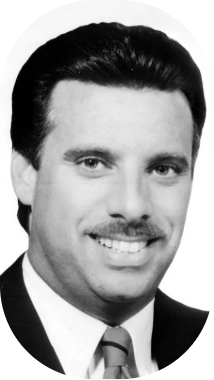
Carlos L. Valdés is a Cuban-American who emigrated to the United States in 1960 at the age of nine. Building a life rooted in perseverance and community, he went on to become a successful businessman and a dedicated public servant.
For more than fifty years, Valdés has been a licensed real estate broker, earning recognition as the first Cuban-American President of the Board of Realtors in 1983. His leadership extended beyond business into public service, where he served twelve years in the Florida House of Representatives (1988–2000). During his legislative career, he rose to positions of Republican Floor Leader, Republican Whip, and Chairman of the International Trade and Economic Development Committee, where he focused on maritime infrastructure, transportation security, and expanding Florida’s role in the global economy.
A lifelong conservative, Valdés has remained an active voice in civic and political affairs, drawing on both his professional experience and personal journey as a Cuban exile. His reflections continue to champion accountability, limited government, and the principles of liberty that inspired his family’s flight from tyranny.
Today, in retirement, Carlos L. Valdés continues to write, speak, and reflect on America’s challenges and future with the perspective of someone who has lived the immigrant story, built a career of service, and never stopped believing in the promise of this nation.
www.carlosvaldes.com
I just had to take a moment to express how deeply moved I am by your book. It is an absolute inspiration to all who have the privilege of reading it .
Your work, masterfully
compiles the essence of
past and present affairs, creating a true work of art..
What makes this book even more remarkable is how it serves and as an incredible educational resource for the younger generation. Through its pages, they can gain valuable insights and learn from experiences you so eloquently share. The book brings many happy memories to the forefront and, at the same time, allows the reader to grasp the reality of the ever -changing world around us.
Carlos, our friendship spanning 60 years has been a remarkable journey, and I want to commend you for this exceptional piece of work. Your dedication, wisdom, and the passion you have poured into this book are truly commendable.
Regards
Robert